Case Record
The following record has been compiled from the available account associated with this case.
The Case
In January 1959, a group of experienced hikers departed for a winter expedition through the northern Ural Mountains.
The group was led by Igor Dyatlov.
There were ten hikers.
One, Yuri Yudin, became ill and turned back early.
The remaining nine continued into the mountains.
None of them returned.
The Search
When the group failed to return on schedule, a search operation was launched.
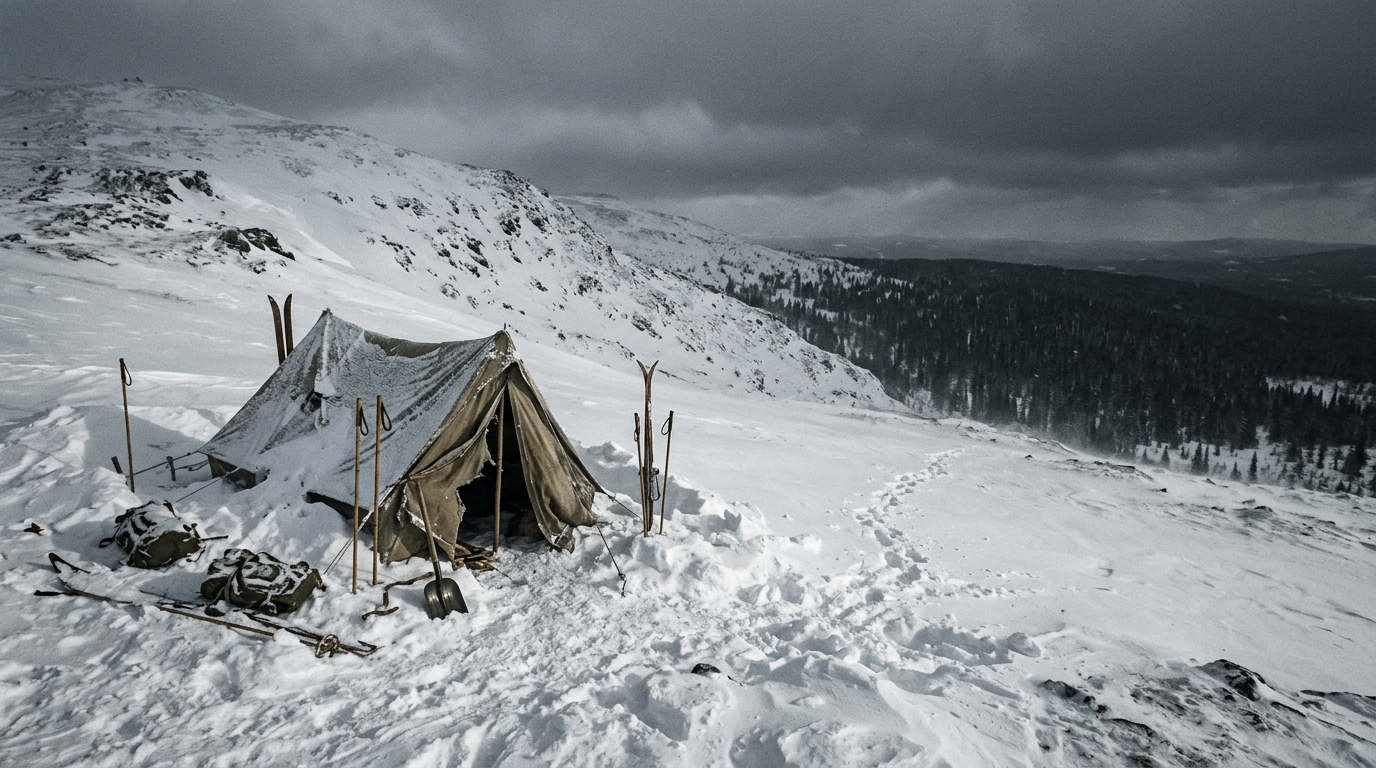
Their tent was eventually discovered on the slope of Kholat Syakhl.
The scene immediately raised questions.
The tent had been damaged and partially cut open.
The hikers had apparently left without adequate clothing for the extreme cold.
Their bodies were later discovered at different locations below the tent.
Some were found relatively close to the forest.
Others were located months later beneath snow.
The Injuries
The victims suffered severe injuries.
Several had fractures and other trauma.
Some bodies showed signs that investigators interpreted as potentially consistent with substantial external force.
The exact circumstances produced decades of speculation.
Theories ranged from an avalanche to military activity, secret weapons testing, infrasound, extreme weather, panic and even supernatural explanations.
The absence of surviving witnesses made the case especially difficult.
The Original Investigation
Soviet investigators concluded that the hikers had died because of an unknown compelling force.
The vague wording became a major reason the case later attracted conspiracy theories.
Because many records were inaccessible or difficult to obtain, later researchers had limited information with which to reconstruct the events.
Over time, the case became one of the world's most famous wilderness mysteries.
The Avalanche Theory
A modern explanation focuses on a slab avalanche.
Under this theory, a snow slab could have broken loose above the tent after the hikers cut into the slope while establishing camp.
The avalanche may have damaged the tent or threatened the group.
The hikers could then have evacuated rapidly, intending to move to safer ground.
Once separated from their shelter in severe weather, survival would have become extremely difficult.
The darkness, cold, wind and terrain could have prevented them from returning to the tent.
Why the Case Became Extraordinary
The avalanche explanation is not simple.
The slope where the tent was found did not look like the dramatic avalanche scene many people imagine.
The tent's position, the injuries, the clothing arrangements and the location of the bodies all generated questions.
For decades, those unanswered questions encouraged increasingly elaborate theories.
Some claimed the group had encountered secret Soviet weapons testing.
Others proposed a military operation.
Still others interpreted the injuries as evidence of something nonhuman.
None of those extraordinary explanations has been established.
Later Reassessment
In the twenty-first century, researchers revisited the avalanche hypothesis using modern modeling and field observations.
A 2020 Russian investigation concluded that an avalanche was the most likely explanation.
Later scientific work also demonstrated that a slab avalanche could plausibly occur under the conditions present at the site.
This does not reconstruct every moment of the hikers' final hours.
It does, however, provide a physically plausible explanation for the initial emergency.
What Remains
The Dyatlov Pass Incident is best understood as a documented tragedy surrounded by uncertainty.
Nine people died.
Their tent was found.
Their bodies were recovered.
Their injuries were documented.
The precise chain of events that led them from their tent into the mountains remains unknown.
The avalanche hypothesis is currently one of the strongest natural explanations.
It does not prove every detail.
And it certainly does not require a supernatural explanation.
The mystery is not that nothing can be explained.
The mystery is how much of the final sequence can ever be reconstructed.
Case Status
Unresolved
The classification above describes the current status of this entry within the Forbidden Lore archive. A documented report does not necessarily establish the explanation offered for it as fact.