Case Record
The following record has been compiled from the available account associated with this case.
John Titor: The Man Who Claimed He Came From 2036
On November 2, 2000, someone appeared on an internet discussion board devoted to time travel.
He did not begin with a dramatic warning.
He did not announce that the world was ending.
He did not even call himself John Titor.
The username was TimeTravel_0.
The forum was the Time Travel Institute, one of the early online communities where people discussed theoretical physics, temporal paradoxes, science fiction, and the possibility that traveling through time might someday become technologically possible.
TimeTravel_0 entered an existing discussion about time-travel paradoxes and began talking as though the subject were not theoretical at all.
He mentioned physicist Frank Tipler and mathematician Roy Kerr.
He discussed singularities.
Gravity.
Parallel worldlines.
And a machine that, according to him, could physically move a person through time.
In one of his earliest surviving messages, he wrote:
"The basics for time travel start at CERN in about a year."
He then made an extraordinary claim.
The first functioning time machine, he said, would eventually be constructed in 2034.
Over the following months, the anonymous poster gradually revealed a much larger story.
He claimed he was an American soldier.
He said he had been born in 1998.
He said the year he came from was 2036.
He claimed the United States he knew had survived a devastating civil conflict followed by a nuclear world war.
He described a future in which American cities had been destroyed, the federal government had fractured, society had become more rural, and millions of people were dead.
But preventing that catastrophe was supposedly not his mission.
According to TimeTravel_0, he had traveled backward more than sixty years for something far stranger.
He had been sent to 1975.
His objective was to recover an obsolete computer.
An IBM 5100.
And after completing that mission, instead of immediately returning to 2036, he had made a personal stop around the year 2000.
There, he said, he was visiting his family.
Including his own younger self.
By January 2001, the anonymous traveler was using the name by which the story would become famous.
John Titor.
For approximately four months, he answered questions.
He argued with skeptics.
He discussed physics.
He described the future.
He posted photographs supposedly showing his time machine.
He shared images said to come from its operating manual.
He made predictions about events that had not yet happened.
And then, in March 2001, he said goodbye.
John Titor disappeared from the forums.
Most of his predictions eventually failed.
No functioning time machine has emerged to validate his story.
Investigators later identified several people who might have been involved in creating the persona.
Yet no universally accepted identification of the person behind the original posts has ever been established.
More than two decades later, the John Titor case remains one of the most elaborate and enduring mysteries of the early internet.
Not necessarily because a man actually traveled here from 2036.
But because someone created John Titor.
And whoever that person was knew exactly how to make people wonder.
Before John Titor
The story may have begun before the name John Titor ever appeared online.
In July 1998, paranormal radio host Art Bell reportedly received a fax from someone claiming to be a time traveler.
Bell's program, Coast to Coast AM, had become famous for discussions involving UFOs, ghosts, conspiracy theories, strange phenomena, and callers claiming extraordinary experiences.
The fax described time travel, singularities, and technology that supposedly allowed movement through time.
Additional communications followed.
These early messages have subsequently been associated with the John Titor story, although establishing that the same individual was responsible for every communication is considerably more difficult than simply repeating the legend.
The most firmly documented phase began two years later.
In October 2000, a person using the handle TimeTravel_0 participated in an IRC conversation.
Then, on November 2, the same username appeared in the Time Travel Institute's discussions.
That is where the story truly began to take shape.
November 2, 2000
TimeTravel_0 did not initially behave like someone attempting to create an internet celebrity.
His early posts were technical.
A discussion about paradoxes had already been taking place when he joined.
He reacted enthusiastically when other participants mentioned ideas associated with Tipler and Kerr.
His language was confident.
Sometimes playful.
Sometimes deliberately vague.
But his central claim quickly became unmistakable.
Time travel was real.
The technology had not been invented yet from the forum members' perspective.
But from his perspective, it already existed.
According to Titor, the first practical time machine would be developed by General Electric in 2034.
He claimed that the machine relied on artificially created gravitational singularities.
His descriptions included a collection of scientific terminology: rotating singularities, gravity fields, Tipler cylinders, Kerr black holes, electron injection systems, and temporal displacement.
Some of those concepts were borrowed from legitimate theoretical physics.
The conclusions Titor drew from them were another matter entirely.
Nevertheless, he presented the machine as engineering rather than magic.
There were components.
Controls.
Operating procedures.
Safety systems.
Limitations.
And, eventually, photographs.
The C204 Time Displacement Unit
Titor claimed his machine was known as a C204 Gravity Distortion Time Displacement Unit.
It was not, he said, a vehicle in the conventional sense.
There was no futuristic DeLorean.
No glowing portal.
No enormous laboratory.
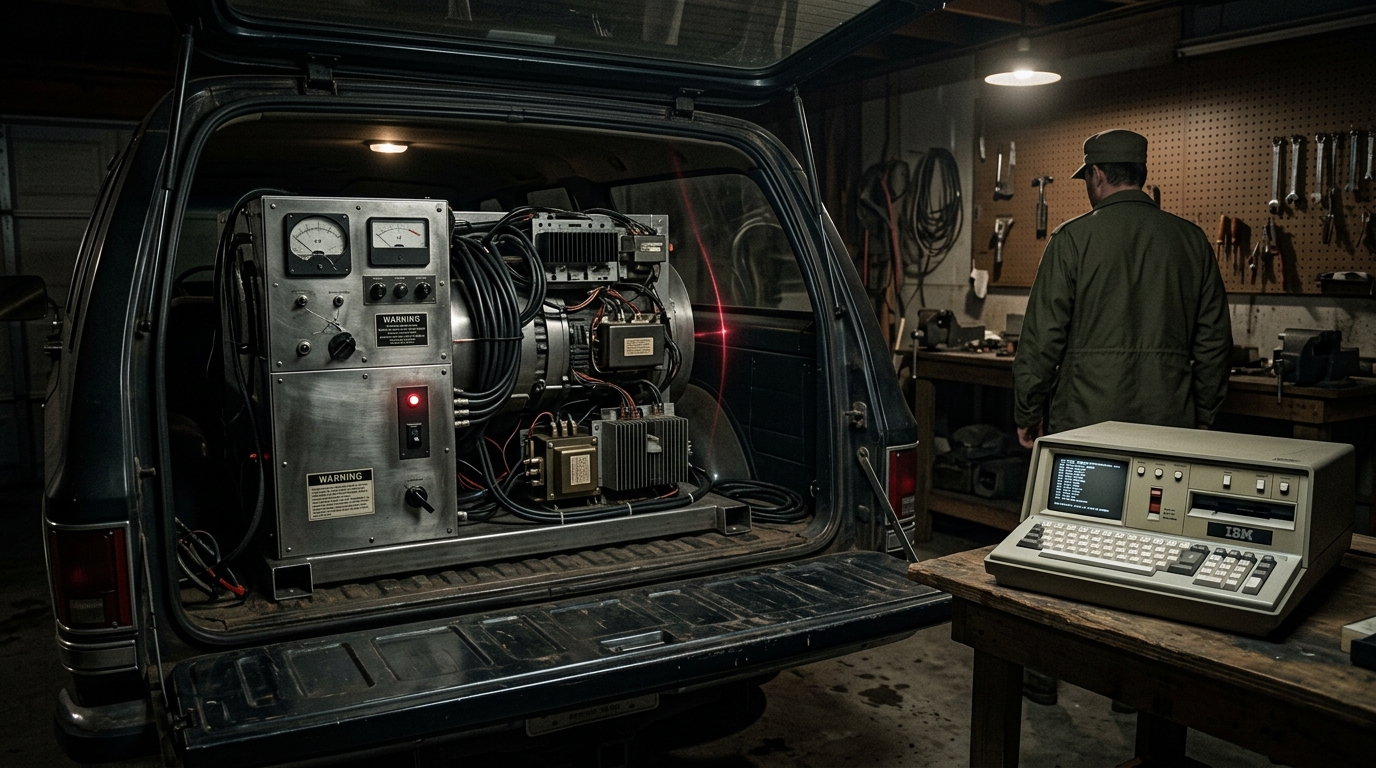
Instead, the temporal displacement equipment was supposedly a compact but extremely heavy apparatus that could be installed inside an ordinary vehicle.
Photographs attributed to Titor appear to show a metal assembly mounted inside a car.
Other photographs show equipment, control panels, labels, and what were presented as pages from an operating manual.
Titor described the machine as using two rotating microsingularities.
In one later introduction, he described it as:
"a stationary mass, temporal displacement unit manufactured by General Electric."
The machine supposedly manipulated gravity sufficiently to alter the traveler's relationship with spacetime.
Titor claimed the device generated a gravitational field around itself and whatever vehicle contained it.
The vehicle itself was not what traveled through time.
It was essentially a container.
According to the story, the machine and everything inside its field moved from one worldline to another.
Titor claimed that his original unit had been installed in a 1967 Chevrolet Corvette.
He later transferred the equipment to a four-wheel-drive truck.
There was a practical reason.
The machine supposedly weighed hundreds of pounds.
And arriving at a destination could be dangerous.
The Problem of Location
Traveling through time presents an obvious problem that science fiction frequently ignores.
The Earth moves.
It rotates on its axis.
It orbits the Sun.
The Solar System moves through the galaxy.
The galaxy itself moves.
If a machine simply changed its position in time while maintaining some absolute coordinate in space, a traveler could theoretically appear thousands or millions of miles away from Earth.
Titor had an answer.
His machine supposedly used gravity as an anchor.
He described a Variable Gravity Lock, or VGL, which kept the machine attached to the Earth's gravitational environment during displacement.
This was typical of the Titor narrative.
Whenever someone identified an obvious problem, there was usually an explanation.
Sometimes that explanation used real scientific terminology.
Sometimes it sounded plausible enough to a layperson.
Sometimes specialists found substantial problems with it.
But the story was rarely careless.
Someone had thought about how the machine was supposed to work.
Why 1975?
The strangest part of Titor's story was not the time machine.
It was his mission.
If someone from 2036 could travel anywhere in the twentieth century, why travel to 1975?
Why not witness a major historical event?
Why not prevent a catastrophe?
Why not obtain lost documents?
Why not become wealthy?
Titor's answer was remarkably mundane.
He needed a computer.
Specifically, an IBM 5100 Portable Computer.
The IBM 5100 was introduced in 1975.
Calling it "portable" requires some historical perspective.
The machine weighed roughly 55 pounds.
It incorporated a keyboard, a small CRT display, magnetic tape storage and computer hardware into a single enclosure.
It was extraordinarily expensive by modern personal-computer standards.
And by 2000, it was largely a historical curiosity.
Yet Titor claimed that in 2036 the IBM 5100 had become extremely valuable.
The IBM 5100 Mission
According to Titor, future computer systems still depended on legacy software.
That legacy created a problem.
He claimed the IBM 5100 possessed capabilities that made it uniquely useful for debugging older computer systems.
He wrote:
"UNIX has a problem in 2038."
That statement refers to a real computing issue.
Unix and Unix-like systems have historically represented time in ways that can produce an overflow problem in January 2038 on systems using signed 32-bit time values.
The problem is now widely known as the Year 2038 problem.
Titor claimed his society needed the IBM 5100 to work with legacy systems affected by problems involving old code.
But the 2038 problem was not the most interesting part of his computer story.
The IBM 5100 itself was.
The Detail That Made People Pay Attention
Titor claimed the 5100 possessed an unusual ability involving older IBM systems.
According to him, the computer could work with legacy IBM code in ways that ordinary users did not realize.
He repeatedly suggested this capability was not generally understood.
That claim became one of the most famous elements of the entire case.
The IBM 5100 really did use an unusual architecture.
Its internal design allowed it to run environments associated with both APL and BASIC, and its implementation incorporated emulation technology connected to larger IBM systems.
Former IBM engineer Bob Dubke, who worked on the 5100, later discussed internal functionality associated with the machine and the interface surrounding its emulation system.
This was enough to give the legend an enduring mystery.
How did someone posting on an obscure time-travel forum know so much about a computer from 1975?
There is, however, an important distinction.
The architecture of the IBM 5100 was not completely unknowable information.
Technical documentation existed.
IBM manuals existed.
People who had worked with the machines existed.
Computer historians and technically sophisticated enthusiasts could potentially have learned a great deal about the system without traveling through time.
The most accurate conclusion is therefore not that Titor revealed an impossible secret.
It is that whoever created the Titor persona possessed—or had access to—unusually specific knowledge about an obscure piece of computing history.
That is still interesting.
It is simply not proof of time travel.
Why Couldn't 2036 Build an Emulator?
Forum participants naturally challenged the mission.
If people in 2036 could create artificial singularities and travel through time, why could they not emulate a computer built in 1975?
Titor claimed the problem was not a total loss of technological knowledge.
Instead, particular tools and techniques had disappeared.
His future had also experienced catastrophic war.
Infrastructure had been destroyed.
Millions had died.
Society had changed.
Recovering an original machine, he suggested, was simply easier and more reliable than reconstructing everything from scratch.
He also claimed a family connection to the IBM 5100 project.
That connection supposedly made him particularly suitable for the assignment.
According to his story, he traveled from 2036 to 1975, obtained the computer, and then began the journey home.
But he made a detour.
The Stop in 2000
Titor claimed he intentionally stopped around the year 2000 for personal reasons.
His parents were alive.
His family existed.
And so did he.
Or, more precisely, the younger version of him supposedly belonging to our worldline existed.
Titor claimed he had been born in 1998.
That meant that while the adult John Titor was posting online, another John—his younger counterpart—would have been approximately two years old.
He claimed to have interacted with the child.
In one particularly strange description, Titor said of his younger counterpart:
"He calls me uncle."
He described watching the child as an emotionally complicated experience.
Here was a grown man supposedly observing a version of himself who had not yet experienced the wars, deaths, hardships and decisions that shaped the adult traveler.
Titor said his family knew who he was.
He claimed they understood what he was doing.
And for a time, according to his story, a soldier from 2036 simply lived with his family in Florida while waiting to return home.
But Was It Really His Past?
Titor's explanation of time travel included one feature that would later become crucial to defending his failed predictions.
He claimed travelers did not actually return to their own exact past.
Instead, reality consisted of multiple worldlines.
Traveling backward placed a person into another worldline similar to—but not perfectly identical with—the one they had left.
Titor frequently discussed the many-worlds interpretation of quantum mechanics.
In simplified terms, the interpretation suggests that possible quantum outcomes may correspond to branching realities.
Titor transformed that philosophical interpretation into the operating principle of his machine.
According to him, a traveler moved between worldlines.
The world he entered might closely resemble his own history.
But it would never be absolutely identical.
Titor estimated the difference between his original worldline and ours at roughly 2.5 percent.
This was one of the most important claims he made.
It also created an enormous problem.
If the future he described did not happen here, then supporters could argue that our worldline was simply different.
A prediction could fail without necessarily disproving the traveler.
That makes the claim extraordinarily difficult—perhaps impossible—to falsify.
The Future According to John Titor
As forum members continued asking questions, Titor described life in 2036.
It was not a gleaming technological utopia.
There were no descriptions of humanity living peacefully among the stars.
No effortless abundance.
No immortal population.
His future was poorer.
Smaller.
More dangerous.
And deeply scarred by war.
The United States, as people knew it in 2000, had effectively ceased to exist.
Large urban centers had been destroyed.
Political authority had fractured.
Communities were more localized.
Agriculture had become more important.
People were expected to possess practical skills.
Family and local community mattered enormously.
Medical care was less advanced in practice because the infrastructure required to deliver sophisticated treatment had been devastated.
Technology still existed.
But civilization had been forced backward in many ways.
The reason was war.
The American Civil War
Titor's most dramatic prediction concerned the United States.
He claimed a second American civil war was approaching.
In one surviving November 2000 exchange, he stated:
"There is a civil war in the United States that starts in 2005."
Elsewhere, he connected the beginning of unrest to events surrounding the 2004 presidential election.
The conflict would supposedly begin gradually.
Americans would become increasingly divided over government authority, constitutional rights and social control.
The division would not immediately resemble conventional warfare.
Instead, confrontation would escalate.
Police actions.
Government raids.
Civil unrest.
Armed resistance.
Titor compared the developing situation to repeated versions of the 1993 federal siege near Waco, Texas.
Eventually, according to him, the conflict would become impossible to ignore.
By 2008, open civil war would supposedly be obvious.
Titor claimed that as a child he eventually joined a fighting unit.
He said his family left the cities.
He described hiding and surviving in rural Florida.
By 2012, according to the narrative, he was a teenager living amid a country that had already been at war for years.
Nothing resembling Titor's predicted civil war occurred on that timetable.
The United States held presidential elections in 2004 and 2008.
There was political division.
There were wars overseas.
There were protests and domestic controversies.
But there was no nationwide armed civil war beginning in 2005.
This was not a minor discrepancy.
It was one of his central predictions.
And it failed.
The "Fighting Diamondbacks"
Titor claimed that as a young teenager he joined a militia unit called the Fighting Diamondbacks.
His descriptions suggested a decentralized conflict in which rural groups fought against forces associated with the federal government.
He portrayed his side as defending constitutional rights and local autonomy.
The war shaped his worldview.
It supposedly shaped the entire society from which he came.
People in 2036 distrusted centralized authority.
They valued self-sufficiency.
They lived in smaller communities.
And they remembered the early twenty-first century as the era when the old America destroyed itself.
But the civil war was only the beginning.
According to Titor, a far larger catastrophe was coming.
World War III
Titor claimed that the American civil war eventually intersected with international instability.
The result was a nuclear conflict in 2015.
Russia, according to his story, launched nuclear attacks against major American cities.
The United States retaliated.
Other countries became involved.
The exchange was devastating.
Titor sometimes described the nuclear war as surprisingly brief.
The consequences were not.
Millions—or, depending on interpretations of his statements, billions worldwide—would die from warfare, infrastructure collapse, disease and subsequent hardship.
Major American cities disappeared.
Government structures changed.
The world of 2036 was built from what survived.
Again, this prediction failed.
The year 2015 passed without a nuclear world war.
What Happened to America's Cities?
Titor's descriptions of the postwar United States were grim.
Large metropolitan areas had suffered enormously.
Rural areas generally fared better.
Florida, where Titor claimed to have grown up, was affected by both the civil conflict and nuclear war.
He specifically discussed Jacksonville as a target.
Washington, D.C., was also described as being destroyed.
Political power became decentralized.
According to the broader Titor narrative, the United States eventually reorganized into several regions.
The national government that emerged was very different from the one that existed in 2000.
The capital was associated with Omaha, Nebraska, rather than Washington.
Life became more local.
People farmed.
Communities relied heavily on themselves.
The technological civilization of 2036 existed alongside a society that, in many respects, resembled an earlier America.
Life in 2036
Questions about everyday life produced some of Titor's most interesting responses.
Forum users wanted to know everything.
What did people eat?
What entertainment survived?
What happened to famous people?
What happened to the internet?
What did money look like?
What was medicine like?
What did people believe?
What technologies existed?
Titor described a society where practical competence mattered.
People knew how to repair things.
They understood sanitation.
They grew food.
They relied on family and neighbors.
Bicycles were useful.
Centralized systems were treated with suspicion.
He claimed people in his time valued independence intensely.
The future he described was technologically uneven.
Humanity had mastered something as extraordinary as time travel, yet many ordinary people lived comparatively simple lives.
That contradiction became one of the stranger features of the story.
Disease
Titor also issued warnings about disease.
He repeatedly mentioned Creutzfeldt-Jakob disease, or CJD, and concerns associated with transmissible spongiform encephalopathies.
The subject was particularly relevant around the turn of the millennium because of widespread concern surrounding bovine spongiform encephalopathy—better known as mad cow disease.
Titor suggested the problem would become far more serious.
He warned people against consuming products from animals fed material derived from other animals of the same type.
He implied that CJD would remain devastating in his future.
This prediction, like many others, did not unfold on the scale he described.
The Olympics Prediction
Some of Titor's claims were unusually specific.
One involved the Olympic Games.
Asked whether the Olympics continued in his time, he answered:
"there were no official Olympics after 2004."
He suggested they might return around 2040.
This prediction failed almost immediately.
The 2006 Winter Olympics took place in Turin.
The 2008 Summer Olympics were held in Beijing.
Olympic competition continued afterward.
Because the prediction was direct and easily testable, it became one of the clearest problems for the Titor narrative.
Supporters could appeal to worldline divergence.
Skeptics saw something simpler.
John Titor had predicted something.
And he was wrong.
Y2K
Another important element of the story involved Y2K.
The Year 2000 computer problem had produced widespread concern during the late 1990s.
Older software frequently represented years using only two digits.
That raised fears that systems might interpret 2000 as 1900.
Governments and corporations spent enormous amounts of money identifying and correcting vulnerable systems.
When January 1, 2000 arrived, widespread technological catastrophe did not occur.
Titor indicated that Y2K had been more disruptive on his worldline.
That conveniently reinforced his worldline explanation.
Our history was already different.
Therefore, future events could also differ.
The mechanism protected the narrative.
But it simultaneously weakened the predictive value of everything Titor said.
If every failed prediction can be explained by divergence, then no prediction can meaningfully test the claim.
Why Didn't He Give Winning Lottery Numbers?
Forum users repeatedly asked questions any alleged time traveler should expect.
Who wins sporting events?
What stocks should people buy?
What happens to famous people?
What discoveries are coming?
What are the lottery numbers?
Titor usually avoided information that could easily produce personal wealth or provide decisive verification.
There were explanations.
Worldline divergence meant events might not happen exactly the same way.
He did not necessarily remember trivial historical information.
He had ethical concerns.
He had a mission.
He was not interested in proving himself to everyone.
At one point, a statement attributed to Titor summarized his attitude:
"My goal is not to be believed."
That sentence captures much of what made the story so effective.
Titor provided enough detail to encourage investigation.
But rarely enough to conclusively prove anything.
Photographs of the Machine
Unlike many anonymous paranormal claimants, Titor provided photographs.
The images supposedly showed the temporal displacement unit.
One photograph appears to show equipment installed in a vehicle.
Others show labels and mechanical components.
There were also diagrams and pages supposedly taken from the machine's technical documentation.
The manual pages included technical language and diagrams describing the alleged temporal displacement system.
The presentation was impressive enough to keep people interested.
But photographs of machinery do not establish that the machinery can manipulate spacetime.
A convincing prop can be photographed.
A technical diagram can be drawn.
A manual can be fabricated.
No independent laboratory was allowed to inspect the machine.
No neutral scientist observed it functioning.
No verified demonstration occurred.
The photographs therefore remain evidence that someone built or photographed something.
They are not evidence that it was a time machine.
The Bent Laser Photograph
One image became particularly famous.
Titor claimed that intense gravitational effects surrounding the machine could bend a beam of light.
A photograph was presented showing what appeared to be a laser beam curving near the vehicle.
Gravitational lensing is real.
Mass and gravity can affect the path of light.
If Titor's machine truly produced the extraordinary gravitational effects he described, some form of optical distortion would at least be conceptually relevant.
But the photograph cannot establish its cause.
Photographic tricks, reflections, long exposures, manipulated images and other mundane explanations are possible.
No controlled experiment accompanied the image.
The photograph is visually memorable.
Scientifically, it proves very little.
The Manual
Titor also presented pages supposedly taken from the operating manual for the time machine.
The documentation gave the story an unusual feeling of authenticity.
Instead of simply saying, "I have a time machine," the anonymous author created an entire technological environment around it.
Model numbers.
Procedures.
Diagrams.
Warnings.
Terminology.
Military context.
Manufacturer information.
The machine supposedly came from General Electric.
The device had a designation.
There were operating instructions.
The details created the impression that the traveler was describing an ordinary piece of equipment from his own era.
That was one of the cleverest aspects of the Titor story.
The extraordinary was presented as routine.
To people in 2001, a time machine was impossible.
To John Titor, it was equipment.
Temporal Recon
Titor claimed he served in a military time-travel program.
Images associated with the case include a unit insignia bearing the Latin phrase:
Tempus Edax Rerum.
The phrase is commonly translated as:
Time, devourer of all things.
The insignia became one of the defining visual symbols of the legend.
Titor described himself as a soldier rather than a scientist.
That distinction helped explain why he could operate the technology without being able—or willing—to provide a complete theoretical derivation proving that it worked.
He knew how to use the machine.
He knew some of its principles.
But he was not presented as the person who invented it.
Again, the narrative contained an answer for a potential weakness.
CERN
Titor repeatedly connected the development of time travel to advances in high-energy physics.
He specifically mentioned CERN.
In November 2000 he suggested that important developments related to time-travel physics would begin there soon.
CERN is, of course, real.
Its experiments investigate fundamental particles and forces.
The Large Hadron Collider would later become the world's most powerful particle accelerator.
But CERN did not announce practical time travel.
Nor did General Electric construct a publicly known time machine in 2034—which, from our present perspective in 2026, remains eight years away and therefore cannot yet be tested.
The important point is that Titor anchored fantastic claims to recognizable scientific institutions.
CERN.
General Electric.
IBM.
Unix.
Real names gave the fictional—or potentially fictional—world texture.
A Surprisingly Personal Traveler
Not everything Titor discussed involved catastrophe.
Some posts were personal.
He talked about family.
Music.
Relationships.
His childhood.
The emotional experience of returning to a world before his society collapsed.
According to archived accounts, he spoke about a woman he had loved who died from brain cancer.
He discussed the strangeness of seeing his younger self.
He described enjoying time with his family.
These details did nothing to prove his story.
But they made the character feel human.
That may explain why the legend survived when countless other internet claims disappeared.
John Titor was not merely a list of predictions.
He had a biography.
A childhood.
A military history.
A family.
A mission.
A machine.
A worldview.
And regrets.
Whether intentionally or accidentally, the person behind the keyboard created a character people could imagine existing.
The Survival Advice
As discussion turned toward the catastrophes he predicted, users naturally asked what they should do.
Titor emphasized practical preparation.
Learn first aid.
Understand sanitation.
Know how to purify water.
Maintain relationships with trustworthy people.
Own a bicycle.
Understand firearms.
Know what you would take if forced to leave home quickly.
Read the United States Constitution.
The advice reflected the future he described.
His apocalypse was not primarily supernatural.
It was infrastructural.
Electricity failed.
Supply systems collapsed.
Governments fractured.
Medical systems deteriorated.
People survived through practical knowledge and local cooperation.
This survivalist element helped the story spread beyond time-travel communities.
"Wake Up"
The tone of Titor's posts could occasionally become almost prophetic.
He suggested people in 2000 were ignoring signs of approaching instability.
One of the most widely circulated lines attributed to him reads:
"Please, please wake up."
The message fit perfectly with early twenty-first-century internet culture.
Government distrust was widespread.
The memory of Waco remained powerful.
Y2K had just passed.
The September 11 attacks had not yet happened when Titor began posting.
The United States was entering a politically polarized period.
Technology was transforming everyday life.
The internet itself felt new.
An anonymous soldier from a ruined future warning people that they were sleepwalking toward catastrophe was an extraordinarily effective story for that moment.
Then September 11 Happened
John Titor stopped posting months before the attacks of September 11, 2001.
This creates one of the largest problems for claims that he possessed detailed knowledge of the immediate future.
If an American soldier from 2036 traveled to the United States in 2000 and 2001, one might reasonably expect September 11 to be among the most historically significant events he would know.
Yet Titor did not clearly predict the attacks.
Supporters have searched his posts for statements that could be interpreted retrospectively as hints.
But there is no straightforward, unmistakable warning comparable to:
Four passenger aircraft will be hijacked on September 11, 2001, and terrorists will attack New York and Washington.
That prediction does not exist.
For skeptics, the omission is devastating.
For believers, worldline divergence again provides an answer.
Perhaps September 11 did not happen the same way in Titor's history.
But the more divergence explains, the less the story can be tested.
Predictions Versus History
Enough time has now passed to compare many of Titor's statements with reality.
The results strongly favor skepticism.
A United States civil war did not begin in 2005.
Open warfare was not consuming the country by 2008.
The Olympics did not end after 2004.
A global nuclear war did not occur in 2015.
The United States did not collapse into the political structure Titor described.
Washington, D.C., was not destroyed.
The social conditions he described for the 2010s did not materialize.
Some statements can be connected loosely to later events.
Political polarization increased.
Concerns about surveillance and government power continued.
The Year 2038 problem is real.
CERN became associated with enormously powerful particle-physics experiments.
The IBM 5100 really did possess technically interesting architecture.
But none of these facts require information from the future.
A successful prediction must generally be specific enough to distinguish foresight from coincidence.
Titor's most specific predictions largely failed.
The Worldline Escape Hatch
This leads to the central philosophical problem with the entire case.
Titor said from the beginning that his future was not necessarily ours.
Therefore:
If his prediction happened, supporters could say he predicted it.
If something similar happened, supporters could attribute the differences to divergence.
If nothing happened, supporters could say our worldline diverged significantly.
There is no possible result that necessarily disproves the claim.
This is what philosophers of science call a problem of falsifiability.
A claim that can accommodate every possible outcome cannot easily be tested.
Titor's worldline theory may therefore be the most important part of the legend.
It transforms failed prophecy into alternate history.
March 2001
By early 2001, the discussions had become extensive.
Hundreds of posts accumulated.
People challenged Titor.
Others defended him.
Some simply enjoyed the conversation.
He continued answering questions about the future, technology and his personal life.
Then he announced that his visit was ending.
He said he would return to 2036.
According to the story, his family would witness his departure.
His father would supposedly record it.
No authenticated recording of the departure ever appeared publicly.
On March 24, 2001, the communications ended.
John Titor was gone.
The Disappearance
This is where the story becomes more interesting as an internet mystery.
The person behind John Titor did not remain online for years attempting to monetize the identity.
He did not continually produce new predictions.
He did not reveal himself during the height of the story's popularity.
He did not appear on television claiming proof.
The original character simply stopped.
That restraint helped the legend enormously.
Had "Titor" continued posting indefinitely, contradictions would likely have accumulated.
Had the creator immediately admitted the hoax, the story might have become an interesting early internet prank and little more.
Instead, the disappearance created a vacuum.
Other people filled it.
Who Was John Titor?
Once the predictions began failing, attention increasingly shifted away from the future.
The question was no longer:
Was John Titor really from 2036?
It became:
Who wrote the posts?
Several investigations attempted to answer that question.
One of the most important leads involved a Florida attorney named Larry Haber.
Haber became connected with the John Titor Foundation, an organization associated with the preservation and publication of Titor material.
A book titled John Titor: A Time Traveler's Tale appeared in 2003.
Investigators examining corporate records, internet information and connections surrounding the foundation began asking whether the people managing the Titor legacy might also have been involved in creating it.
The Haber Theory
In 2008, the Italian television program Voyager investigated the Titor case.
Private investigator Mike Lynch examined records connected to the identity.
According to later accounts of the investigation, Lynch was unable to establish an ordinary identity for a person matching the alleged traveler.
Attention instead moved toward the John Titor Foundation and people associated with it.
Larry Haber served as the foundation's attorney or registered representative.
His brother Morey Haber had substantial experience in computers and information technology.
That combination immediately attracted suspicion.
A lawyer could understand how to establish and manage an organization surrounding intellectual property.
A computer specialist could potentially possess the technical knowledge visible in the Titor posts.
Investigators and online researchers therefore proposed that one or more members of the Haber family might have created John Titor.
But suspicion is not proof.
Morey Haber has explicitly denied being John Titor.
No conclusive document has surfaced showing that Larry Haber authored the original posts.
No verified confession from either brother has settled the case.
The Haber theory remains one of the most prominent explanations.
It is not a demonstrated fact.
Joseph Matheny
Another intriguing name entered the story years later.
Joseph Matheny was associated with Ong's Hat, an early alternate-reality narrative that deliberately blurred fiction and reality.
Ong's Hat involved interdimensional travel, conspiracy material, fabricated documents and online communities trying to determine what was real.
The parallels to John Titor are obvious.
In a later interview, Matheny claimed that the Titor story had been created as a literary experiment by people familiar with his work and that he had served as a consultant.
If true, that would strongly support the idea that John Titor was an early form of alternate-reality storytelling.
But Matheny did not publicly provide enough independently verifiable evidence to conclusively identify the original author.
His statement is therefore important.
It is not the final answer.
Could It Have Been an Alternate Reality Game?
The possibility fits surprisingly well.
An alternate reality game, or ARG, uses real-world media to tell a fictional story as though it were actually happening.
Players are not always clearly told where fiction ends and reality begins.
Websites.
Emails.
Telephone calls.
Documents.
Photographs.
Hidden clues.
Real locations.
Real companies.
Real scientific concepts.
All can become part of the narrative.
John Titor contained many of those ingredients.
The character appeared inside existing communities rather than on a website announcing a fictional project.
He interacted with real people.
He responded to questions.
His story evolved conversationally.
He supplied photographs and documents.
He referenced real companies and real technology.
Then he disappeared.
If it was interactive fiction, it was extraordinarily well suited to the internet of its era.
Or Was It Simply One Very Talented Hoaxer?
An ARG does not require a large team.
One knowledgeable individual could potentially have created most of the Titor material.
The author would have needed several interests.
Computers.
Science fiction.
Theoretical physics.
Survivalism.
American politics.
Military terminology.
Internet culture.
Perhaps knowledge of IBM systems.
None of those requirements are impossible.
The apparent complexity of the story can make a conspiracy of specialists seem necessary.
But talented hobbyists often know a surprising amount about obscure subjects.
The simplest explanation may be that John Titor was created by a technically knowledgeable person who enjoyed constructing an elaborate story.
Why the IBM 5100 Still Matters
Even after the failed predictions, the IBM 5100 remains the detail believers return to most often.
And understandably so.
It is specific.
It is obscure.
It is real.
Why would a hoaxer choose that machine?
Why not an Apple II?
Why not an early IBM PC?
Why not some imaginary computer?
Instead, Titor selected a comparatively obscure portable IBM machine from 1975 and constructed his entire mission around its architecture.
That decision was excellent storytelling.
It gave researchers something real to investigate.
And when they investigated it, they found genuine technical complexity.
The discovery did not prove the time traveler.
But it rewarded curiosity.
That is one reason the mystery survived.
What the IBM Evidence Actually Proves
The IBM evidence proves several things.
The IBM 5100 existed.
It was introduced in the 1970s.
Its internal architecture used emulation techniques.
It could run APL and BASIC environments.
It contained technically unusual features.
People involved in its development later discussed aspects of its internal operation.
The person writing as John Titor knew—or had researched—some of this.
What the evidence does not prove is that the information could only have come from 2036.
That distinction is essential.
A documented case should not become less interesting when mundane explanations remain possible.
In fact, the mystery becomes more interesting.
Someone deliberately chose the IBM 5100.
Why?
The Psychology of the Titor Story
John Titor appeared at exactly the right historical moment.
The internet was large enough for a mysterious story to spread.
But it was still small enough for an anonymous person to feel genuinely unreachable.
Social media did not dominate online identity.
Reverse-image searching did not exist in its modern form.
Digital forensic tools were less accessible.
People routinely used pseudonyms.
Forums created intimate communities where strangers could talk for months without knowing one another's real names.
At the same time, the cultural atmosphere was unusually receptive.
Y2K had just happened.
The contested 2000 U.S. presidential election dominated political discussion.
Government distrust remained widespread.
Survivalism had a significant subculture.
Technology was accelerating.
The future felt close.
Then a stranger arrived claiming he had already seen it.
Why People Believed
Not everyone believed John Titor.
Many participants challenged him directly.
But even skeptics often continued asking questions.
That interaction gave the character depth.
Every challenge forced the story to expand.
How does the machine compensate for Earth's movement?
There was an answer.
Why can't you change your own history?
There was an answer.
Why retrieve an old computer?
There was an answer.
Why are your predictions different from our reality?
There was an answer.
Why don't you give us lottery numbers?
There was an answer.
Each response added another layer.
The forum itself became part of the creation process.
John Titor may have been written by one person.
But the community helped build the world around him.
Why People Still Believe
Belief in Titor did not disappear when his predictions failed.
Instead, the theory adapted.
Perhaps his presence changed our timeline.
Perhaps the 2.5 percent divergence was larger than expected.
Perhaps his warnings helped prevent the future he remembered.
Perhaps dates were misunderstood.
Perhaps some events happened symbolically rather than literally.
Perhaps the worst events are still coming.
These explanations can preserve the belief indefinitely.
But they also move the story farther away from something that can be scientifically tested.
There is a difference between:
We cannot explain this.
and:
Therefore, the extraordinary explanation is true.
The first statement can be justified.
The second requires evidence.
The Case Against John Titor
The skeptical case is substantial.
His major predictions failed.
No civil war occurred on his timetable.
The Olympics continued.
No 2015 nuclear world war occurred.
No independently verified time machine was demonstrated.
No physical artifact has been authenticated as originating in the future.
No future scientific information provided by Titor has revolutionized physics.
No recording of his alleged departure has been authenticated.
The IBM information, while interesting, was potentially accessible to technically knowledgeable people.
And plausible human candidates have been proposed for involvement in the creation or promotion of the story.
By ordinary evidentiary standards, there is no compelling reason to conclude that John Titor was literally a traveler from 2036.
The Case That Keeps the Mystery Alive
And yet there are reasons people continue discussing him.
The story was unusually detailed.
The author understood obscure technical subjects.
The IBM 5100 choice was remarkably specific.
The photographs and manual pages required preparation.
The character maintained a reasonably coherent voice across months of interaction.
The creator walked away.
And despite years of investigation, no universally accepted, fully documented identification of the original poster has emerged.
That last mystery is genuine.
Someone typed those messages.
Someone took or created those photographs.
Someone produced the diagrams.
Someone knew about the IBM 5100.
Someone decided that this traveler came from 2036.
Someone chose the name John Titor.
We simply cannot say with certainty who that person was.
A Time Traveler Who Didn't Need to Be Real
There is another way to understand the case.
Perhaps the most remarkable thing about John Titor is not whether he traveled through time.
Perhaps it is that the story itself did.
The posts were created in a particular era of the internet.
They survived.
They were copied.
Archived.
Reposted.
Translated.
Discussed.
Adapted.
The legend entered books, radio programs, documentaries, online videos, anime, visual novels and popular culture.
People born after John Titor supposedly returned to 2036 now debate whether he existed.
The world he predicted never arrived.
But the character did.
The Steins;Gate Connection
A major reason younger audiences know the name John Titor is the Japanese science-fiction franchise Steins;Gate.
The visual novel was released in 2009 and later adapted into a highly successful anime.
Its story incorporates concepts directly reminiscent of the Titor legend.
John Titor.
Worldlines.
Time travel.
An old IBM computer.
The fictionalized version helped introduce the real internet mystery to an entirely new international audience.
For many people, discovering that John Titor existed as an internet legend before Steins;Gate is itself surprising.
The fictional adaptation became more famous than the obscure forum discussions that inspired part of it.
The Future That Never Happened
There is something eerie about reading the original Titor material now.
Not because it accurately predicted our world.
It didn't.
What makes it strange is reading a detailed description of a future that has already become our past.
2004 arrived.
2005 arrived.
2008 arrived.
2015 arrived.
The predicted milestones came and went.
The Olympics continued.
America did not descend into Titor's civil war.
Nuclear weapons did not destroy its major cities.
The future refused to cooperate.
And yet the posts remain frozen online.
A message written in 2001 warning about 2015 now reads less like prophecy and more like an artifact from an alternate history.
Perhaps that is fitting.
John Titor always insisted that there were other worldlines.
His predicted future now exists only as one.
A world that never happened.
The Unanswered Question
The easiest conclusion is that John Titor was a hoax.
It is also overwhelmingly the conclusion most consistent with the failed predictions and absence of extraordinary physical evidence.
But "hoax" does not answer every question.
Who created it?
Was it one person?
Several?
Was it an experiment in interactive storytelling?
Was the John Titor Foundation connected to the original creation or merely the later commercialization of an existing mystery?
How much technical expertise did the original author possess?
Why was the IBM 5100 chosen?
Why did the creator never conclusively reveal themselves?
Those are legitimate unanswered questions.
They do not require time travel.
But they are mysteries nonetheless.
Case Assessment
Documented: A user called TimeTravel_0 posted on the Time Travel Institute beginning in November 2000 and later used the name John Titor in discussions associated with Art Bell's online community.
Documented: The poster claimed to be a time traveler from 2036.
Documented: He claimed his mission involved retrieving an IBM 5100 from 1975.
Documented: Photographs, diagrams and purported manual pages were presented in connection with the story.
Documented: The IBM 5100 was a real computer with unusual emulation-based architecture.
Documented: Titor made predictions involving American civil conflict, the Olympics and nuclear war.
Documented: His major dated predictions failed to occur as described.
Documented: The original posting activity ended in March 2001.
Documented: Later investigators proposed possible human creators, including people connected with the Haber family.
Disputed: Whether those individuals actually created the original John Titor persona.
Unverified: Whether the photographs depict any functioning temporal technology.
Unverified: Whether any information posted by Titor originated in the future.
Unsupported by physical evidence: The claim that John Titor was an actual traveler from 2036.
Final Analysis
If John Titor was telling the truth, then sometime in 2036 an American soldier entered a machine capable of manipulating gravity.
He traveled to 1975.
Recovered an IBM 5100.
Stopped around the year 2000.
Visited his own family.
Spent months arguing with strangers on the internet.
Warned them about a catastrophic future.
And returned to a world recovering from nuclear war.
If he was lying, the reality may be less extraordinary but almost as fascinating.
Someone at the dawn of modern internet culture created one of the medium's first great reality-bending legends.
They combined genuine computer history with speculative physics.
They mixed political anxiety with survivalism.
They created photographs and documents.
They built a character with memories, relationships and regrets.
They allowed strangers to interrogate that character in real time.
And then, at exactly the right moment, they stopped.
No endless sequels.
No definitive confession.
No final explanation.
Just an abandoned username and thousands of words describing a future that never came.
John Titor's strongest evidence was never his predictions.
Most of those failed.
It was never his photographs.
They proved too little.
It was never even the IBM 5100.
Interesting as that detail remains, obscure technical knowledge is not evidence of temporal displacement.
The strongest element of the John Titor story was uncertainty.
Someone was behind the screen.
Someone knew what to say.
Someone knew when to disappear.
On March 24, 2001, the traveler signed off.
More than twenty-five years later, we know that his future did not become ours.
We still do not know, with absolute certainty, who was typing.
And somewhere in the archives of the early internet, John Titor remains exactly where he has always been:
A man claiming to remember a future that never happened.
Case Status
Unresolved
The classification above describes the current status of this entry within the Forbidden Lore archive. A documented report does not necessarily establish the explanation offered for it as fact.