Case Record
The following record has been compiled from the available account associated with this case.
The Case
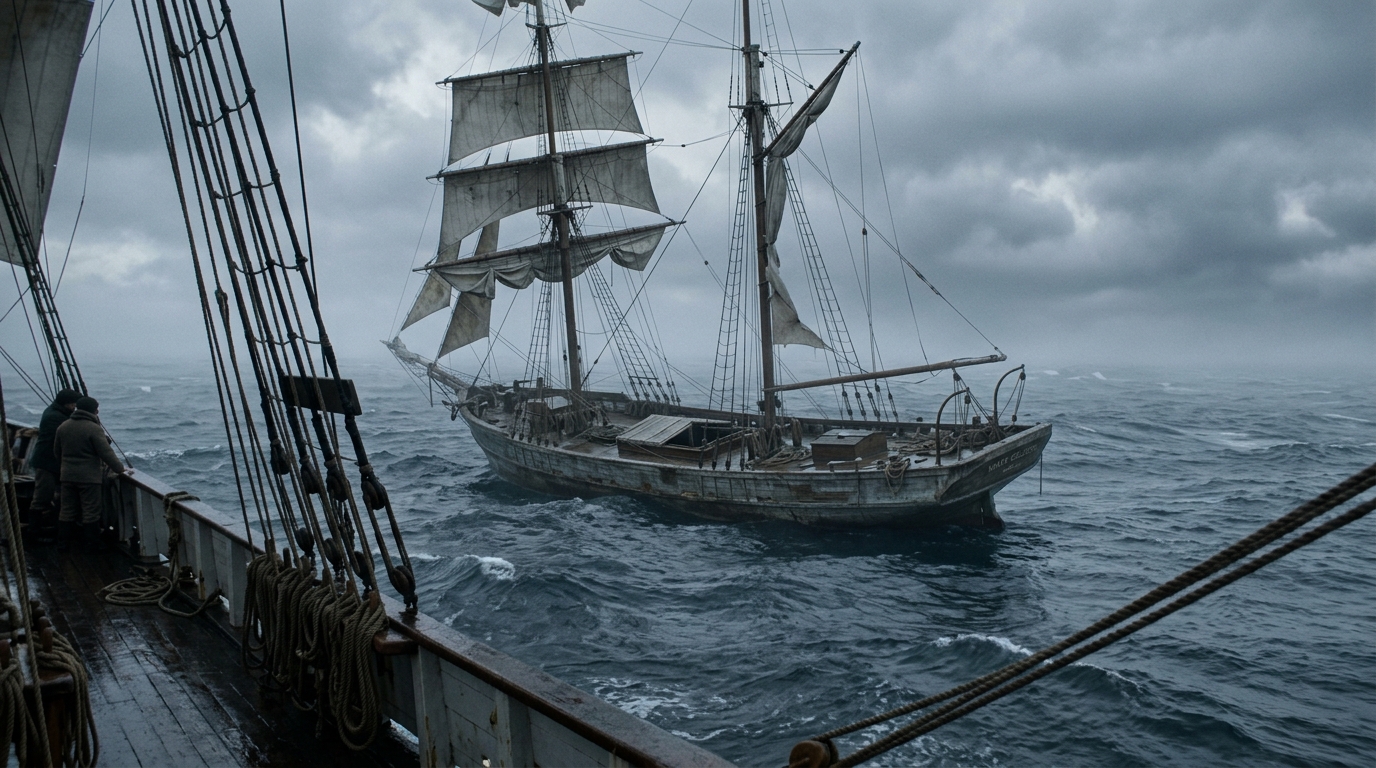
On December 4, 1872, sailors aboard the British brigantine Dei Gratia spotted another vessel moving strangely through the Atlantic.
The ship was sailing between the Azores and the coast of Portugal.
Something appeared wrong.
The vessel was the Mary Celeste, an American merchant brigantine that had departed New York nearly a month earlier.
The Dei Gratia approached.
No one appeared on deck.
Signals received no response.
Members of the Dei Gratia eventually boarded the drifting ship.
What they found would become one of the most famous maritime mysteries in history.
The Mary Celeste was abandoned.
Captain Benjamin Briggs was gone.
His wife was gone.
Their two-year-old daughter was gone.
Seven crewmen were gone.
Ten people had disappeared from a ship that remained afloat.
There was no surviving witness.
There was no body.
There was no final message explaining an emergency.
There was no definitive evidence of piracy or murder.
The ship's cargo was largely still aboard.
Personal belongings remained.
Food and water remained.
Yet the vessel's small boat was missing.
Some navigation equipment and papers were missing as well.
The evidence suggested that the people aboard the Mary Celeste had left the ship.
The question was why.
The question after that was even worse.
What happened to them once they did?
More than 150 years later, neither question has been answered with certainty.
Before the Mary Celeste
The mystery did not begin with a ship called the Mary Celeste.
The vessel had originally been named the Amazon.
Built in Nova Scotia and launched in 1861, the brigantine had already experienced a complicated history before becoming one of the most famous abandoned ships ever discovered.
Ships of the nineteenth century lived difficult lives.
They were damaged.
Repaired.
Sold.
Rebuilt.
Renamed.
Transferred between owners.
Sailing across the Atlantic was routine commerce, but it was never safe in the modern sense.
Weather forecasts were primitive.
Communication with shore disappeared once a vessel entered open water.
Medical emergencies could become fatal.
Navigation depended on instruments, calculations and observations.
A damaged pump, leaking hull, shifted cargo or sudden storm could become a crisis hundreds of miles from assistance.
The Amazon changed ownership several times and experienced accidents before eventually passing into American ownership.
After repairs and reconstruction, the vessel received a new name.
The Mary Celeste.
Nothing about that name was particularly ominous in 1872.
The legend came later.
Captain Benjamin Briggs
The man commanding the Mary Celeste on its final voyage was Captain Benjamin Spooner Briggs.
Briggs was an experienced American mariner from Massachusetts.
He came from a seafaring family and had spent much of his life around ships.
He was not an inexperienced captain attempting a voyage beyond his abilities.
By 1872, Briggs was an established shipmaster.
That fact matters because many theories about the disappearance require him to make an extraordinary decision.
Abandoning a seaworthy vessel at sea is dangerous.
A large sailing ship provides shelter, supplies, visibility and a far greater chance of rescue than a small open boat.
Experienced captains understood a basic principle:
A damaged ship that remains afloat is often safer than a lifeboat.
Whatever caused Briggs to leave the Mary Celeste must therefore have seemed serious enough to outweigh the obvious danger of abandoning her.
Unless, of course, he never made that decision voluntarily.
That possibility would become central to the investigation.
Sarah and Sophia Briggs
Benjamin Briggs was not traveling alone.
His wife, Sarah Elizabeth Briggs, accompanied him.
So did their young daughter, Sophia Matilda.
Their presence changes the emotional and practical character of the mystery.
This was not merely a commercial crew accepting the occupational risks of nineteenth-century seafaring.
The captain had brought his family aboard.
Briggs had another child, a son, who remained behind in Massachusetts to attend school.
The decision to take Sarah and Sophia suggests that Briggs did not regard the voyage as exceptionally dangerous.
The Mary Celeste was expected to cross the Atlantic, deliver its cargo and continue its commercial life.
Instead, Sarah and Sophia disappeared with the crew.
No confirmed trace of either was ever found.
The Crew
Seven crewmen sailed under Briggs.
They were experienced sailors, most of them of German background.
Contemporary investigators had reason to examine them closely once the ship was discovered.
Could the crew have mutinied?
Could they have murdered Briggs and his family?
Could they have stolen money and escaped?
These were obvious questions.
But the surviving evidence did not establish a mutiny.
The men had been selected for the voyage and were generally regarded as capable sailors.
There was no clear record of serious conflict aboard the ship before its disappearance.
A mutiny remained theoretically possible.
Evidence for one did not emerge.
The Cargo
The Mary Celeste carried a large commercial cargo of barrels of industrial alcohol.
The shipment was destined for Genoa, Italy.
This detail would become central to one of the strongest explanations for the abandonment.
Alcohol is volatile.
Vapors can accumulate.
Leaks can create dangerous fumes.
A captain who believed the cargo might explode could have an extremely good reason to evacuate.
Yet the cargo was not found destroyed.
The ship had not exploded.
There was no evidence of a catastrophic fire.
The alcohol was still largely aboard.
This produced a question that has lasted for generations:
Could the crew have abandoned the ship because they believed an explosion was imminent even though no explosion actually occurred?
Departure From New York
The Mary Celeste left New York Harbor in November 1872.
Its destination was Genoa.
The voyage across the Atlantic should have been demanding but ordinary.
Briggs maintained the ship's log.
For days, the vessel progressed eastward.
Nothing in the surviving record indicates that the ship departed under mysterious circumstances.
There was no known warning that everyone aboard was about to vanish.
The Mary Celeste simply sailed out into the Atlantic.
And eventually, the written record stopped.
The Final Log
The ship's final known log information placed the Mary Celeste near the Azores.
The last recorded position was made days before the vessel was discovered by the Dei Gratia.
This gap is one of the most important facts in the case.
The ship continued moving after the final recorded entry.
That means the crew's disappearance did not necessarily occur at the location where the vessel was eventually found.
The Mary Celeste could drift.
Wind and currents could carry it considerable distances.
Investigators therefore had to reconstruct not only what happened but where it happened.
There was no exact coordinate marking the moment the crew abandoned ship.
The Dei Gratia
The vessel that found the Mary Celeste was the Dei Gratia.
Its captain was David Morehouse.
The Dei Gratia had also sailed from New York for Europe.
When its crew encountered the Mary Celeste in early December, the other ship's behavior attracted attention.
A sailing vessel does not need an engine to continue moving after its crew disappears.
If sails remain set and wind remains available, an abandoned ship can continue traveling.
But an unmanned vessel behaves differently from one under competent command.
The Mary Celeste appeared to be adrift or sailing erratically.
Morehouse's crew watched.
There was no visible activity aboard.
Eventually, men were sent over to investigate.
Boarding the Mary Celeste
The boarding party stepped onto one of the strangest scenes in maritime history.
The ship was empty.
No captain greeted them.
No sailor emerged from below deck.
No injured passenger called for assistance.
The living quarters contained belongings.
The cargo remained.
The vessel was damaged and disordered in places, but it was not a floating ruin.
This distinction is essential.
Popular culture often presents the Mary Celeste as a perfectly preserved ship from which everyone somehow evaporated.
That is not accurate.
The vessel had problems.
There was water inside.
Equipment was missing.
The small boat was gone.
Some hatches were not in their expected condition.
The ship required attention.
But it was still afloat.
Indeed, members of the Dei Gratia were eventually able to sail it to Gibraltar.
Whatever had caused Briggs and the others to leave had not destroyed the ship.
The Missing Boat
The absence of the ship's small boat is perhaps the most important clue in the entire case.
The people were gone.
The boat was gone.
This strongly suggests that the disappearance was not some inexplicable vanishing from the deck.
The occupants probably left the Mary Celeste in the boat.
That conclusion immediately makes the case less supernatural.
But it creates another mystery.
Why would ten people leave a large ship for a small open boat in the middle of the Atlantic?
And if they did, why did none survive?
The Missing Navigation Equipment
Certain navigational instruments and ship's papers were reportedly missing.
This also matters.
If someone abandons a vessel deliberately, navigational equipment is exactly the kind of material they might take.
A crew expecting to spend time in a small boat would need to determine position and direction.
Important papers might also be taken by the captain.
The missing equipment therefore supports an intentional evacuation more strongly than a sudden disappearance caused by violence or some unknown phenomenon.
The crew appears to have prepared, at least to some degree, to leave.
But the preparation was incomplete.
They did not take everything they would need for a prolonged journey.
That suggests they may not have expected to remain away from the ship for long.
Was the Ship Seaworthy?
This question lies at the heart of the mystery.
The Mary Celeste was seaworthy enough to be sailed to Gibraltar by a small salvage crew.
That does not mean it appeared safe at the moment Briggs abandoned it.
A captain must make decisions using the information available at the time.
He cannot know that a suspected danger will fail to materialize.
If Briggs believed the ship was sinking, exploding or otherwise becoming unsafe, abandoning it could have seemed rational.
The fact that the vessel survived does not prove that the decision was irrational.
It may simply mean that Briggs misjudged the danger.
Water in the Hold
Water was found inside the ship.
The exact amount and significance have been debated.
Wooden sailing ships routinely took on some water.
Pumps existed precisely because perfectly dry hulls were unrealistic.
The important question is whether Briggs believed the water level indicated a serious leak.
If the crew could not accurately determine how much water was entering, the situation might appear much worse than it actually was.
A damaged or obstructed pump could magnify the uncertainty.
This becomes especially important when combined with other problems.
Bad weather.
A questionable position.
A cargo capable of producing dangerous vapors.
Water in the hold.
A captain does not experience these as isolated historical clues.
He experiences them simultaneously.
The Pumps
The condition of the ship's pumps has received considerable attention from modern researchers.
A vessel crossing the Atlantic depended on pumps to manage water entering the hull.
If a pump malfunctioned or became clogged, the crew could lose confidence in their ability to determine whether the ship was taking on water faster than they could remove it.
Cargo and construction could also make direct inspection of the hold difficult.
A captain who could not trust his sounding or pumping system might believe his vessel was filling with water.
Even if that belief turned out to be wrong, the decision to evacuate could make sense in the moment.
This provides one of the most grounded explanations for the abandonment.
Not a perfectly healthy ship mysteriously deserted.
A captain confronting incomplete and potentially alarming information.
The Sounding Rod
Determining the depth of water in a ship's hold was essential.
If equipment used for sounding the water gave confusing results, Briggs might have been unable to judge the vessel's condition accurately.
This uncertainty is central to modern reconstructions.
Imagine being aboard a ship carrying volatile alcohol after severe weather.
You suspect water is entering.
Your pumping system is unreliable.
Your position may not be exactly where you think it is.
You are responsible not only for sailors but for your wife and two-year-old daughter.
The rational threshold for taking emergency action may become much lower.
The Cargo Hatches
Accounts of the Mary Celeste mention hatches and cargo-related conditions that suggested the ship had experienced trouble.
Details have often been exaggerated in later retellings.
What matters is that the vessel was not discovered in immaculate condition.
The cargo area had been exposed to the conditions of the voyage.
Some barrels were later found empty.
That fact became particularly important.
The Empty Barrels
Nine barrels of alcohol were reportedly found empty.
This has generated enormous speculation.
Were they deliberately opened?
Did the crew drink the alcohol?
Did vapors escape?
Had someone stolen part of the cargo?
The most likely explanation may involve the barrels themselves.
Some were reportedly made from a type of wood more porous than the others.
Alcohol could leak or evaporate through imperfect barrels.
If alcohol escaped into the hold, fumes could accumulate.
Those fumes might have frightened the crew even without an actual fire.
The Alcohol Vapor Theory
This is one of the most enduring natural explanations.
Suppose alcohol leaked from several barrels.
Vapors accumulated.
The crew noticed fumes.
Perhaps they heard a noise from the hold.
Perhaps pressure displaced a hatch.
Perhaps they feared fire or explosion.
An alcohol-vapor explosion aboard a wooden sailing ship could be catastrophic.
Briggs would not need to know that an explosion was definitely going to happen.
He would only need to believe that remaining aboard posed an unacceptable risk.
He might order everyone into the boat temporarily.
The plan could have been to remain near the ship until the danger passed.
That would explain why so many belongings remained behind.
They intended to come back.
Could Alcohol Vapors Explode Without Fire?
A combustible vapor-air mixture can ignite under appropriate conditions.
But the Mary Celeste showed no evidence of a devastating explosion.
That once seemed to weaken the theory.
More recent experiments and reconstructions have explored whether a pressure event or limited ignition could occur without producing the kind of obvious burning people imagine.
Even without an actual explosion, the crew may simply have feared one.
This distinction is crucial.
The theory does not require the ship to explode.
It requires the captain to believe it might.
Historical mysteries are often distorted by hindsight.
We know the Mary Celeste did not sink or explode.
Benjamin Briggs did not.
A Temporary Evacuation
One of the most compelling reconstructions is that Briggs never intended to abandon the ship permanently.
He may have ordered a temporary evacuation.
The crew could enter the small boat.
A line could connect the boat to the Mary Celeste.
They could trail behind the larger vessel at what seemed a safe distance.
Once the suspected danger passed, they would pull themselves back and reboard.
This scenario explains several otherwise strange facts.
Why leave belongings?
Because they planned to return.
Why take navigational instruments?
Because the evacuation might last longer than expected.
Why use the small boat?
Because remaining aboard seemed temporarily dangerous.
Why was the Mary Celeste later found without them?
Because something went wrong with the connection.
The Broken Towline Theory
If the small boat remained connected to the Mary Celeste by rope, a sudden gust or change in weather could become fatal.
The larger ship had sails and considerable mass.
The small boat did not.
If the line broke, the Mary Celeste could move away quickly.
The people in the boat would have little chance of catching it.
They might watch their ship disappear toward the horizon.
Everything they needed would remain aboard.
Food.
Water.
Shelter.
Additional clothing.
Their only refuge would be a small boat in the Atlantic.
Under those circumstances, disappearance would require no further mystery.
The ocean would do the rest.
Why No Bodies?
The absence of bodies has sometimes been presented as evidence that ordinary explanations are inadequate.
In reality, people lost in the open Atlantic frequently leave no recoverable remains.
A small boat can capsize.
Bodies can sink.
Currents can carry them enormous distances.
Marine scavengers and decomposition can eliminate evidence.
The Atlantic is vast.
In 1872 there was no aerial search, satellite tracking or emergency beacon.
If the occupants of the Mary Celeste became separated from the ship, finding them would have depended largely on another vessel happening to pass close enough to see them.
No such rescue is known to have occurred.
Why Wasn't the Boat Found?
For the same reason.
A small wooden boat lost in the Atlantic is an extremely difficult object to recover.
It could capsize.
Break apart.
Drift for weeks.
Wash ashore somewhere far from the point of separation.
Sink.
Be encountered without anyone realizing its significance.
The absence of the boat is tragic.
It is not inexplicable.
The Salvage Crew
After discovering the abandoned vessel, Captain Morehouse faced a decision.
The Mary Celeste represented valuable property.
Under maritime salvage law, people who rescue a ship and cargo from danger may be entitled to compensation.
Members of the Dei Gratia therefore took control of the vessel.
A small crew sailed the Mary Celeste toward Gibraltar while the Dei Gratia continued separately.
This successful voyage later became part of the mystery.
If the ship could be sailed to Gibraltar, why had Briggs abandoned it?
Again, the salvage crew knew something Briggs could not have known:
The feared disaster had not occurred.
Gibraltar
The arrival of the Mary Celeste at Gibraltar did not end the mystery.
It began the investigation.
A salvage proceeding was required to determine what compensation the Dei Gratia crew deserved for recovering the ship.
Normally, a successful salvage would result in a relatively straightforward legal process.
Instead, authorities became suspicious.
Why had a valuable ship been abandoned?
Where were its people?
Could the salvagers themselves have been involved?
The Mary Celeste was transformed from a maritime curiosity into evidence.
Frederick Solly-Flood
The British official most associated with the Gibraltar investigation was Frederick Solly-Flood, the Attorney General.
Solly-Flood became suspicious that foul play might have occurred.
The possibility was not absurd.
A ship had arrived without its crew.
The people claiming salvage rights would financially benefit from recovering it.
Investigators therefore examined the vessel for signs of violence or deliberate damage.
This investigation is one reason the Mary Celeste case is so valuable historically.
Unlike many legendary disappearances, there was a contemporary legal proceeding.
People testified.
The ship was inspected.
The physical evidence was considered while the event was still recent.
Was There Blood?
One of the most persistent legends claims that blood was discovered aboard the Mary Celeste.
Some versions describe a bloody sword.
Others describe bloodstains suggesting murder.
These claims helped create the image of a violent mystery.
Contemporary investigation did examine suspicious marks.
But no convincing evidence established that the marks were human blood connected to a massacre.
The supposed signs of violence failed to produce proof of murder.
This is a perfect example of how a tentative investigative suspicion can become a "fact" in later storytelling.
Investigators asked whether there had been bloodshed.
Popular legend eventually remembered that there was bloodshed.
Those are not the same thing.
The Supposed Sword
A weapon found aboard also entered the mythology.
Marks or discoloration on a blade were treated with suspicion.
Could the crew have been attacked?
Had someone been killed?
Again, investigation failed to establish a violent crime.
The existence of a potentially suspicious object aboard a nineteenth-century ship is not surprising.
Connecting it to murder requires evidence.
That evidence was never established.
Damage to the Ship
Investigators also examined damage to the bow and hull.
Could the Mary Celeste have collided with something?
Could deliberate damage have been inflicted?
Could the salvagers have altered the scene?
A diver reportedly examined the underwater portion of the hull.
No evidence emerged of catastrophic structural damage sufficient to explain the disappearance by itself.
Nor did investigators establish that the ship had been intentionally sabotaged.
The Salvage Fraud Theory
Suspicion naturally fell on Captain Morehouse and the Dei Gratia.
What if they had encountered the Mary Celeste earlier?
What if the crews knew each other?
What if the discovery had been staged?
Perhaps the men aboard the Mary Celeste were murdered and the ship claimed for salvage.
The motive would be money.
But the theory creates major problems.
Ten people would need to disappear.
Bodies would need to be concealed.
The Dei Gratia crew would risk execution or severe punishment for a relatively uncertain salvage award.
And investigators found no convincing physical evidence of massacre.
The salvage award itself was also not so enormous as to make such an elaborate crime obviously worthwhile.
Suspicion existed.
Proof did not.
Did Briggs and Morehouse Know Each Other?
Later accounts sometimes emphasize that Benjamin Briggs and David Morehouse knew one another.
In some versions, they were close friends who dined together immediately before departure.
Such details make conspiracy theories much more dramatic.
The historical evidence for the strongest versions of these claims is weak.
Nineteenth-century maritime communities were interconnected, and captains operating from the same ports could know of one another without participating in a criminal plot.
Even if Briggs and Morehouse were acquainted, acquaintance does not establish conspiracy.
Mutiny
Another early theory blamed the crew.
Perhaps the sailors rebelled.
Perhaps they murdered Briggs and his family.
Perhaps they escaped in the boat.
This scenario could explain why everyone disappeared.
But it struggles with motive and evidence.
Why abandon a valuable ship after taking control of it?
Why leave much of the cargo and possessions behind?
Where did the mutineers go?
Why was there no convincing evidence of violence?
No confirmed later appearance of the crew established that they survived under new identities.
The mutiny theory remains possible only at a very general level.
There is little evidence supporting it.
Drunkenness
Because the cargo consisted of alcohol, some stories claimed the crew opened barrels, became drunk and mutinied.
This is one of the classic Mary Celeste legends.
It has a basic factual problem.
The cargo was industrial alcohol, not a shipment of ordinary drinking liquor.
Consuming it would be dangerous.
The theory also lacks evidence that the crew broke into the cargo and became intoxicated.
The empty barrels are better explained by leakage than by a drunken rampage.
Piracy
Pirates provide another obvious explanation for an abandoned ship.
Perhaps attackers boarded the Mary Celeste, removed or killed everyone, then left.
But pirates generally attack ships for a reason.
Cargo.
Money.
Supplies.
The Mary Celeste retained valuable cargo and personal property.
A pirate attack that removes ten people while leaving the primary economic value of the ship largely intact makes little sense.
There was also no convincing evidence of violent boarding.
Piracy cannot be ruled out merely because it seems unlikely.
But the evidence does not point strongly toward it.
Sea Monsters
As the story entered popular culture, natural explanations became increasingly extravagant.
Could a giant squid have attacked?
Could some unknown sea creature have pulled the crew overboard?
There is no evidence for this.
A sea animal capable of removing ten people from a ship while leaving the vessel largely intact would require an extraordinary sequence of events.
No biological traces or structural damage support such a theory.
The sea-monster explanation belongs to folklore, not the historical evidence.
Waterspouts
A waterspout is a rotating column of air and water that forms over the sea.
Some researchers have suggested that a waterspout could have created sudden violent conditions around the Mary Celeste.
It might explain water aboard the ship.
It could potentially disturb sails or cargo.
It might create panic.
But there is no direct evidence that a waterspout struck the vessel.
The theory is physically possible.
It remains speculative.
Rogue Waves
A large unexpected wave could also frighten a crew into believing a ship had suffered catastrophic damage.
If water suddenly entered the vessel, cargo shifted and pumps seemed unreliable, Briggs might conclude that the ship was sinking.
But again, the Mary Celeste did not show evidence of being devastated by an enormous wave.
A less extreme weather event combined with other problems may be more plausible than a single spectacular wave.
Earthquakes and Seaquakes
Underwater seismic activity has occasionally been proposed.
An earthquake at sea might produce strange sounds or movement.
A captain unfamiliar with the source could interpret the event as a problem with the ship or cargo.
Some theories combine seismic activity with alcohol fumes, suggesting that a sudden shock could have frightened the crew.
There is no definitive evidence tying a particular seismic event to the abandonment.
The Weather
Weather is a less dramatic but essential part of the case.
The Mary Celeste had experienced difficult Atlantic conditions.
Poor weather could contribute to nearly every natural explanation.
It could create water ingress.
It could damage equipment.
It could complicate navigation.
It could increase stress on the cargo.
It could make an emergency evacuation more dangerous.
And after the crew entered the boat, changing wind could rapidly separate them from the ship.
Mysteries often search for a single dramatic cause.
Real disasters frequently emerge from several ordinary problems occurring at once.
Navigation Error
Briggs needed to know where the ship was relative to land.
If navigation errors placed the Mary Celeste somewhere other than where the captain believed it to be, his decisions could be based on incorrect assumptions.
The Azores were nearby.
If Briggs believed land was within reachable distance, entering the boat might seem less suicidal than it appears from a map viewed today.
A navigational error combined with concerns about the ship could therefore contribute to the evacuation decision.
Did They Try to Reach the Azores?
One possibility is that Briggs believed the crew could reach land in the boat.
If the ship seemed unsafe and an island appeared accessible, evacuation might seem reasonable.
But a small error in estimated position could make the journey impossible.
Currents and wind could push the boat away.
Once separated from the Mary Celeste, the group might have found itself farther from land than expected.
No evidence proves this scenario.
It is consistent with the geography of the final known voyage.
Insurance Fraud
Another theory proposes that the abandonment was staged for financial reasons.
Ships and cargo were insured.
Maritime fraud existed.
Could Briggs have conspired to make the vessel disappear or create a false salvage situation?
The theory struggles with the most obvious fact.
Briggs, his wife, his child and seven sailors vanished permanently.
An insurance scheme that requires ten people to disappear without ever collecting an obvious reward is difficult to sustain.
There is no convincing evidence that Briggs survived secretly.
Did Everyone Die?
Almost certainly, if the conventional abandonment theory is correct.
But technically, the historical record establishes disappearance, not observed death.
No confirmed bodies were recovered.
No later record conclusively established the survival of any member of the group.
Could someone have survived and assumed another identity?
Anything is possible in the abstract.
There is no evidence for it.
The reasonable historical conclusion is that the occupants died at sea after leaving the ship.
The Mary Celeste Was Not Found in the Bermuda Triangle
Modern retellings sometimes connect the Mary Celeste to the Bermuda Triangle.
Geographically, this is wrong.
The ship was found in the eastern North Atlantic near the Azores and Portugal.
The Bermuda Triangle legend concerns a very different region of the western Atlantic.
Connecting the two is a later attempt to merge famous mysteries.
It has no basis in the actual location of the 1872 discovery.
The "Ghost Ship" Myth
The Mary Celeste is routinely called the world's most famous ghost ship.
That description is understandable.
An abandoned ship drifting at sea is inherently eerie.
But nothing in the historical evidence requires ghosts.
No apparition was documented.
No supernatural force was observed.
No paranormal event was recorded in the ship's log.
The mystery concerns human decision-making and maritime survival.
The supernatural reputation came later.
The Famous Uneaten Meal
One of the most persistent images associated with the Mary Celeste is a meal sitting untouched on the table.
Food still warm.
Coffee waiting.
Perhaps a pipe still smoking.
The implication is powerful.
Everyone vanished in the middle of ordinary life.
But this image belongs largely to later storytelling.
The historical evidence does not establish that investigators found a freshly prepared meal abandoned on the table as though everyone had disappeared seconds earlier.
The ship had been unmanned for days before discovery.
Any "hot meal" version is impossible on its face.
Yet the image survives because it is narratively perfect.
Arthur Conan Doyle Changes the Story
One of the most important moments in the transformation of the Mary Celeste from historical mystery into legend came more than a decade after the disappearance.
In 1884, Arthur Conan Doyle published a fictional story inspired by the case.
Doyle had not yet become world-famous as the creator of Sherlock Holmes.
His story altered names and details.
It presented a fictional explanation for an abandoned ship.
But many readers blurred the distinction between fiction and fact.
Even the ship's name was changed in Doyle's story to the Marie Celeste.
That incorrect name became remarkably persistent.
For decades, people repeated fictional details as though they came from the original investigation.
The Marie Celeste Error
The ship was the Mary Celeste.
Not the Marie Celeste.
The incorrect version became so widespread that it is still encountered today.
This small error illustrates how deeply fiction reshaped the historical memory of the case.
When a mystery becomes culturally famous, the popular version can eventually overwhelm the documented one.
Forbidden Lore cases like this are most interesting precisely where those two versions separate.
What Conan Doyle Added
Doyle's fictional treatment helped popularize a more dramatic abandoned-ship narrative.
Later writers added further details.
Meals waiting.
Warm drinks.
Signs that everyone had vanished instantly.
Strange clues.
Mysterious messages.
The story became less about a nineteenth-century crew probably evacuating into a boat and more about a ship whose occupants seemed to have disappeared from reality.
The second version is much more frightening.
It is also much less historical.
The Ship After 1872
The Mary Celeste did not disappear after the famous incident.
It continued sailing.
This fact is often overlooked because the ship's legend makes it feel as though the abandoned vessel should have vanished into maritime history immediately after its discovery.
Instead, it returned to commercial service.
Owners changed.
The ship continued carrying cargo.
The most famous "ghost ship" in history had a surprisingly ordinary later career.
Until its final voyage.
The Final Wreck
In 1885, years after the disappearance of Briggs and his crew, the Mary Celeste was deliberately wrecked near Haiti as part of an attempted insurance fraud.
This later event has nothing to do with the 1872 disappearance.
But it adds a strange final chapter.
The ship that became famous because investigators suspected fraud was ultimately destroyed in an actual fraudulent scheme under different ownership.
The vessel's career ended not through a supernatural curse but through human criminal behavior.
Finding the Wreck
Later researchers attempted to identify the remains of the Mary Celeste near Haiti.
Possible wreckage associated with the ship has been investigated, though establishing the identity of nineteenth-century wreck remains can be difficult.
Even if the physical remains of the vessel are conclusively identified, they cannot answer the central mystery.
The ship survived the 1872 incident.
The missing people did not.
The evidence needed to solve the disappearance left in the small boat with them.
Why the Case Became So Famous
Thousands of ships have been lost at sea.
Thousands of sailors have disappeared.
Why did the Mary Celeste become different?
Because the ship came back without them.
A shipwreck provides an explanation.
The vessel sinks.
People die.
An abandoned vessel reverses that logic.
The supposed place of danger survives.
The people disappear.
That inversion is psychologically powerful.
It makes the ship seem like the survivor of an event it refuses to explain.
The Empty-Ship Effect
There is something uniquely disturbing about an empty environment built for human activity.
An abandoned house.
A deserted town.
A car found running without its driver.
A ship under sail with no one aboard.
The mind immediately asks where everyone went.
The Mary Celeste amplifies this effect because the surrounding environment was the open Atlantic.
There was nowhere obvious for ten people to go.
Their absence became more visible than their presence ever could have been.
What Contemporary Investigators Actually Had
Unlike many mysteries from the nineteenth century, the Mary Celeste produced substantial contemporary documentation.
There was the ship itself.
There was its cargo.
There were logs and records.
There were the men who found it.
There was a salvage hearing.
There were inspections.
There were witnesses.
There was legal scrutiny.
This makes the case unusually strong as a documented historical mystery.
The problem was not lack of evidence about the ship.
The problem was lack of evidence about the final human decision.
No investigation could interview Benjamin Briggs.
No survivor could explain why the boat was launched.
The central witness was missing.
What Is Actually Documented?
The basic historical facts are remarkably compelling without embellishment.
The Mary Celeste departed New York in November 1872 bound for Genoa.
Captain Benjamin Briggs commanded the vessel.
His wife Sarah and daughter Sophia were aboard.
Seven crewmen accompanied them.
The ship carried a commercial cargo of alcohol.
In early December, the Dei Gratia encountered the Mary Celeste in the Atlantic.
No one was aboard.
The ship remained afloat.
Much of the cargo and personal property remained.
The small boat was missing.
Certain navigation equipment and papers were missing.
Water was present inside the vessel.
The ship was sailed to Gibraltar.
Authorities investigated.
No convincing evidence established murder, piracy or sabotage.
None of the ten missing people was conclusively seen again.
That is enough for a mystery.
Nothing supernatural needs to be added.
What Is Legend?
The famous hot meal waiting on the table is not reliable historical evidence.
A still-smoking pipe is not part of the established scene.
The crew did not simply vanish from a perfectly untouched ship.
The Mary Celeste was not found in the Bermuda Triangle.
There is no evidence that a sea monster attacked it.
There is no evidence of extraterrestrial involvement.
There is no documented supernatural event.
There was no established massacre aboard.
And many details repeated in popular accounts originated or evolved through later fiction.
Separating those claims from the contemporary record makes the case less sensational.
It also makes it more interesting.
The Strongest Natural Reconstruction
A plausible reconstruction begins before the crew leaves the ship.
The Mary Celeste has endured difficult weather.
Water has entered the vessel.
The captain may have doubts about the reliability of the pumps or his ability to determine how much water is in the hold.
Several alcohol barrels have leaked.
Fumes may be present.
The ship's exact position may be uncertain.
Briggs has his wife and young daughter aboard.
Something happens.
Perhaps a noise.
Perhaps shifting cargo.
Perhaps a hatch moves.
Perhaps the smell of alcohol becomes alarming.
Perhaps a sounding suggests more water than expected.
Briggs concludes that remaining aboard may be dangerous.
He orders a temporary evacuation.
Everyone enters the small boat.
They take navigation equipment and important papers.
They leave many possessions because they intend to return.
The boat remains connected to the ship.
Then the line breaks.
Or is deliberately released and cannot be recovered.
Wind catches the Mary Celeste.
The larger vessel begins moving away.
The people in the boat cannot catch it.
The ship continues across the Atlantic.
Days later, the Dei Gratia finds it.
The ten people left behind in the boat disappear into the ocean.
This scenario does not require any single extraordinary event.
It requires a chain of ordinary dangers.
That may be exactly why it is so compelling.
Could We Ever Prove It?
Probably not.
The small boat was never conclusively recovered.
The bodies were never found.
No final diary survives.
No message in a bottle established what happened.
No witness reached shore.
The physical evidence aboard the Mary Celeste can tell us what conditions existed before the evacuation.
It cannot tell us what Benjamin Briggs believed.
That distinction may make the mystery permanently unsolvable.
What Would Solve the Mary Celeste?
A credible contemporary document describing the crew's fate could transform the case.
A recovered wreck of the boat with identifiable remains might provide evidence, although after more than 150 years such a discovery is extraordinarily unlikely.
A previously unknown message written by Briggs could explain his decision.
But barring some remarkable archival discovery, the evidence available today is probably close to all the evidence we will ever have.
Historical reconstruction can identify the most plausible scenario.
It cannot turn probability into eyewitness certainty.
The Case for Foul Play
The strongest argument for foul play begins with the unusual fact of an abandoned ship.
People do not normally leave seaworthy vessels in the Atlantic.
The Dei Gratia crew had a financial interest in salvage.
Mutiny and piracy were real nineteenth-century dangers.
Some physical details initially appeared suspicious to investigators.
Those facts justified investigation.
But justification for suspicion is not proof.
No confirmed bloodshed was established.
No bodies showed up.
No stolen cargo provided a clear motive.
No participant confessed.
No documentary evidence established conspiracy.
The foul-play theories remain possible.
They are not strongly supported.
The Case for Accidental Abandonment
The accidental-abandonment theory fits more of the physical evidence.
The missing boat indicates evacuation.
Missing navigational equipment suggests preparation.
Remaining belongings suggest the occupants did not intend permanent abandonment.
Water aboard and possible pump problems provide a reason to worry about seaworthiness.
Leaking alcohol provides another possible danger.
Weather and uncertain navigation add pressure.
Once separated from the ship, ten people in a small boat could disappear without leaving recoverable evidence.
This explanation requires no unknown force.
Its greatest weakness is that the exact trigger cannot be identified.
But historical explanations do not always require knowing the final trigger.
Why Briggs Matters
Ultimately, the mystery centers on one decision.
Benjamin Briggs was responsible for everyone aboard.
He was experienced.
He knew the Atlantic.
He knew the danger of entering a small boat.
And he had his wife and daughter with him.
It is difficult to imagine him abandoning the Mary Celeste casually.
That strongly suggests that, at the moment the boat was launched, Briggs believed he was protecting them.
Whether his belief was correct is another question.
The ship's survival suggests that whatever danger he perceived was either temporary, misunderstood or less severe than it appeared.
The tragedy may therefore have begun with a completely rational decision based on incomplete information.
A Disaster Without a Villain
Humans prefer mysteries with causes that can be named.
A murderer.
A pirate.
A monster.
A conspiracy.
A supernatural force.
The Mary Celeste may have had none.
There may have been no villain.
No secret.
No deliberate disappearance.
No single spectacular catastrophe.
A leaking barrel.
A questionable pump.
Water in the hold.
Bad weather.
An uncertain position.
A frightened captain.
A temporary evacuation.
A broken rope.
That could be enough.
At sea, small errors and ordinary mechanical problems can combine into irreversible disasters.
The Mary Celeste and the Nature of Mystery
The case demonstrates an important difference between unexplained and inexplicable.
The disappearance is unexplained because no surviving evidence tells us exactly what happened.
It is not inexplicable.
Several physically ordinary scenarios account for the known evidence.
That distinction matters.
A mystery does not become less real because its most likely explanation is natural.
If anything, the possibility that ten people died because of a sequence of understandable decisions makes the story more disturbing.
There was no monster to defeat.
There may have been only bad information, bad conditions and bad luck.
More Than 150 Years Later
The Atlantic where the Mary Celeste sailed looks much the same today.
Ships still cross it.
Storms still form.
Waves still erase evidence.
But the world around the ocean has changed completely.
Modern vessels carry radios.
Satellite navigation provides exact positions.
Weather systems can be tracked.
Emergency beacons can transmit distress signals.
Search aircraft can cover enormous areas.
A modern crew experiencing the same emergency would have options Benjamin Briggs could never imagine.
In 1872, once the occupants entered that small boat, they were effectively alone.
If the ship moved away, no one on land knew.
No rescue center received an alert.
No satellite recorded their position.
No aircraft began searching.
They simply disappeared from the connected world.
Why the Mary Celeste Still Matters
The Mary Celeste became one of the foundational mysteries of modern popular culture.
Its influence extends far beyond maritime history.
The phrase "Mary Celeste" itself became shorthand for an eerily abandoned place.
Books, documentaries, films and television programs repeatedly returned to the story.
Fictional ghost ships borrowed its atmosphere.
Mystery writers embellished it.
Conspiracy theories absorbed it.
Paranormal culture claimed it.
But the documented story is powerful enough without any of those additions.
A ship left New York carrying ten people.
Weeks later, the ship was found.
The people were not.
That is the mystery.
The Verdict
Status: Unresolved
The abandonment of the Mary Celeste was a genuine historical event.
The vessel was discovered in the Atlantic in December 1872 with no one aboard.
Captain Benjamin Briggs, his wife Sarah, their young daughter Sophia and seven crewmen disappeared.
The ship's small boat was missing.
Navigation equipment and papers were missing.
Much of the cargo, supplies and personal property remained aboard.
The vessel was sufficiently seaworthy to be sailed to Gibraltar.
A contemporary salvage investigation examined the possibility of violence and fraud but did not establish that either had occurred.
The evidence strongly suggests that Briggs and the others left the ship deliberately in the small boat.
The most plausible explanations involve a perceived maritime emergency: concerns about water entering the vessel, problems determining the ship's condition, leaking alcohol and the possibility of dangerous vapors, severe weather, navigational uncertainty, or some combination of those factors.
They may have intended the evacuation to be temporary.
If their boat became separated from the Mary Celeste, their survival prospects would have deteriorated almost immediately.
This explanation is ordinary.
It is also unproven.
No survivor returned to describe the decision.
No body provided a final clue.
No boat was conclusively recovered.
No document records the last moments of Benjamin, Sarah or Sophia Briggs or the seven sailors traveling with them.
The later legends can largely be discarded.
There was no documented hot meal mysteriously left steaming on a table.
There is no credible evidence of a sea monster.
The ship was not discovered in the Bermuda Triangle.
No supernatural explanation is required.
But removing the mythology does not remove the mystery.
In some ways, it makes the case stranger.
Ten people were alive aboard the Mary Celeste.
Something convinced an experienced captain that taking his wife, his two-year-old daughter and his crew into a small boat on the open Atlantic was safer than remaining aboard his ship.
He was almost certainly wrong.
The Mary Celeste survived.
They did not.
The ship reached land.
The people who left it vanished.
And after more than a century and a half, the Atlantic has never returned the answer.
Case Status
Unresolved
The classification above describes the current status of this entry within the Forbidden Lore archive. A documented report does not necessarily establish the explanation offered for it as fact.