The Jersey Devil: The Monster That Haunted the Pine Barrens
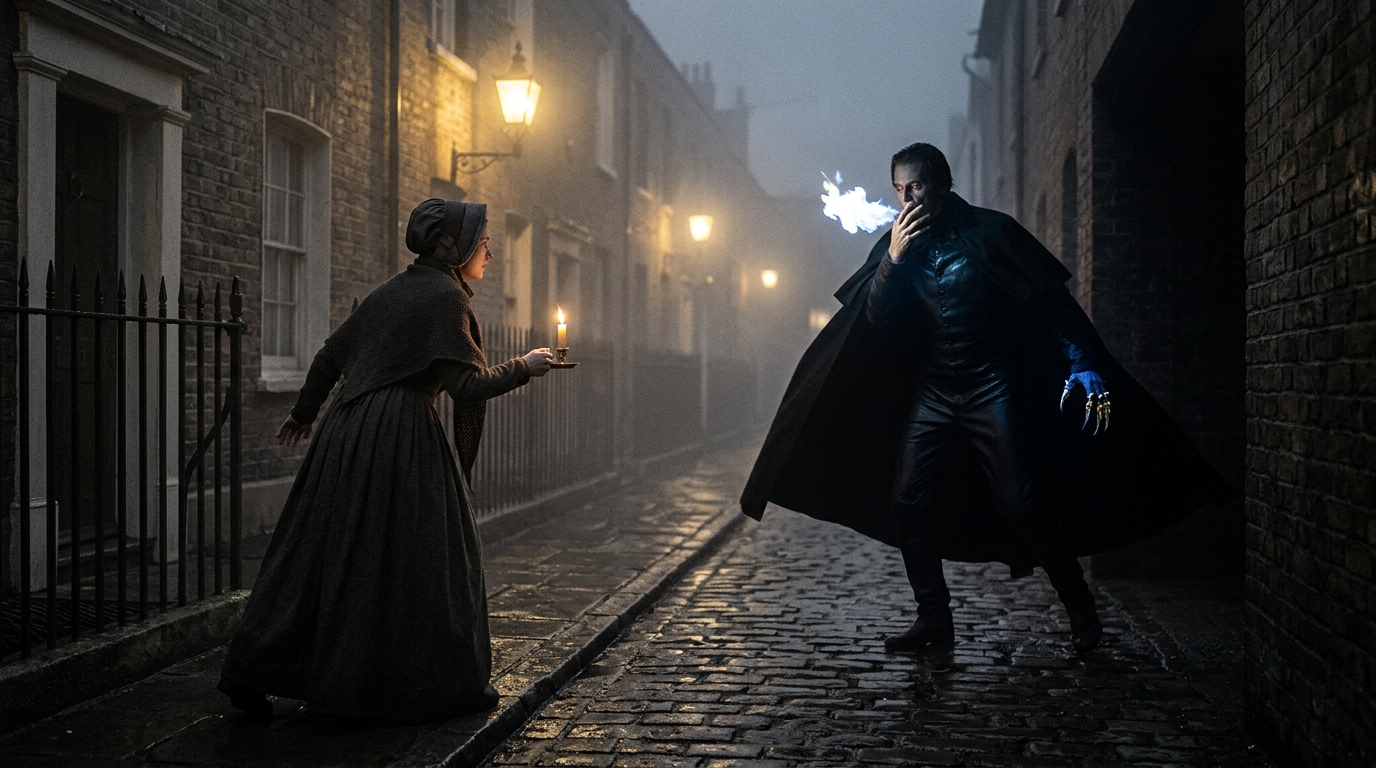
The story usually begins with a woman.
Her name is Mother Leeds.
The place is southern New Jersey.
The year is usually given as 1735.
And Mother Leeds is pregnant.
Again.
She already has twelve children.
According to the legend, she discovers that she is expecting a thirteenth.
Exhausted, overwhelmed, angry, terrified, or perhaps simply having an extraordinarily bad day, she curses the unborn child.
Different versions give her different words.
But the meaning is generally the same.
Let this one be a devil.
Months later, during a violent storm, Mother Leeds goes into labor.
Friends or family gather inside the house.
The child is born.
At first, according to some versions, the baby appears normal.
Then it changes.
Its body stretches.
Its head becomes that of a horse or goat.
Hooves emerge from its legs.
Its hands become claws.
A tail grows behind it.
Wings unfold from its back.
The creature attacks the people in the room.
Then it flies upward.
Up the chimney.
Into the night.
And into the enormous pine forests of southern New Jersey.
It is never truly gone.
For generations afterward, people report screams in the woods.
Strange tracks appear in snow.
Animals are supposedly found dead.
Travelers glimpse something moving between the trees.
Witnesses describe wings.
Hooves.
A horse-like face.
A long neck.
Claws.
Horns.
Red eyes.
A forked tail.
Sometimes it walks.
Sometimes it leaps.
Sometimes it flies.
Eventually the creature acquires a name.
The Jersey Devil.
It is one of the most recognizable monsters in American folklore.
There is only one problem.
The familiar story about Mother Leeds appears to have developed after something else had already been happening in New Jersey for generations.
Before the Jersey Devil was a monster, there was the Leeds Devil.
Before there was Mother Leeds, there was a real family named Leeds.
Before newspapers printed stories about hoofprints on rooftops, members of that family had been accused of religious heresy, political betrayal, astrology, occultism, and association with the devil.
One Leeds published controversial almanacs.
Another became Benjamin Franklin's rival.
Franklin publicly predicted that his competitor would die.
When the man insisted that he was still alive, Franklin essentially replied that the real Titan Leeds must already be dead and whoever was answering him was an impostor.
It was an eighteenth-century flame war conducted through colonial almanacs.
And somehow, over the next two centuries, that history became a bat-winged monster stalking the Pine Barrens.
Then, in January 1909, the monster exploded into public life.
Tracks appeared across New Jersey.
People claimed something had walked across rooftops.
Police reportedly fired at strange creatures.
Trolley passengers saw something flying overhead.
Schools closed.
Workers supposedly refused to leave their homes.
Armed groups went hunting.
Newspapers competed for the strangest reports.
Sightings spread into Pennsylvania and Delaware.
And one enterprising showman eventually displayed a kangaroo fitted with artificial wings and announced that the Jersey Devil had finally been captured.
The kangaroo, to its credit, does not appear to have been consulted.
The story of the Jersey Devil is therefore not one mystery.
It is several.
Was there ever a real creature behind the sightings?
Did people in the Pine Barrens genuinely believe something supernatural lived in the forests?
Was Mother Leeds based on an actual woman?
Did the legend begin with the politically controversial Leeds family?
What happened during the remarkable panic of 1909?
And perhaps most interestingly:
How did a colonial religious argument become a monster?
The Pine Barrens
The Jersey Devil belongs to a landscape.
Without the New Jersey Pine Barrens, the legend would probably not exist in anything resembling its modern form.
The Pine Barrens—or New Jersey Pinelands—stretch across an enormous portion of southern New Jersey.
More than a million acres of pine and oak forests, wetlands, streams, bogs, sandy roads, abandoned industrial sites, farms, and small communities occupy an area surprisingly close to some of the most densely populated parts of the United States.
Philadelphia lies to the west.
Atlantic City sits along the coast.
New York City is not impossibly far away.
And between those metropolitan areas sits a forest that can still feel remarkably isolated.
The landscape has always encouraged stories.
The soil is sandy and acidic.
Streams often run dark with tannins.
Dense pine forests can look nearly identical for miles.
Wetlands break the terrain.
Old roads disappear.
Abandoned settlements and industrial ruins remain hidden among trees.
At night, the Pine Barrens become something else entirely.
Visibility collapses.
Animals make noises that are difficult to identify.
Sound travels strangely through woods and wetlands.
And a person who leaves the main roads can become lost with impressive efficiency.
It is excellent monster country.
Before the Devil
Human history in the Pinelands extends thousands of years before European settlement.
The ancestors of the Lenape lived throughout the region long before Europeans arrived.
European settlement increased significantly during the seventeenth century.
The forests eventually supported industries involving timber, charcoal, iron, glassmaking, shipbuilding, and other trades.
Small settlements formed.
Then some disappeared.
Industrial operations were abandoned.
Roads shifted.
Communities became isolated.
By the nineteenth century, outsiders increasingly treated the Pine Barrens as a strange and remote region.
That reputation mattered.
Places acquire reputations just as people do.
A forest described repeatedly as isolated, mysterious, primitive, or dangerous becomes the obvious home for mysterious things.
The Jersey Devil did not create the eerie reputation of the Pine Barrens.
It benefited from it.
The Creature Everyone Knows
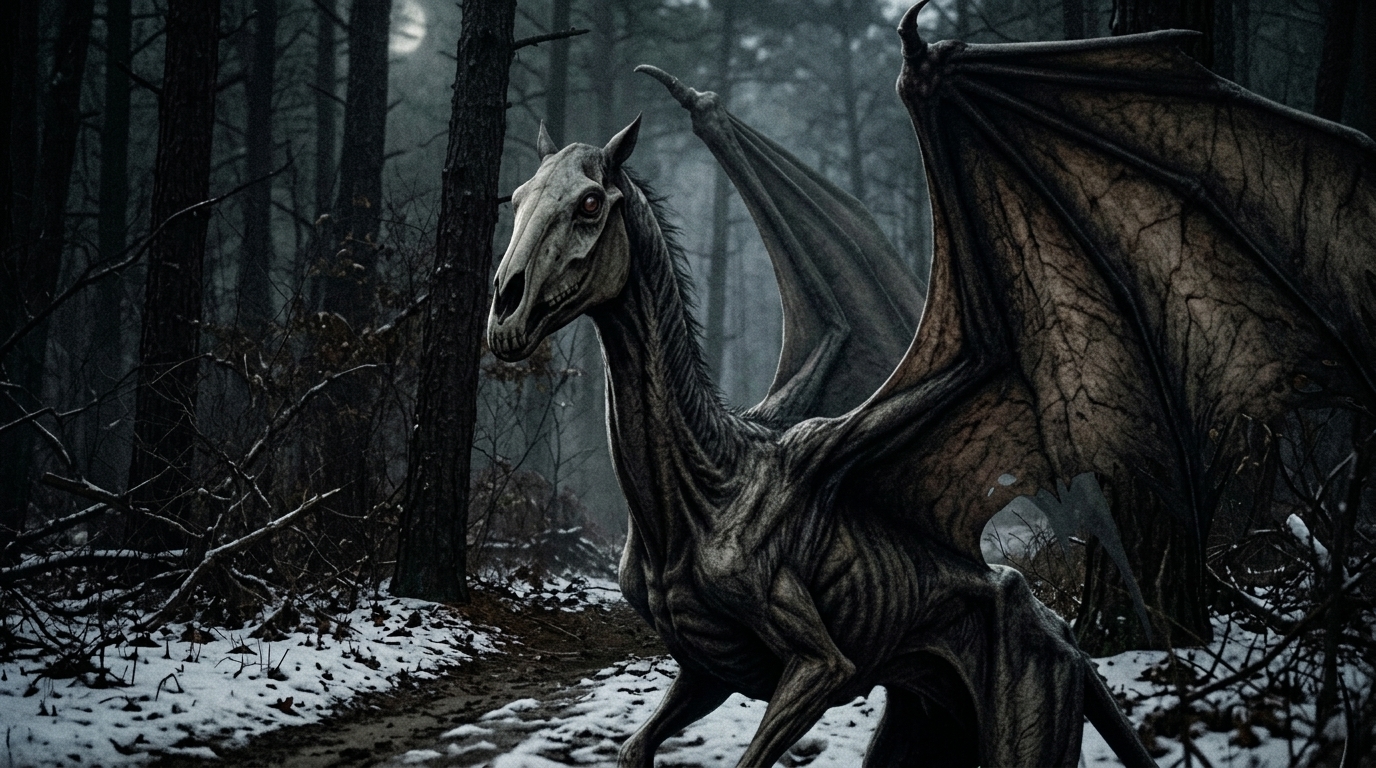
Modern descriptions of the Jersey Devil are remarkably specific considering how inconsistent the historical sightings actually were.
The standard creature usually has:
A horse-like or goat-like head.
A long neck.
A narrow body.
Two short forelegs.
Clawed hands.
Powerful hind legs.
Cloven hooves.
Large bat-like wings.
A long tail.
Sometimes horns.
Sometimes glowing red eyes.
The overall result resembles someone asked several unrelated animals to collaborate without giving them enough time to plan.
It is difficult to imagine how the animal would function biologically.
That has never damaged its popularity.
In fact, the absurd anatomy may be part of the appeal.
The Jersey Devil does not look like an unknown species that science happened to miss.
It looks like a monster.
But Early Descriptions Were Not Consistent
Historical sightings do not provide one stable anatomical description.
Some witnesses described something horse-like.
Others described a bird.
Others described a kangaroo.
A dog.
A crane.
A bat.
A winged reptile.
A creature with a collie-like head.
Something with monkey-like hands.
Something covered in hair.
Something nearly hairless.
A thing with two legs.
A thing with four.
A creature that walked.
A creature that hopped.
A creature that flew.
A creature that screamed.
A creature that apparently had no particular difficulty walking across roofs.
If all of those witnesses saw one biological species, that species was remarkably committed to confusing zoologists.
But folklore does not require anatomical consistency.
Over time, illustrators and storytellers chose the most memorable features.
Those features became standardized.
Eventually the modern Jersey Devil emerged.
Mother Leeds
The most famous origin story identifies the creature's mother simply as Mother Leeds.
She supposedly lived near an area now known as Leeds Point, in what is today Atlantic County.
The story usually places the birth in 1735.
Mother Leeds already has twelve children.
When she learns she is pregnant with her thirteenth, she curses the baby.
Then the child becomes the Devil.
There are many variations.
In one, Mother Leeds herself is a witch.
In another, the father is supposedly the Devil.
In another, she refuses food to a wandering stranger and is cursed.
In another, a clergyman curses her.
In another, the child is born deformed but remains with its mother until she dies.
Only afterward does it escape into the woods.
These contradictions are not evidence that someone failed to preserve the original script properly.
They are evidence that we are dealing with folklore.
Stories change.
Was Mother Leeds a Real Person?
Possibly.
But the answer is considerably more complicated than many monster books suggest.
Researchers have attempted to identify Mother Leeds with Deborah Leeds, the wife of Japhet Leeds.
The family lived in the area associated with Leeds Point.
A will written by Japhet Leeds in 1736 names twelve children.
That is certainly interesting.
A real Leeds family.
In the correct region.
With twelve known children.
Very close to the legendary date of a thirteenth birth.
It appears almost too perfect.
But it does not prove that Deborah gave birth to a supernatural thirteenth child in 1735.
Obviously.
More importantly, it does not even prove that the Mother Leeds story originally referred specifically to Deborah.
Folklore can attach itself to historical people retrospectively.
Once researchers know that a Leeds woman really had twelve children, the temptation to identify her as the legendary mother becomes enormous.
The evidence supports a connection.
It does not provide a birth certificate reading:
Child: Devil, Jersey.
The Strange Importance of the Name Leeds
The name Leeds matters far more than the name Mother.
The creature was once widely known as the Leeds Devil.
That suggests the legend's roots may lie not in one supernatural childbirth story but in the historical reputation of the Leeds family itself.
And that story begins decades before 1735.
With a man named Daniel Leeds.
Daniel Leeds
Daniel Leeds was born in England in 1651.
He later emigrated to New Jersey and became part of the colonial Quaker community.
He was educated.
Politically active.
Interested in publishing.
Interested in astronomy and astrology.
And eventually very good at irritating other Quakers.
In 1687, Leeds began publishing an almanac.
Almanacs were enormously important in colonial life.
They could contain calendars.
Weather information.
Astronomical material.
Practical advice.
Poetry.
Astrological predictions.
Religious observations.
And political commentary.
In a world without smartphones, search engines, weather apps, or even widespread newspapers, an annual book telling people what day it was and when the moon would appear was genuinely useful.
It was also an excellent platform for starting arguments.
Daniel Leeds took advantage of the opportunity.
The Leeds Almanac
Leeds's almanac incorporated astrology.
That alone could be controversial.
Astrology and astronomy were not separated in the seventeenth century as cleanly as they are today, but religious authorities could still view particular astrological or occult ideas with suspicion.
Leeds became increasingly interested in subjects that some fellow Quakers considered inappropriate.
His writings included discussions of cosmology.
Angels.
Astrology.
Natural magic.
Theology.
And the behavior of devils.
Eventually the disputes became severe enough that Leeds's work was publicly condemned.
A man whose descendants would become associated with a supernatural monster had, generations earlier, literally published about devils.
Folklore rarely receives ingredients this convenient.
The Temple of Wisdom
In 1688, Daniel Leeds published a work commonly known as The Temple of Wisdom for the Little World.
The book explored a mixture of religious, scientific, astrological, and philosophical subjects.
To modern readers, such a combination may seem eclectic.
To some members of Leeds's religious community, it looked dangerous.
Critics accused him of publishing material inconsistent with Quaker beliefs.
His interests could be characterized as pagan.
Occult.
Heretical.
The argument escalated.
And in seventeenth-century religious disputes, accusations were rarely restrained.
"Satan's Harbinger"
One response to Leeds reportedly carried a title beginning:
Satan's Harbinger Encountered.
The language is revealing.
This was not yet a monster story.
Nobody was reporting hoofprints.
Nobody had seen a flying horse-headed creature.
But the Leeds name was already being publicly associated with Satan.
Historian Brian Regal has argued that this religious and political hostility toward Daniel Leeds and his descendants forms an important foundation for the later Leeds Devil legend.
If so, the Jersey Devil did not begin in a delivery room.
It began in pamphlets.
Religious Arguments Were Not Gentle
Modern religious disagreements can become ugly.
Colonial religious disagreements were frequently uglier.
Accusing an opponent of being associated with Satan was not metaphorically mild.
It could attack a person's reputation.
Faith.
Social standing.
Political legitimacy.
Daniel Leeds increasingly separated himself from the Quaker community.
He eventually converted to Anglicanism.
And his political loyalties made the situation worse.
The Royal Governor
Daniel Leeds aligned himself with colonial authorities associated with the British crown.
He served as a surveyor and held government positions.
This placed him in conflict with political and religious opponents who viewed royal influence with suspicion.
One of the governors associated with Leeds was Edward Hyde, Lord Cornbury, a deeply controversial figure in colonial history.
Stories later accused Cornbury of corruption, political abuse, and famously of dressing in women's clothing—although historians continue to debate the accuracy and political origins of those claims.
Whatever the truth of every accusation against Cornbury, association with the governor did Daniel Leeds no favors among his enemies.
Religion.
Politics.
Astrology.
Royal power.
Devils.
The Leeds reputation accumulated layers.
From Heretic to Monster
This is an important stage in the legend's evolution.
A political opponent does not need to literally believe someone is Satan in order to call them devilish.
But over generations, the original context can disappear.
Suppose people repeatedly describe the Leeds family as evil.
Devilish.
Occult.
Enemies of the community.
Then the original pamphlets are forgotten.
The politics are forgotten.
The theological arguments are forgotten.
The insult remains.
Leeds Devil.
A phrase once describing people can become the name of something else.
Titan Leeds
Daniel Leeds died in 1720.
The almanac continued through his son Titan Leeds.
Titan inherited more than the publishing business.
He inherited controversy.
And then he acquired a rival.
A young printer in Philadelphia.
His name was Benjamin Franklin.
Benjamin Franklin Enters the Story
Before he became a Founding Father, diplomat, scientist, and face on the hundred-dollar bill, Benjamin Franklin was a printer trying to sell almanacs.
In 1732, Franklin began publishing Poor Richard's Almanack under the fictional persona Richard Saunders.
Titan Leeds published a competing almanac.
Franklin decided to promote his product by doing something exceptionally Franklin-like.
He announced that astrology had revealed the exact date on which Titan Leeds would die.
Franklin Predicts Titan Leeds's Death
In Poor Richard's Almanack, Franklin jokingly predicted that Titan Leeds would die on October 17, 1733.
This was not an earnest supernatural prophecy.
It was satire.
Franklin was mocking both astrology and his commercial competitor.
Titan Leeds did not appreciate the joke.
He remained alive.
Which, under ordinary circumstances, would settle the matter.
Franklin disagreed.
"Titan Leeds" Is Dead
When Leeds publicly objected that he had not died, Franklin refused to concede.
Instead, he claimed the real Titan Leeds must indeed have died as predicted.
Therefore whoever was publishing under Leeds's name afterward must be an impostor.
Franklin continued the joke in later almanacs.
The supposed dead Leeds became a ghostly figure in Franklin's satire.
This continued even after Titan Leeds actually died in 1738.
Franklin's joke had effectively transformed a living rival into a dead man who kept writing.
And all of this occurred around the same historical period later assigned to the birth of the Jersey Devil.
Benjamin Franklin Did Not Invent the Jersey Devil
This distinction matters.
There is no evidence Benjamin Franklin sat down and deliberately invented a horse-headed monster to haunt New Jersey.
The connection is subtler.
Franklin participated in a long tradition of publicly portraying members of the Leeds family in supernatural or devilish terms.
Daniel Leeds had already been attacked as a religious heretic.
Titan Leeds became a supposedly dead astrologer whose ghost continued publishing.
The Leeds family crest contained imagery that may have contributed another important detail.
The ingredients accumulated.
The monster came later.
The Leeds Family Crest
Titan Leeds's almanac displayed the Leeds family heraldic crest.
It included wyverns.
A wyvern is a dragon-like creature traditionally depicted with wings and two legs.
Look at modern illustrations of the Jersey Devil.
Two legs.
Wings.
A long body.
A tail.
A vaguely dragon-like appearance.
Historian Brian Regal has suggested that the Leeds crest may have contributed to the visual evolution of the monster.
This cannot be proven conclusively.
But it is striking.
The family accused of devilish behavior was publicly represented by winged dragon-like creatures.
Generations later, the Leeds Devil became a winged monster.
Folklore had plenty to work with.
The Mother Leeds Story May Be Younger Than It Looks
One of the most surprising arguments made by historians studying the legend is that the familiar Mother Leeds narrative may not be the ancient core people assume it is.
Printed references to the fully developed Jersey Devil story become much more visible in the late nineteenth and especially early twentieth centuries.
Earlier material contains regional monster stories and references to the Leeds Devil, but the standardized story of Mother Leeds and her transformed thirteenth child appears to have crystallized gradually.
That means the legend may work backward.
Instead of:
Mother Leeds gives birth to monster → people call it Leeds Devil.
The historical development may have been closer to:
Leeds family gains devilish reputation → Leeds Devil becomes regional folklore → later storytellers invent or standardize Mother Leeds as the monster's mother.
The origin story may have been created to explain a name whose original political meaning had been forgotten.
Folklore Hates an Unexplained Name
This happens constantly.
A place has a strange name.
The original reason is forgotten.
Someone tells a story explaining it.
The story spreads.
Eventually the explanation becomes more famous than the real history.
"Leeds Devil" raises an obvious question.
Why Leeds?
A cursed Leeds mother giving birth to the creature provides an excellent answer.
Whether that answer was historically original is another matter.
Folklore does not wait for archival verification.
The Thirteenth Child
The number thirteen also feels suspiciously perfect.
Western superstition has long associated thirteen with bad luck.
Christian traditions sometimes connect the number to Judas and the Last Supper.
Buildings omit thirteenth floors.
Friday the 13th became a cultural symbol of misfortune.
A monster being born as a thirteenth child immediately sounds cursed.
But large families were not unusual in the eighteenth century.
And the possible historical Mother Leeds really may have had twelve children.
That coincidence could have helped the story form.
Reality gave folklore twelve.
Folklore added one more.
1735
Why 1735?
The date appears constantly in modern accounts.
It places the birth during the historical period when the Leeds family was active in southern New Jersey.
It also falls close to Benjamin Franklin's feud with Titan Leeds.
But like many precise dates in folklore, 1735 should be treated cautiously.
A story repeated for generations often acquires specificity it did not originally possess.
A date makes a legend sound documented.
Sometime in the eighteenth century sounds like folklore.
1735 sounds like a record.
Those are not the same thing.
The Birth
The standard birth scene contains almost everything required for Gothic horror.
A storm.
A secluded house.
A distressed mother.
A cursed child.
A transformation.
A chimney escape.
Some versions say the newborn immediately transformed.
Its legs lengthened.
Hooves appeared.
Its face stretched.
Wings burst from its body.
It attacked the midwife.
Then it flew around the room before escaping.
Other versions describe the creature attacking members of the family.
Some say it killed them.
Others allow everyone to survive.
This is another sign of narrative evolution.
The monster's first five minutes of life are remarkably poorly documented for an event supposedly witnessed by an entire household.
Why the Chimney?
The chimney is a classic supernatural doorway.
Witches.
Ghosts.
Santa Claus, somewhat more pleasantly.
Creatures entering or leaving through a chimney appear throughout European and American storytelling.
The Jersey Devil flying up the chimney accomplishes several narrative tasks.
It demonstrates supernatural ability.
It removes the monster from the house.
And it sends it directly into the landscape where the rest of the legend occurs.
The birth story creates the creature.
The chimney delivers it to the Pine Barrens.
Efficient storytelling.
The Devil in the Woods
Once free, the creature supposedly disappeared into the surrounding forest.
There it survived.
Not for years.
For centuries.
This creates an interesting biological problem.
If the Jersey Devil is literally the transformed baby born in 1735, then the creature is now approaching three hundred years old.
That is unusual longevity for something apparently built from horse, bat, goat, kangaroo, dog, and dragon components.
The legend does not seem concerned.
The Jersey Devil is supernatural.
Normal actuarial tables do not apply.
Or Is There More Than One?
Cryptozoological interpretations sometimes treat Jersey Devil sightings as evidence of an unknown animal species.
That solves the longevity problem.
But it creates another.
A species requires a population.
Mating.
Offspring.
Food.
Habitat.
Bodies.
Bones.
Eventually roadkill.
A single immortal demon avoids those ecological responsibilities.
An undiscovered biological species does not.
There has never been reliable physical evidence of a breeding population of large winged hoofed animals living in New Jersey.
Early Sightings
Many modern timelines claim sightings stretching back into the eighteenth century.
Some stories involve ministers.
Travelers.
Local residents.
Military figures.
And prominent historical personalities.
The problem is documentation.
Later books often repeat stories without providing contemporary records.
A famous person being inserted into an old legend makes the legend more impressive.
It does not automatically make the encounter historical.
One of the best examples involves Joseph Bonaparte.
Napoleon's Brother Meets the Jersey Devil
Joseph Bonaparte was the older brother of Napoleon Bonaparte.
He had briefly been king of Naples and later king of Spain.
After Napoleon's defeat, Joseph eventually lived in the United States.
He maintained an estate called Point Breeze near Bordentown, New Jersey.
According to a popular Jersey Devil story, Bonaparte was hunting in the woods sometime around 1820 when he encountered the creature.
He supposedly saw strange tracks.
Then a winged animal appeared.
The former king was shocked.
The creature flew away.
The story is wonderful.
A former European king encounters New Jersey's bat-winged swamp demon.
Unfortunately, strong contemporary documentation for the encounter is difficult to find.
The anecdote appears prominently in later folklore.
That does not establish that Joseph Bonaparte actually reported it.
Famous Witnesses Improve Legends
There is a simple reason historical celebrities get added to monster stories.
They create credibility.
"Anonymous farmer saw monster" is interesting.
"Napoleon's brother saw monster" sounds important.
The same process affects ghost stories.
Presidents encounter ghosts.
Generals see apparitions.
Scientists investigate séances.
Celebrities encounter UFOs.
Sometimes the stories are well documented.
Sometimes the famous name appears generations later.
The Joseph Bonaparte story belongs in Jersey Devil folklore.
It should not automatically be treated as eyewitness evidence.
The Nineteenth-Century Pines
By the nineteenth century, written descriptions of the Pine Barrens increasingly emphasized local traditions, isolation, strange residents, and unusual stories.
An 1859 article titled "In the Pines" published in The Atlantic Monthly is identified in New Jersey Pinelands historical materials as containing one of the earliest written versions connected with Jersey Devil folklore.
This is important.
It demonstrates that supernatural traditions involving the region existed before the famous twentieth-century panic.
But the creature still had not achieved its final standardized form.
That would happen later.
And newspapers would help.
The Leeds Devil
During the late nineteenth century, newspapers occasionally mentioned a creature called the Leeds Devil.
Stories described strange sightings.
Winged creatures.
Unusual tracks.
Frightened residents.
The exact details varied.
Then, in January 1909, something happened.
For approximately one extraordinary week, southern New Jersey seemed to become convinced that a monster was everywhere.
January 1909
The weather was cold.
Snow covered parts of the region.
Then mysterious footprints appeared.
They looked, according to witnesses, like hooves.
But the tracks did strange things.
They crossed yards.
Roads.
Fields.
Fences.
And rooftops.
They appeared in towns far apart from one another.
People followed them.
Sometimes the tracks simply stopped.
Reports spread.
Then people began seeing the creature.
Or creatures.
The Leeds Devil was back.
And this time, newspapers were ready.
The Tracks
Tracks are powerful evidence psychologically.
A fleeting creature can be dismissed.
A footprint remains.
You can point to it.
Photograph it.
Measure it.
Follow it.
In 1909, newspapers printed photographs and descriptions of alleged Jersey Devil tracks.
Some were described as hooflike.
Others looked unusual enough that witnesses struggled to identify the animal responsible.
Tracks reportedly crossed rooftops and other obstacles.
This seemed impossible for an ordinary terrestrial animal.
Unless, of course, several different animals—or several different people—were making them.
The Devil Goes to Trenton
One of the frequently repeated 1909 reports involved E.P. Weeden, a Trenton councilman.
Weeden reportedly heard noises outside his home.
The following morning, hooflike prints were found.
Similar tracks appeared elsewhere.
The involvement of a public official gave newspapers something useful.
This was not merely a story from an anonymous rural witness.
A councilman had encountered the mystery.
Reports multiplied.
Gloucester City
A particularly influential sighting came from Mr. and Mrs. Nelson Evans of Gloucester City.
They claimed to have observed a strange creature on the roof of a shed.
Descriptions attributed to the couple helped shape the classic image.
The animal was said to have a long neck.
Wings.
A horse-like or dog-like head.
Hooved feet.
And a strange body.
Illustrations appeared.
The monster was becoming visible to people who had never been anywhere near the Pine Barrens.
This mattered enormously.
Once newspapers supplied a picture, future witnesses knew what they were expected to see.
The Creature Becomes Standardized
Before 1909, the Leeds Devil could be vague.
After the newspapers published illustrations, the monster acquired recognizable anatomy.
Horse-like head.
Long neck.
Bat wings.
Small forelegs.
Long hind legs.
Hooves.
Tail.
This is a crucial moment in monster history.
An illustration does not merely depict folklore.
It can control folklore.
People remember the image.
Artists copy it.
Children see it.
Newspapers reuse it.
Later witnesses compare their experience with it.
Eventually everyone agrees that this is simply what the creature has always looked like.
Even when earlier descriptions say otherwise.
"WHAT-IS-IT VISITS ALL SOUTH JERSEY"
The Philadelphia Inquirer devoted major attention to the panic.
A front-page headline in January 1909 announced:
"WHAT-IS-IT VISITS ALL SOUTH JERSEY."
The phrasing captures the atmosphere.
Nobody knew what the creature was.
That uncertainty was not a problem for newspapers.
It was a feature.
The stranger the reports became, the more material there was to print.
Hoofprints appeared across Burlington.
Residents armed themselves.
Dogs supposedly refused to follow trails.
People reported winged animals.
And each new article made the next report more likely.
A Monster Made for Newspapers
The Jersey Devil arrived during a perfect media environment.
Newspapers competed fiercely for readers.
Sensational stories sold copies.
A mysterious flying monster offered endless updates.
There was no need to solve the story immediately.
In fact, solving it would have been commercially inconvenient.
Every new witness could produce another headline.
Every new track could produce another article.
Every theory could produce another day of coverage.
The Jersey Devil became serialized news.
Mass Panic
Later accounts often describe the January 1909 events as a genuine panic.
Businesses reportedly experienced disruptions.
Some workers were afraid to travel.
Children were frightened.
Schools in certain places were said to close.
People carried weapons.
Hunting parties formed.
Whether every dramatic claim repeated in later books is accurate is difficult to establish.
But contemporary newspapers clearly demonstrate an extraordinary level of public interest.
For several days, the creature was everywhere.
New Jersey had monster fever.
Sightings Spread Beyond New Jersey
The panic did not respect state lines.
Reports appeared in Pennsylvania.
Then Delaware.
Newspapers in Wilmington described sightings of the strange creature.
That expansion demonstrates something important about folklore.
Monsters travel fastest through communication.
Once Philadelphia newspapers began reporting the story, witnesses across the region had a name for anything unusual they saw.
A large bird in Delaware was no longer merely a large bird.
It might be the Leeds Devil.
The "Flying Hoof"
The creature acquired multiple nicknames.
Leeds Devil.
Jersey Devil.
Flying Hoof.
Flying Death.
Air Hoss.
What-Is-It.
Some newspapers used terms that sound like they were generated during a newsroom competition to see who could make the animal more ridiculous.
This instability is revealing.
The modern identity had not fully solidified.
Even the name Jersey Devil was still becoming dominant.
Everybody Saw Something Different
Reports from 1909 describe creatures with dramatically different characteristics.
One had a collie-like head.
Another resembled a horse.
Another seemed like a kangaroo.
Some had feathers.
Others had leathery wings.
One was covered with dark hair.
Another appeared nearly bare.
Some were small.
Others enormous.
Some flew.
Others jumped.
Some left hoofprints.
Others appeared to have hands.
If these reports describe one creature, the Jersey Devil possessed a flexible anatomy rarely observed outside mythology.
A simpler explanation is that people were seeing different things.
And then giving them the same name.
The Power of Expectation
Imagine hearing for three days that a winged monster is stalking your town.
You go outside at night.
Something large moves above you.
Normally, you might think:
Owl.
Now you think:
Devil.
A strange print appears in snow.
Normally:
Dog? Deer?
Now:
Devil.
Something scratches on the roof.
A branch.
A raccoon.
A bird.
But everyone has spent the week discussing a flying hoofed monster.
Expectation does not create sensory experience from nothing.
It changes interpretation.
That is enough.
Dogs Refused to Follow It
One wonderfully dramatic newspaper detail claimed that dogs tracking the mysterious footprints became frightened and refused to continue.
Stories of animals sensing supernatural danger are common in folklore.
Dogs bark at ghosts.
Horses refuse to cross haunted bridges.
Birds fall silent before monsters appear.
The idea works because animals possess senses humans do not.
If a dog reacts strangely, people assume it knows something.
But dogs can become frightened or distracted for countless ordinary reasons.
One terrified hound is atmospheric.
It is not zoological proof of Satan.
Police and Guns
Reports circulated of police officers and armed residents firing at strange creatures.
Shots allegedly failed to stop them.
This is another recurring monster motif.
Ordinary weapons do not work.
The creature survives.
Or disappears.
But the records do not provide a preserved Jersey Devil corpse with bullets embedded in it.
Nor is there evidence that every shooting incident involved the same target.
A frightened population firing weapons at unidentified animals at night may actually create a problem more immediate than the monster.
Fortunately, the panic appears not to have produced a Devil-related human body count.
The Trolley Incident
Some 1909 reports described a creature approaching or attacking a trolley.
This placed the Devil in a distinctly modern environment.
The old Pine Barrens monster was no longer hiding in remote forests.
It was confronting electric transportation.
That is another reason the 1909 panic matters.
The Jersey Devil became an urban and suburban creature.
It appeared around homes.
Streets.
Businesses.
Rail lines.
Rooftops.
The monster had escaped the Pines.
Then Someone Captured It
In late January 1909, newspapers announced astonishing news.
The Leeds Devil had been captured.
A creature was displayed publicly in Philadelphia.
People could pay admission to see it.
At last, physical evidence.
Mystery solved.
Except the creature appears to have been a kangaroo fitted with artificial wings.
The Kangaroo
A showman displayed a kangaroo as the captured Jersey Devil.
Artificial wings were attached to the animal.
Reports suggest it may have been trained or encouraged to jump in ways that made the exhibition more dramatic.
The public paid to see it.
This was an obvious hoax.
And possibly one of the funniest attempts to resolve a cryptozoological mystery in American history.
A kangaroo is already strange enough.
Adding wings seems almost disrespectful.
Why a Kangaroo?
Because the descriptions helped.
Many witnesses had described the Jersey Devil as having powerful hind legs.
It jumped.
Its front limbs appeared small.
Its body could look upright.
A kangaroo already matched parts of the developing image.
Add wings and a little showmanship and there it was.
The Jersey Devil.
At least for ten cents.
The exhibition demonstrates how quickly commercial interests entered the panic.
The monster was frightening.
It was also profitable.
Did the Hoax Cause the Entire Panic?
Probably not.
The kangaroo display came after sightings had already become widespread.
It exploited the panic.
It does not explain every earlier report.
But hoaxes may have contributed to the broader phenomenon.
Once public excitement grew, pranksters had incentives to create tracks.
Wear strange shoes.
Make noises.
Invent sightings.
And frighten neighbors.
There is no reason to assume one explanation accounts for every report.
Mass folklore events are usually messier.
Tracks Can Be Faked Very Easily
Mysterious footprints sound impressive until someone remembers that humans possess tools.
A person can carve hoof-shaped blocks.
Attach them to shoes.
Stamp snow.
Walk backward.
Use sticks.
Create discontinuous trails.
Throw objects.
And generally make tracking a nightmare for anyone arriving later.
Historical monster panics are full of suspicious footprints.
The famous Devil's Footprints in Devon in 1855 involved similar reports of hooflike marks crossing impossible terrain.
Whether that earlier event influenced New Jersey reporting is uncertain.
But mysterious hoofprints already belonged to the cultural vocabulary of supernatural animals.
Snow Is Also Terrible Evidence
Even genuine animal tracks can transform dramatically.
Snow melts.
Refreezes.
Collapses.
Wind alters edges.
Rain enlarges prints.
Separate toes merge.
A bird print can become hooflike.
A small animal's trail can look much larger hours later.
People seeing a track after reading newspaper stories about the Jersey Devil are not approaching the evidence neutrally.
They already know what they hope—or fear—it represents.
The Owl Explanation
Owls have been suggested as explanations for some Jersey Devil sightings.
This is reasonable.
Large owls fly silently.
Their wingspans can look enormous in darkness.
Their eyes reflect light.
Their calls can be terrifying to someone unfamiliar with them.
Some owls have feather structures that create ear-like tufts or horned silhouettes.
A large owl taking flight unexpectedly from a low perch can produce a surprisingly monstrous impression.
But owls do not have hooves.
That only matters if the footprints and flying-creature reports truly belonged to the same animal.
They may not have.
The Sandhill Crane
Another popular candidate is the sandhill crane.
Sandhill cranes are large birds.
Adults can stand several feet tall.
Their wingspans can exceed six feet.
They have long necks.
Long legs.
Powerful calls.
And reddish coloration on the head.
A crane encountered unexpectedly in poor light can look spectacularly strange.
People unfamiliar with the species may struggle to identify it.
A tall bird seen among reeds or trees could contribute to some Jersey Devil reports.
But again, cranes do not explain every claimed feature.
No ordinary animal does.
That may be because no single ordinary animal caused every sighting.
The Great Horned Owl
Great horned owls are native to New Jersey.
They possess large wings.
Prominent feather tufts.
Powerful talons.
Reflective eyes.
And calls that can sound ominous in darkness.
They can attack poultry and small animals.
An owl perched above a roof could explain scratching noises or wing sounds.
Its tracks would not resemble cloven hooves.
But during a monster panic, separate events can become fused into one creature.
The Devil heard on the roof does not need to be the Devil that left prints in the yard.
Folklore performs the merger afterward.
A Hammer-Headed Bat?
Later writers have occasionally noticed that the standard Jersey Devil illustration resembles unusual bat species.
The hammer-headed bat of equatorial Africa has an elongated head and large wings.
It is indeed bizarre-looking.
It also lives in Africa.
There is no established population of giant African fruit bats surviving winters in the New Jersey Pine Barrens.
Invoking an exotic species can make a mystery sound scientific without actually solving it.
If your explanation requires secretly importing African megabats into New Jersey, the burden of proof has merely moved.
Escaped Exotic Animals
Escaped zoo or circus animals are always worth considering in historical monster reports.
Traveling circuses and private menageries transported unusual species across the United States.
Animals escaped.
People encountered creatures they had never seen before.
The 1909 kangaroo hoax demonstrates that exotic animals were available in the region.
Could an escaped animal have inspired some sightings?
Certainly.
Has any specific escaped animal been documented as the source of the Jersey Devil panic?
No.
Possible is not the same thing as established.
The Hoax Theory
Another explanation treats the Jersey Devil primarily as a manufactured phenomenon.
Newspapers wanted circulation.
Showmen wanted customers.
Pranksters wanted entertainment.
Local promoters wanted attention.
A few fake tracks and sensational headlines could produce dozens of sincere misidentifications.
That model is plausible.
But it probably oversimplifies the history.
The Leeds Devil tradition existed before 1909.
The panic did not invent the legend from nothing.
Instead, 1909 transformed an older regional tradition into a modern media monster.
This Is Where the Jersey Devil Was Really Born
If the Mother Leeds story describes a supernatural birth in 1735, the cultural birth of the modern Jersey Devil arguably happened in January 1909.
That is when:
The creature acquired national publicity.
Illustrators standardized its appearance.
Newspapers established its behaviors.
Sightings multiplied dramatically.
The name Jersey Devil became increasingly prominent.
Commercial exhibitions appeared.
And the creature moved from regional folklore into American popular culture.
The monster supposedly born in 1735 may have needed 174 years to become recognizable.
From Leeds Devil to Jersey Devil
The name change matters.
Leeds Devil ties the creature to a specific family.
Jersey Devil ties it to an entire state.
The second name is vastly more marketable.
It also removes historical context.
Once the creature becomes the Jersey Devil, the political and religious history of Daniel Leeds becomes almost invisible.
The monster is no longer about a family feud.
It belongs to New Jersey.
That is the version that survived.
Did Philadelphia Help Create the Jersey Devil?
Ironically, some of the most important forces shaping New Jersey's monster came from across the Delaware River.
Philadelphia newspapers reported extensively on the panic.
Philadelphia showmen commercialized it.
Benjamin Franklin, one of Philadelphia's most famous historical residents, had mocked Titan Leeds generations earlier.
The Jersey Devil may belong to New Jersey.
Philadelphia has fingerprints all over it.
Probably hoofprints too, if the 1909 newspapers are to be believed.
Why the Pine Barrens Kept the Legend Alive
After the 1909 panic faded, the Jersey Devil did not disappear.
The landscape protected it culturally.
The Pine Barrens remained large.
Wooded.
Mysterious.
Local.
Stories continued to circulate.
People heard screams.
Saw strange animals.
Found tracks.
Told children not to wander too far.
A monster needs somewhere to live.
The Pine Barrens never stopped providing the perfect address.
A Creature You Mostly Hear
Many later Jersey Devil reports involve sound rather than sight.
Screams.
Shrieks.
Wingbeats.
Crashing through brush.
Unidentified cries in the night.
This is unsurprising.
Forests contain many animals capable of producing alarming sounds.
Foxes can scream in ways that resemble people.
Owls make calls that sound deeply unnatural to unfamiliar listeners.
Bobcats can produce eerie vocalizations.
Coyotes create chaotic group calls.
Deer make surprising noises.
Herons can sound prehistoric.
A person alone in a dark forest does not need a supernatural animal to become uncomfortable.
New Jersey wildlife is perfectly capable of helping.
The Red-Eye Problem
Modern Jersey Devil reports sometimes include glowing red eyes.
This feature appears in countless cryptid legends.
Mothman has red eyes.
Black dogs have glowing eyes.
Bigfoot reports sometimes mention red eyes.
The explanation can be simple.
Many animals produce eyeshine when light reflects from structures in the eye.
Headlights.
Flashlights.
Camera flashes.
The result can look supernatural.
Two red points floating in darkness do not reveal much about the body attached to them.
The brain supplies the rest.
If you are standing in the Pine Barrens while thinking about the Jersey Devil, the brain has excellent reference material.
The Scream
The Devil's scream is another signature characteristic.
Witnesses describe it as piercing.
Humanlike.
Animalistic.
Terrifying.
Again, no authenticated recording has established a unique unknown species.
Audio clips online claiming to capture the Jersey Devil are usually impossible to verify.
The forest produces plenty of strange sounds.
Folklore supplies identification afterward.
A scream becomes the scream because someone tells you what made it.
1960
In 1960, strange tracks and screams near Mays Landing generated renewed interest.
That same year, merchants in Camden reportedly offered a $10,000 reward for the creature's capture.
If captured, the Jersey Devil was supposedly going to be displayed in a private zoo.
Nobody collected.
A ten-thousand-dollar reward in 1960 was not trivial.
Apparently the Devil either declined the opportunity or had concerns about zoo accommodations.
The episode shows that decades after 1909, the legend remained commercially useful.
1978
The New Jersey Historical Society recounts another later report involving two teenage boys near Chatsworth.
While ice skating, they reportedly noticed a foul smell resembling dead fish.
Then they saw red eyes watching them.
They left.
The sighting contains several classic features.
Young witnesses.
Remote location.
Bad smell.
Glowing eyes.
No physical evidence.
And a wise decision not to approach whatever was staring at them.
Sometimes folklore teaches excellent practical behavior regardless of whether the monster exists.
Modern Sightings
Jersey Devil sightings continue into the twenty-first century.
Witnesses report strange flying animals.
Unusual photographs.
Dark silhouettes.
Winged creatures crossing roads.
Videos periodically appear online.
Most are blurry.
Some clearly show ordinary animals.
Others remain ambiguous.
No modern photograph has produced the kind of detailed biological evidence necessary to establish an unknown large flying species.
But every new sighting revitalizes the legend.
The 2015 Photograph
In 2015, a New Jersey resident named Dave Black reported seeing and photographing a strange flying figure.
The image spread widely online.
The silhouette appeared to show something with a four-legged body and wings.
Black maintained that the image was genuine and said he wanted an explanation for what he had seen.
Skeptics proposed possibilities including an unusual combination of animals, perspective effects, or misidentification.
Historian Brian Regal was unimpressed by the image as evidence of the Jersey Devil.
The episode followed a familiar pattern.
Ambiguous image.
Viral attention.
Multiple explanations.
No specimen.
The legend survives another day.
Why Photographs Rarely Solve Cryptid Cases
A blurry photograph produces exactly the wrong amount of information.
Enough to look strange.
Not enough to identify the subject.
A clear photograph of a deer is a deer photograph.
A completely empty photograph proves nothing.
A vaguely winged silhouette creates a mystery.
Digital photography should theoretically make cryptid evidence stronger.
Instead, it often produces a virtually unlimited supply of ambiguous objects.
Every person carries a camera.
Very few produce a clear Jersey Devil.
The Biological Problem
Suppose the Jersey Devil is not supernatural.
Suppose it is an unknown animal.
Its reported anatomy creates substantial difficulties.
A large mammal-like body is heavy.
Powered flight requires enormous energy.
Birds possess lightweight skeletal adaptations and specialized respiratory systems.
Bats have highly modified forelimbs supporting wing membranes.
The standard Jersey Devil possesses something closer to:
Horse torso.
Goat legs.
Kangaroo posture.
Tiny arms.
Bat wings.
Dragon tail.
That is not a body plan evolutionary biology would predict.
Nature creates weird animals.
It generally makes them weird in functional ways.
Hooves and Flight
Hooves are especially strange.
Hooves evolve for terrestrial locomotion.
They are useful for running.
Walking.
Supporting weight.
They are not particularly useful for landing on branches or manipulating surfaces.
A large flying animal carrying heavy hooves would be transporting substantial weight for little aerial benefit.
Evolution could theoretically produce almost anything within physical constraints.
But a winged hoofed vertebrate would require an extraordinary evolutionary history.
And that history should leave relatives.
Fossils.
Bones.
Something.
None have appeared.
No Body
Nearly three centuries of alleged Jersey Devil activity have produced no authenticated corpse.
No skeleton.
No skull.
No feather linked to an unknown species.
No tissue.
No DNA.
No egg.
No nest.
No scat sample.
No preserved juvenile.
No roadkill.
No hunter has returned with one.
No zoo has received a genuine specimen.
The only famous captured Jersey Devil was apparently a kangaroo in costume.
For the biological hypothesis, this is a major problem.
But a Supernatural Devil Doesn't Need a Body
Believers can avoid the biological problem by treating the Jersey Devil as what the legend originally says it is.
A supernatural entity.
A cursed human.
A demon.
Something not governed by ordinary animal biology.
That explains the absence of breeding populations.
The extraordinary lifespan.
The impossible anatomy.
And the lack of remains.
It also makes the hypothesis impossible to test easily.
Anything can be explained by supernatural powers once the powers are allowed to expand as needed.
No body?
It vanishes.
Impossible wings?
Magic.
Three centuries old?
Demon.
This preserves the legend.
It does not provide scientific evidence.
Is the Jersey Devil a Cryptid?
Usually, yes.
Popular cryptozoology places the Jersey Devil alongside Bigfoot, Mothman, the Loch Ness Monster, and other alleged unknown creatures.
But the classification is awkward.
Bigfoot is usually proposed as an undiscovered primate.
That is a biological hypothesis.
The Loch Ness Monster is often proposed as an unknown aquatic animal.
Biological again.
The Jersey Devil's traditional origin is explicitly supernatural.
It was born from a curse.
Transformed instantly.
Flew up a chimney.
Lives for centuries.
Calling it a cryptid means stripping away much of the legend and treating eyewitness reports as though they describe an animal.
That is possible.
It is not the same story.
The Jersey Devil Is Better Understood as Folklore
As folklore, the contradictions stop being problems.
Different witnesses can describe different bodies.
The creature can survive for centuries.
Mother Leeds can have several different biographies.
Daniel Leeds can be both historical background and forgotten source material.
The 1909 panic can combine hoaxes, animals, newspaper sensationalism, and sincere fear.
Folklore does not require one literal creature to cause everything.
The legend is the thing connecting the events.
A Monster Made From Politics
Brian Regal and Frank Esposito's historical work offers one of the most compelling explanations for the Jersey Devil's development.
The Leeds family became controversial during the colonial era.
Daniel Leeds fought with Quakers over religion and publishing.
He aligned himself with royal authorities.
Opponents associated him with Satan.
Titan Leeds inherited the almanac.
Benjamin Franklin publicly mocked him.
The family crest displayed winged dragon-like creatures.
Over time, the specific political context faded.
The Leeds name retained an association with devilry.
Regional folklore transformed that association.
Then twentieth-century media supplied the monster.
This does not mean one person sat down and consciously invented the entire legend.
Folklore rarely works that way.
The creature evolved.
Political Monsters Become Literal Monsters
History contains many examples of political rhetoric turning opponents into monsters metaphorically.
Enemies are called:
Devils.
Beasts.
Serpents.
Demons.
Vermin.
Eventually, people forget the argument.
Images survive.
The Jersey Devil may represent an unusually literal example.
A family portrayed as devilish becomes connected to a literal Devil.
The insult acquires wings.
Benjamin Franklin's Unexpected Contribution
This gives the Jersey Devil one of the strangest family trees in American folklore.
A colonial almanac publisher.
Quaker religious conflict.
A royal governor.
A future Founding Father.
A heraldic wyvern.
A possible mother of twelve.
Pine Barrens storytelling.
Nineteenth-century regional folklore.
Sensational newspapers.
A kangaroo with fake wings.
And several generations of witnesses.
Somehow the result is one monster.
No wonder its anatomy is confused.
Its history is too.
The Wyvern May Matter More Than the Horse
The Leeds family crest is particularly fascinating because visual symbols can survive even after their meaning is forgotten.
If residents associated the Leeds name with a winged dragon-like heraldic creature, that image could influence later depictions.
Modern Jersey Devil anatomy resembles a wyvern more naturally than it resembles an actual horse-bat hybrid.
Two powerful hind legs.
Wings.
Tail.
Dragon-like posture.
Later artists may have added horse features because witness descriptions demanded them.
The result became the familiar creature.
Again, this is suggestive.
Not proven.
But folklore is often built from suggestive fragments.
Why a Horse Head?
Horse-headed monsters are visually disturbing because horses are familiar.
Stretch the face.
Expose teeth.
Add horns.
Combine it with a human-sized body.
The result feels almost recognizable.
But not quite.
Newspaper descriptions from 1909 repeatedly compared the creature's face or head with horses, dogs, and other familiar animals.
Illustrators needed to choose something.
The horse-like face won.
Once established, it became mandatory.
Why Bat Wings?
Bat wings are the standard visual language for demons.
Angels receive feathered wings.
Demons receive bat wings.
Western art has reinforced that distinction for centuries.
If your creature is called the Devil, bat wings almost design themselves.
The wings also distinguish it from a mere strange horse.
And unlike feathered wings, leathery wings reinforce the supernatural aesthetic.
Again, artistic convention may be as important as witness testimony.
The Forked Tail
The forked tail is even more obviously devilish.
Traditional Christian imagery often depicts Satan with horns, cloven hooves, and a pointed or forked tail.
Add those features to the Leeds Devil and the animal becomes visually self-explanatory.
You do not need to be told it is demonic.
Its anatomy tells you.
Folklore borrows symbols people already understand.
The Devil Becomes New Jersey's Monster
By the twentieth century, the Leeds family's original controversies had mostly vanished from popular memory.
The creature no longer belonged to Daniel or Titan.
It belonged to the Pine Barrens.
Then to South Jersey.
Then to the entire state.
New Jersey embraced it.
That process eventually reached professional sports.
The New Jersey Devils
In 1982, the National Hockey League's Colorado Rockies franchise relocated to New Jersey.
A public naming process followed.
The winning name:
New Jersey Devils.
The team adopted the state's famous monster.
The logo incorporated horns and a pointed tail into the letters N and J.
The Jersey Devil had officially completed a remarkable transformation.
Colonial insult.
Regional monster.
Newspaper sensation.
Cryptid.
Professional hockey branding.
Very few demons have managed comparable career development.
The Devil as Mascot
Once a monster becomes a mascot, its cultural role changes.
The creature no longer exists only to frighten people.
It represents identity.
Local pride.
Humor.
Tourism.
Sports.
Merchandise.
New Jersey residents who do not believe for one second that a winged horse demon lives in the Pine Barrens can still love the Jersey Devil.
Belief is no longer required.
The legend belongs to them anyway.
The Pine Barrens Protect Their Monster
Modern conservation has also changed the symbolic meaning of the Jersey Devil.
The Pinelands are now recognized as environmentally important.
The region contains distinctive ecosystems, wetlands, rare species, and enormous areas of preserved open space.
Some modern retellings even recast the Jersey Devil as a protector of the Pines.
That is almost the opposite of the original monster.
Instead of threatening people in the wilderness, the Devil defends the wilderness from people.
Folklore adapts to contemporary concerns.
A monster born from religious conflict becomes an environmental guardian.
That is a long journey.
Is That Traditional?
Not particularly.
There is little reason to believe eighteenth-century storytellers imagined the Jersey Devil as an ecological activist.
The interpretation is modern.
But modern folklore is still folklore.
Legends do not become invalid because they continue changing.
The important thing is knowing which layer belongs to which period.
Piney Stereotypes
The history of the Jersey Devil also intersects with uncomfortable stereotypes about people living in the Pine Barrens.
For generations, outsiders sometimes portrayed rural Pine Barrens residents—often called Pineys—as isolated, backward, ignorant, or degenerate.
Such portrayals could be deeply prejudiced.
Monster stories sometimes reinforced the idea that the region itself was strange and its residents unreliable.
This matters when evaluating historical accounts.
The Jersey Devil was not created in a cultural vacuum.
Stories about monsters can reflect how outsiders view places and people.
Monsters Live on the Edge
Folklore frequently places monsters in marginal landscapes.
Mountains.
Swamps.
Deserts.
Deep forests.
Remote islands.
Places beyond normal settlement.
The Pine Barrens were ideal.
Close enough that urban newspapers could report stories.
Remote enough to seem mysterious.
A monster fifty miles from Philadelphia is far more useful than one living on an inaccessible Arctic island.
Readers can imagine going there.
Or accidentally driving through.
Roads Changed the Legend
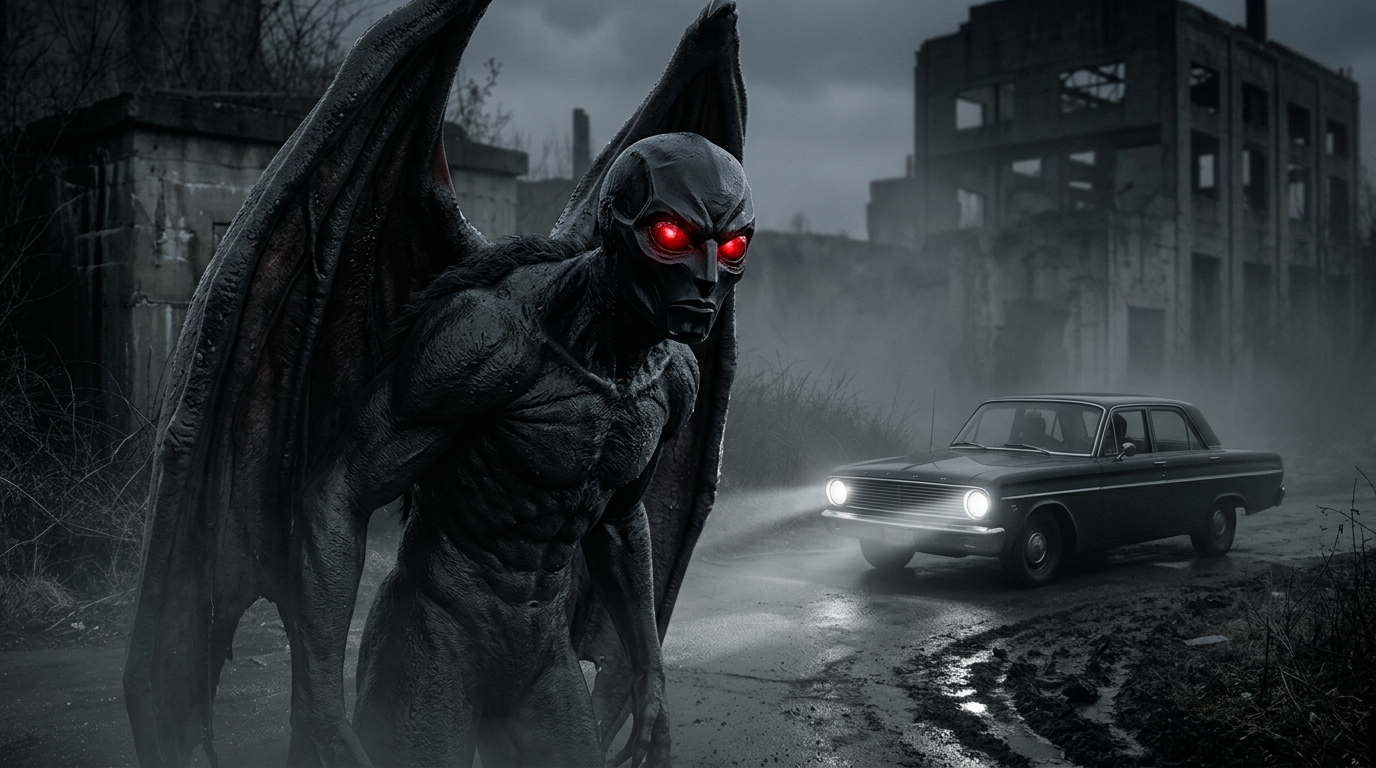
As roads improved and cars became common, encounters changed.
The creature increasingly appeared beside roads.
Crossing highways.
Flying above vehicles.
This mirrors other American monster traditions.
Mothman chases cars.
Bigfoot crosses roads.
Ghosts appear on highways.
The automobile changes folklore by creating a new boundary.
The witness is inside a safe, illuminated machine.
The monster is outside in darkness.
For a few seconds, their paths intersect.
Then both continue.
Could the Jersey Devil Be a Misidentified Deer?
Parts of the creature certainly resemble deer.
Long legs.
Hooves.
Large body.
A deer standing unexpectedly on its hind legs can appear bizarre.
In darkness, antlers could be confused with horns.
But deer do not have wings.
Again, this only becomes a problem if the witness accurately observed every feature.
A deer crossing a road while a large bird takes flight nearby could theoretically produce a combined impression.
Fear does not guarantee perfect visual parsing.
The brain is trying to identify threats quickly.
Not conduct taxonomy.
Two Animals Become One
This explanation is sometimes underrated.
Suppose a witness sees movement.
A deer bolts from brush.
At the same moment, a large owl or heron takes flight.
The witness sees:
Large body.
Hooves.
Wings.
Movement.
Darkness.
The events happen in seconds.
Later memory consolidates them into one object.
A winged animal with hooves.
This kind of perceptual fusion is entirely possible.
It does not explain every report.
It does demonstrate that bizarre anatomy need not exist physically for someone to remember seeing it.
The Kangaroo Shape
Many illustrations give the Jersey Devil a strongly kangaroo-like stance.
Large hind legs.
Small forelimbs.
Upright torso.
Long tail.
This was especially prominent during the 1909 panic.
The similarity may explain why a showman believed a kangaroo could pass as the captured Devil.
Once that hoax was displayed publicly, it may even have reinforced the kangaroo-like image further.
The fake monster helps shape the real legend.
Can a Legend Influence Future Sightings?
Absolutely.
This is one of the central facts of unexplained phenomena.
A witness does not experience the world without context.
If someone knows Mothman has red eyes, a red-eyed animal becomes Mothman-like.
If someone knows the Wendigo has antlers in modern art, an antlered silhouette becomes Wendigo-like.
If someone knows the Jersey Devil has wings and hooves, unusual movement in the Pine Barrens is interpreted through that image.
This does not mean witnesses are lying.
It means cultural expectations influence perception.
A Century of Feedback
The Jersey Devil has now existed within a feedback loop for more than a century.
Stories produce illustrations.
Illustrations shape expectations.
Expectations shape sightings.
Sightings produce news stories.
News stories reinforce the legend.
Films and television add new features.
New witnesses recognize those features.
The cycle repeats.
At some point, asking which detail was "original" becomes surprisingly difficult.
What Did People See in 1909?
Probably many different things.
That is the most defensible explanation.
Ordinary animal tracks.
Deliberately fabricated tracks.
Owls.
Cranes.
Dogs.
Deer.
Pranks.
Newspaper inventions.
Misidentifications.
Hoaxes.
And perhaps a small number of genuinely puzzling observations.
The great mistake is assuming one cause must explain every report.
A mass sighting wave is a social event.
Social events have multiple causes.
Could There Have Been an Unknown Animal Too?
It cannot be logically excluded.
Perhaps an unusual escaped animal contributed to some sightings.
Perhaps a rare bird wandered into the region.
Perhaps witnesses encountered something that was never identified.
But there is no physical evidence supporting a surviving unknown Jersey Devil species.
The unknown-animal hypothesis becomes weaker as it accumulates supernatural features.
A strange bird?
Plausible.
A three-hundred-year-old horse-headed bat dragon born from a cursed woman?
We have left zoology.
Why the 1909 Panic Ended
Mass panics are difficult to sustain.
People become bored.
Weather changes.
Tracks disappear.
Newspapers move to other stories.
Hoaxes are exposed.
Witness reports decline.
The creature that seemed ubiquitous for days suddenly becomes rare again.
That happened with the Jersey Devil.
The extraordinary wave faded.
The legend remained.
This pattern appears repeatedly in paranormal history.
Attention amplifies reports.
When attention fades, reports decline.
Whether the phenomenon caused the attention or the attention caused the phenomenon becomes difficult to separate.
The Devil Never Completely Leaves
After 1909, sightings returned periodically.
Not at the same intensity.
But often enough to keep the story alive.
One report every few years is enough.
A hunter hears something.
Teenagers see red eyes.
A driver sees wings.
Tracks appear.
A photograph goes viral.
The monster receives another generation.
Folklore does not require constant evidence.
It requires occasional reminders.
Does Anyone Still Believe?
Yes.
Some people interpret unusual experiences in the Pine Barrens as genuine encounters with the Jersey Devil.
Others treat the story primarily as cultural folklore.
Some cryptid researchers investigate sightings as possible evidence of an unknown creature.
Historians study the Leeds family and political origins.
Skeptics study misidentification and hoaxes.
Tourists buy shirts.
Hockey fans yell.
All of these groups participate in the legend differently.
None owns it completely.
What We Know About the Leeds Family
The Leeds family itself is not imaginary.
Daniel Leeds was real.
His almanacs were real.
His religious controversies were real.
His political connections were real.
Titan Leeds was real.
His rivalry with Benjamin Franklin was real.
Franklin really did satirically predict Titan's death and continue joking about him afterward.
The family's heraldic imagery really did include winged creatures.
These historical facts create an unusually rich foundation for the later folklore.
They do not prove a monster existed.
They show where a monster story could grow.
What We Know About 1909
The 1909 panic is also real.
Newspapers documented it extensively.
People reported tracks.
People reported creatures.
Newspapers published illustrations.
Reports spread across multiple states.
Public excitement became intense.
A commercial exhibition displayed a supposed captured Devil.
The captured animal was exposed as a hoax.
Those events are historical.
The question is what caused the individual sightings.
That remains much less certain.
What We Don't Know
We do not know whether one unusual animal triggered the 1909 panic.
We do not know who created every mysterious footprint.
We do not know which reports were sincere.
We do not know which were jokes.
We do not know which newspaper stories exaggerated witness claims.
We do not know precisely when the Mother Leeds story reached its modern form.
We do not know whether Deborah Leeds was truly the woman around whom that tradition developed.
And we do not know whether anyone has ever encountered something in the Pine Barrens that cannot be explained by known animals or ordinary human behavior.
Those uncertainties are where the legend lives.
The Jersey Devil Was Probably Not Born in 1735
At least not in the way the legend claims.
There is no credible evidence that a woman gave birth to a winged demon.
There is substantial evidence that a real Leeds family became associated with religious and political controversy.
That association involved devil imagery.
Over generations, the original disputes were forgotten.
Regional folklore preserved the name.
Then the monster developed.
The symbolic birth took centuries.
That may be less supernatural.
It is not less fascinating.
A Monster Created by Enemies
If the historical interpretation is correct, the Jersey Devil may be one of the rare monsters whose ancestry can be traced partly through political propaganda.
Daniel Leeds's enemies portrayed his ideas as dangerous.
The Leeds name became associated with Satan.
Benjamin Franklin continued mocking the family through Titan.
The family's own crest contributed dragon-like imagery.
Later storytellers transformed historical hostility into supernatural genealogy.
The monster may therefore have begun as something brutally human:
People hated one another.
Then they told stories about it.
The Forgotten Daniel Leeds
There is an irony here.
Millions know the Jersey Devil.
Far fewer know Daniel Leeds.
The monster consumed the man whose reputation may have helped create it.
His almanacs became obscure.
His religious disputes became specialist history.
His political controversies faded.
The Devil remained.
Folklore is extremely efficient at deciding which details deserve immortality.
Horse-headed flying demon:
Yes.
Seventeenth-century publishing dispute:
Apparently not.
Titan Leeds Loses Twice
Titan Leeds suffered an even stranger fate.
Benjamin Franklin jokingly declared him dead while he was alive.
Then history largely forgot him.
Then a monster possibly descended from his family's reputation became far more famous than his almanac.
For a professional publisher, this is an unfortunate long-term branding outcome.
Franklin won the rivalry fairly comprehensively.
Franklin's Joke Became Part of Something Bigger
Franklin could never have known what later folklore might do with the Leeds name.
His satire was commercial.
Political.
Comedic.
It belonged to the culture of eighteenth-century print.
Yet centuries later, historians examining a monster legend find him standing near its roots.
This is one reason the Jersey Devil is such a remarkable case.
The historical trail does not lead to one definitive hoaxer.
It leads to culture.
The Monster Doesn't Need to Exist
This may sound dismissive.
It is not.
The Jersey Devil does not need to be biologically real to have real effects.
People became frightened.
Newspapers sold stories.
Businesses profited.
Tourists traveled.
Historians researched.
Artists created images.
Sports teams adopted the name.
Generations of New Jersey children heard the story.
The creature shaped regional identity.
That is real.
Folklore can alter the world without possessing bones.
But What If Someone Really Saw Something?
That possibility remains.
The historical explanation for the legend does not automatically explain every reported encounter.
A legend can have invented origins and still become attached to genuine unexplained observations.
Someone in 1909 may have seen an unusual animal.
Someone later may have encountered something they sincerely could not identify.
The historical origin and the eyewitness question are separate.
Understanding Daniel Leeds does not identify every shadow in the Pines.
This Is Where Skepticism Should Stop
Skepticism should distinguish:
We can explain how the legend developed.
from:
We can explain every experience anyone has ever reported.
The first is possible.
The second is unrealistic.
Some reports lack enough information.
Some occurred too long ago.
Some witnesses are dead.
Some evidence was never preserved.
An unresolved sighting remains unresolved.
That does not transform it into a demon.
It means the evidence is insufficient.
Forbidden Lore does not need to fill every gap.
Sometimes the gap is the story.
The Pine Barrens at Night
Forget the historical argument for a moment.
Drive into the Pine Barrens after dark.
Leave the highway.
Take smaller roads.
The lights become fewer.
Trees close in.
The forest appears repetitive.
Pine trunks catch the headlights.
Everything beyond them disappears.
A deer moves unexpectedly.
An owl crosses the road.
Something screams from a swamp.
You cannot see what made it.
The legends make more sense here.
Not because the Jersey Devil must be real.
Because the landscape makes uncertainty easy.
A Monster Doesn't Need Much Light
Most Jersey Devil encounters happen under terrible observational conditions.
Night.
Distance.
Forest.
Brief exposure.
Fear.
Movement.
Those are exactly the conditions under which humans make identification errors.
They are also exactly the conditions required for good monster stories.
A creature standing calmly beneath stadium lighting for twenty minutes is useful to science.
A shape passing between pine trees at midnight is useful to folklore.
The Jersey Devil has generally preferred the second arrangement.
Why Nobody Finds It During the Day
Monster legends often depend on limited observation.
The creature appears briefly.
Runs.
Flies.
Disappears.
If it remained in daylight, witnesses could study proportions.
See feathers.
Identify species.
Take photographs.
Call wildlife authorities.
Mystery requires escape.
Whether by supernatural ability, ordinary animal behavior, or storytelling structure, the Jersey Devil always leaves before examination becomes comfortable.
The Devil as Memory
The Jersey Devil may also preserve a cultural memory of a region changing.
The Pine Barrens were once industrial.
Then industries declined.
Communities disappeared.
Forests reclaimed sites.
Old roads survived.
Stories remained.
A monster occupying abandoned landscapes becomes a way of giving those places continuity.
Buildings vanish.
Families leave.
The Devil stays.
The Protector of the Pines
Modern environmental interpretations take this idea further.
The creature that once represented danger inside the wilderness becomes the wilderness itself.
Development threatens the Pines.
Pollution threatens wetlands.
Roads fragment habitat.
The Devil becomes a guardian.
A warning against intrusion.
This version may be historically new.
It is emotionally powerful.
People often transform feared creatures into protectors when they begin fearing the loss of the landscape more than the landscape itself.
Monsters Change When We Change
In 1735, the Devil represented sin.
In 1909, it represented the terrifying unknown.
In the mid-twentieth century, it became a cryptid.
Later it became a mascot.
A tourist attraction.
An environmental symbol.
An internet meme.
The monster changes because the people telling the story change.
That is not corruption of folklore.
That is folklore.
The Real Jersey Devil Has Several Bodies
There is the supernatural child.
The colonial political insult.
The winged creature of 1909.
The kangaroo hoax.
The cryptid.
The hockey mascot.
The environmental guardian.
The thing in blurry photographs.
The monster children hear about.
All are Jersey Devils.
Asking which is the "real" one may therefore be the wrong question.
The legend survives precisely because it can become whatever a particular generation needs.
Could the Original Legend Have Involved a Child With a Birth Defect?
Some writers have suggested that Mother Leeds may have given birth to a child with a severe congenital condition.
In an eighteenth-century community, a visibly unusual birth might have attracted superstition.
The child could later have become the basis for a monster legend.
This is possible in the abstract.
There is no strong historical evidence demonstrating that such a child existed.
The theory also risks turning real disability into monstrous folklore without evidence.
It should therefore be treated cautiously.
Possible stories are not historical facts merely because they sound plausible.
The Witch Version
Another version makes Mother Leeds a witch.
This simplifies the supernatural mechanics.
A witch curses her child.
The child becomes demonic.
But labeling inconvenient or unusual women as witches is one of the oldest tools in Western folklore.
The witch detail may simply have attached itself later because the monster required a supernatural mother.
No documentation establishes that the historical Deborah Leeds practiced witchcraft.
The legend does not need her permission.
The Devil as Father
Some versions go further.
The father of the thirteenth child is Satan himself.
That transforms the creature from cursed human into literal demonic offspring.
Again, this appears to be legendary elaboration.
Once storytellers decide a child becomes a devil, assigning Satan paternity is almost inevitable.
Folklore rarely leaves a dramatic possibility unused.
The Midwife
The midwife sometimes appears in modern retellings.
She assists with the birth.
The child transforms.
The creature attacks her.
In some versions, it kills her.
This detail makes the story more cinematic.
But the identity of the supposed midwife changes or disappears depending on the version.
No reliable contemporary birth record describes a midwife being killed by a flying newborn monster near Leeds Point.
That would probably have generated paperwork.
The Chimney Scratches
Some versions claim physical marks remained on the Leeds house chimney after the creature escaped.
Locations have occasionally been promoted as the alleged birthplace.
Again, the evidence is weak.
Old houses accumulate scratches.
Burn marks.
Structural changes.
And legends.
A physical mark becomes compelling once someone explains what caused it.
Without that story, it is just damage.
The Problem of the Original House
Claims about the exact birthplace are complicated by the passage of time.
Buildings disappear.
Are rebuilt.
Are replaced.
Properties change owners.
Later residents promote connections.
The desire to identify a physical birthplace is understandable.
Tourists like locations.
Folklore likes addresses.
History is often less cooperative.
There is no universally authenticated Jersey Devil delivery room preserved from 1735.
Leeds Point
The geographic name Leeds Point itself helps keep the legend grounded.
This is not a fictional town.
The Leeds name remains embedded in the landscape.
Visitors can travel there.
That physical reality reinforces the Mother Leeds story.
The place exists.
The family existed.
The monster feels one step closer to historical.
But geography confirms the Leeds family's regional presence.
It does not confirm supernatural childbirth.
The Devil's Footprints
The alleged tracks remain some of the most memorable evidence from 1909.
If photographs truly show unusual prints, that demonstrates only that unusual prints existed.
To establish the Jersey Devil, investigators would need to demonstrate:
The tracks came from an unknown creature.
They were not altered by weather.
They were not ordinary animal tracks.
They were not fabricated.
They were made by the same thing witnesses saw.
And that thing possessed the other reported characteristics.
That chain is much harder than simply photographing a mark in snow.
Rooftop Tracks
Reports of tracks crossing rooftops sound especially supernatural.
A hoofed terrestrial animal should have trouble reaching roofs.
A flying creature could land there.
Therefore:
Jersey Devil.
But people can place tracks on roofs.
Birds can create marks.
Snow can fall or slide strangely.
Prints can be misinterpreted.
And newspaper reporting during a panic is not controlled forensic documentation.
The impossible trail is only as strong as the observation establishing it.
Did Schools Really Close?
The claim that schools closed because of the Jersey Devil appears frequently in modern retellings of the 1909 panic.
Contemporary reporting does support significant public fear and disruptions in some places.
But later summaries often compress separate claims into a larger image of statewide shutdown.
That should be resisted.
New Jersey did not enter a monster emergency under martial law.
There was a real panic.
There was also later exaggeration.
Both can be true.
Did Factories Close?
Similar claims describe workers refusing to enter mills or factories because they feared attacks.
Again, contemporary newspapers reported considerable anxiety.
But every later anecdote should not be treated as independently verified.
Sensational reporting rewards exactly these stories.
"The Devil may have been seen again" is news.
"Everyone went to work normally" is less exciting.
Historical source selection can therefore make a panic look even more universal than it was.
The Monster and the Media
This does not mean newspapers simply invented the Jersey Devil.
Media and folklore interact.
Witnesses provide reports.
Newspapers amplify them.
Readers reinterpret experiences.
New reports appear.
Newspapers publish those.
The loop accelerates.
Modern social media produces the same process much faster.
The Jersey Devil panic was essentially a viral event before the word viral meant anything except disease.
1909 Was an Internet Panic Without the Internet
Think about the mechanics.
A strange report appears.
People share it.
More witnesses emerge.
Images circulate.
Theories proliferate.
Pranksters participate.
Businesses monetize it.
Fake evidence appears.
People argue.
Authorities comment.
The story spreads geographically.
Everyone becomes temporarily obsessed.
Then attention collapses.
Replace newspapers with TikTok and Reddit and the structure looks remarkably modern.
Human beings did not need the internet to behave like the internet.
Why This Monster Won
New Jersey undoubtedly possessed other local legends.
Most never became internationally famous.
The Jersey Devil had advantages.
A memorable name.
A vivid visual design.
A perfect habitat.
A historical family connection.
A sensational sighting wave.
Newspaper coverage.
Commercial exploitation.
And enough ambiguity to avoid resolution.
A monster that is conclusively identified becomes trivia.
A monster that remains almost identifiable becomes folklore.
The Perfect Amount of Evidence
The Jersey Devil has enough evidence to remain interesting.
Historical newspaper reports.
Witness accounts.
Photographs of alleged tracks.
A real family.
A real place.
A major public panic.
Later sightings.
But not enough evidence to settle the central question.
No body.
No DNA.
No definitive photograph.
No original 1735 documentation.
That balance is ideal.
Too little evidence and nobody cares.
Too much and the mystery disappears.
The Jersey Devil lives in the middle.
The Most Likely History
The strongest historical reconstruction is not supernatural.
A prominent Leeds family became involved in intense religious and political disputes in colonial New Jersey.
Daniel Leeds was condemned by opponents.
The family's name became associated with satanic language.
Titan Leeds became the target of Benjamin Franklin's famous death satire.
The family's heraldry included winged dragon-like imagery.
Over generations, those historical disputes faded from memory.
A regional Leeds Devil tradition developed.
Stories connected it with the Pine Barrens.
The Mother Leeds birth narrative provided an origin.
Then the 1909 newspaper panic transformed the creature into the standardized Jersey Devil.
That explanation accounts for the legend.
It does not require the creature itself.
The Most Likely Explanation for the Sightings
There probably is no single explanation.
Known animals.
Misidentification.
Pranks.
Hoaxes.
Weather-altered tracks.
Newspaper exaggeration.
Cultural expectation.
And occasional genuinely unexplained observations likely contributed at different times.
The mistake is searching for one ordinary animal that looks exactly like every Jersey Devil description.
No such animal exists because the descriptions themselves do not match one another.
The phenomenon is cultural before it is zoological.
Could Something Still Be Out There?
The Pine Barrens contain real wildlife.
Some of it is difficult to observe.
New species continue to be discovered around the world.
So it would be foolish to claim humanity has catalogued every living thing perfectly.
But extraordinary claims require proportionate evidence.
A small unknown insect in the Pinelands?
Entirely plausible.
A previously undocumented bat-winged, hoofed vertebrate large enough to terrify motorists and survive for generations without leaving biological remains?
Much less so.
The probability is not zero because science rarely offers zero.
It is simply very small.
The Supernatural Question
Science cannot meaningfully test every version of the supernatural Jersey Devil.
A demon that appears selectively, vanishes, lives indefinitely, and leaves no necessary physical evidence is not a conventional scientific hypothesis.
That does not make belief meaningless.
It places the claim within religion, folklore, personal experience, and metaphysics rather than zoology.
People are free to believe the Jersey Devil is supernatural.
Evidence cannot currently demonstrate that belief as physical fact.
Was Mother Leeds Real?
A Leeds woman with a large family almost certainly existed.
Deborah Leeds is a plausible historical figure behind aspects of later tradition.
But the leap from:
A woman named Leeds had twelve children
to:
Her thirteenth transformed into a winged demon
is precisely where history ends and folklore begins.
That boundary should remain visible.
The real history is strange enough.
Did Benjamin Franklin Create the Jersey Devil?
No.
But he may have contributed indirectly to the cultural environment from which the legend emerged.
His feud with Titan Leeds helped preserve the Leeds family's association with death, astrology, ridicule, and supernatural language.
Later generations forgot the joke.
The family name survived.
Folklore did the rest.
Franklin helped create many things.
A monster may be one of his least intentional contributions.
Did Newspapers Create the Jersey Devil?
Not entirely.
The Leeds Devil existed beforehand.
But newspapers in 1909 dramatically reshaped and popularized the creature.
They standardized imagery.
Amplified sightings.
Expanded the geographic range.
Turned local folklore into regional mass culture.
And provided commercial opportunities.
Without 1909, the Jersey Devil might remain an obscure Pine Barrens legend known mainly to folklorists.
The newspapers gave it wings.
Metaphorically.
The monster already had enough literal ones.
Did a Kangaroo Create the Modern Image?
The fake captured Devil probably reinforced the popular image.
But it was responding to descriptions already circulating.
The relationship runs both ways.
Witness reports made the kangaroo seem plausible.
The kangaroo then made a kangaroo-like Devil seem familiar.
Hoaxes do not merely exploit folklore.
Sometimes they become part of it.
The Monster That Survived Its Explanations
The Jersey Devil has now survived:
Historical research.
Zoological theories.
Exposed hoaxes.
Mass-hysteria explanations.
Modern photography.
Environmental study.
Urban development.
Tourism.
Professional sports.
And the internet.
Each explanation removes one layer.
The legend simply continues through another.
That resilience is more interesting than whether an owl once frightened someone in 1909.
What the Jersey Devil Really Haunts
The traditional answer is the Pine Barrens.
But culturally, the Jersey Devil haunts something broader.
The boundary between history and folklore.
There was a real Leeds family.
Then there were stories about them.
There were real political fights.
Then supernatural insults.
There were real newspaper reports.
Then mass panic.
There were real animals.
Then monsters.
There were real hoaxes.
Then traditions.
Every layer contains enough reality to support the next.
That is how a legend becomes difficult to dismantle.
The Mother, the Almanac, and the Kangaroo
Most monster legends do not involve such a spectacular collection of historical ingredients.
A woman with twelve children.
A heretical almanac maker.
Angry Quakers.
A controversial royal governor.
Benjamin Franklin trolling a dead rival.
Dragon heraldry.
A remote forest.
Hoofprints on rooftops.
Police with guns.
Frightened dogs.
A kangaroo wearing fake wings.
And a hockey team.
If someone submitted that as fiction, an editor might suggest removing a few elements.
History showed less restraint.
The Real Story Is Better Than the Simplified One
The Mother Leeds story is excellent folklore.
But the historical development is arguably stranger.
A family becomes controversial.
Opponents call them satanic.
A son gets into an almanac war with Benjamin Franklin.
The family's symbol contains winged monsters.
Their name becomes connected with a regional Devil.
The original context is forgotten.
A birth legend appears.
Newspapers create a panic.
Artists define the creature.
A hoaxer adds wings to a kangaroo.
The whole state eventually adopts the monster.
That is not one person's invention.
It is cultural evolution.
Was the Jersey Devil Real?
The answer depends on what is meant by real.
Was there a real Leeds family whose history probably contributed to the legend?
Yes.
Did members of that family participate in documented religious and political conflicts?
Yes.
Did Benjamin Franklin feud publicly with Titan Leeds?
Yes.
Did people report a creature known as the Leeds Devil?
Yes.
Did an extraordinary wave of sightings and mysterious-track reports occur in January 1909?
Yes.
Did newspapers document public excitement and fear?
Yes.
Did hoaxers exploit that panic?
Yes.
Have people continued reporting strange encounters in the Pine Barrens?
Yes.
Is there scientifically verified evidence for a three-hundred-year-old supernatural horse-headed creature with bat wings and cloven hooves?
No.
Is there verified evidence of an unknown biological species matching the classic Jersey Devil?
No.
The history is real.
The legend is real.
The creature remains unverified.
The Most Important Question
Maybe the question is not:
What animal was the Jersey Devil?
Maybe it is:
How did so many different things become the Jersey Devil?
A political enemy.
A religious heretic.
A family crest.
A cursed child.
A strange bird.
A footprint.
A newspaper illustration.
A prank.
A kangaroo.
A regional identity.
The monster is not one thing.
It is what remained after centuries of stories accumulated around the same name.
Somewhere in the Pines
Still, folklore has never depended entirely upon scholarly explanations.
Drive through the Pine Barrens after midnight.
Turn away from the main road.
Stop the car.
Switch off the engine.
The darkness arrives immediately.
Wind moves through the pines.
Something splashes in water.
A distant animal cries.
You know there are ordinary explanations.
Owls.
Foxes.
Deer.
Coyotes.
Branches.
Wind.
Then something screams again.
Closer.
You look toward the trees.
For a moment, there is movement.
Too tall.
Maybe.
Something passes between two trunks.
Then nothing.
You tell yourself it was a deer.
Probably.
You start the car anyway.
Because whether Daniel Leeds was unfairly attacked by Quakers three hundred years ago suddenly feels less important than it did ten minutes earlier.
That is the final advantage the Jersey Devil has over historians.
History can explain where the legend came from.
It cannot stand beside you in the dark and tell you exactly what just moved behind the trees.
And as long as the Pine Barrens still contain places where something can disappear before you identify it, New Jersey's Devil still has somewhere to live.
Sources and Further Reading
- New Jersey State Government — New Jersey Devil
- New Jersey Pinelands Commission — The Legend of the Jersey Devil
- New Jersey Historical Society — Legend of the New Jersey Devil
- New Jersey Humanities — The Jersey Devil in Myth and History
- Brian Regal — The Jersey Devil: The Real Story, Skeptical Inquirer
- Johns Hopkins University Press — The Secret History of the Jersey Devil: How Quakers, Hucksters, and Benjamin Franklin Created a Monster
- Johns Hopkins University Press — The Jersey Devil in the Twenty-First Century
- Library of Congress — Snallygasters and Cadborosauruses: Exploring American Cryptids with Chronicling America
- The Philadelphia Inquirer — The Jersey Devil and the 1909 Sightings
- The Philadelphia Inquirer — Jersey Devil Seen by Many, Reportedly Caught 100 Years Ago
- New Jersey Pinelands Commission — History of the Pinelands
- New Jersey Historical Commission — New Jersey Folklore and Folk Art
- Brian Regal and Frank J. Esposito, The Secret History of the Jersey Devil: How Quakers, Hucksters, and Benjamin Franklin Created a Monster (Johns Hopkins University Press, 2018)
- James F. McCloy and Ray Miller Jr., The Jersey Devil (Middle Atlantic Press, 1976)
- James F. McCloy and Ray Miller Jr., Phantom of the Pines: More Tales of the Jersey Devil
- David Steven Cohen, The Folklore and Folklife of New Jersey (Rutgers University Press, 1983)