Spring-Heeled Jack: The Leaping Terror of Victorian London
Before Jack the Ripper stalked Whitechapel, London had another Jack.
This one was stranger.
Beginning in 1837, stories spread around the outskirts of the city about a mysterious man—or creature—appearing suddenly on dark roads.
He frightened pedestrians.
Attacked women.
Leapt over walls.
Escaped pursuers.
Witnesses struggled to describe him.
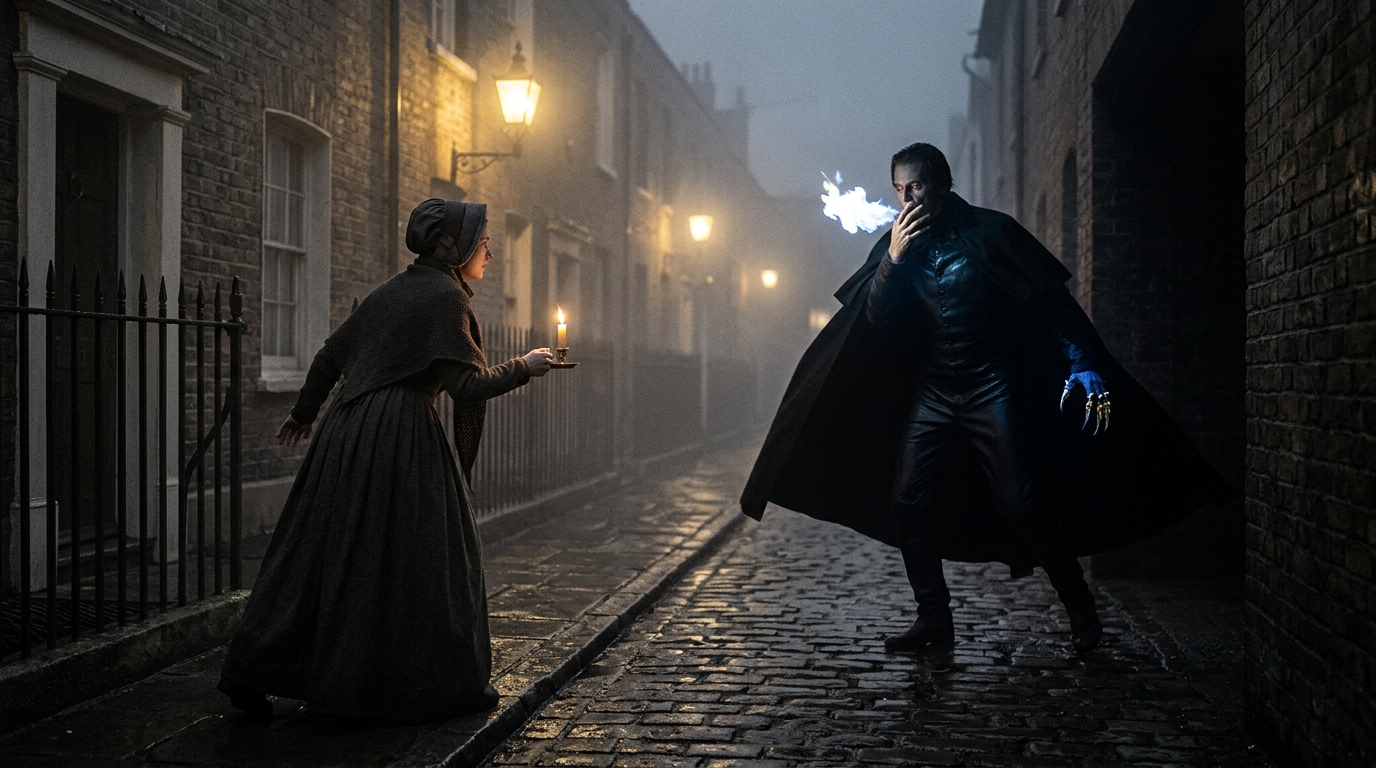
Some said he was a tall man wrapped in a dark cloak.
Others described a devil.
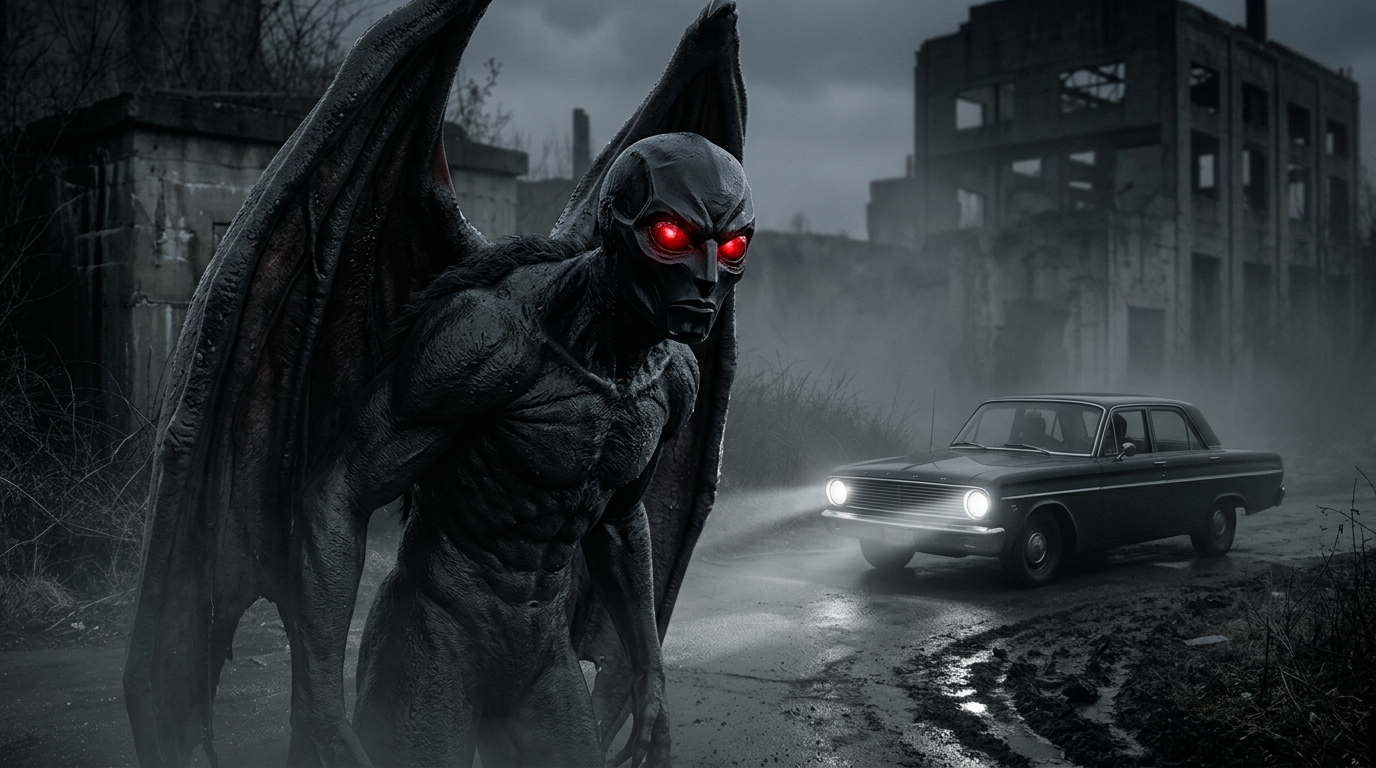
His eyes supposedly glowed.
His hands ended in claws.
He wore something tight and shining beneath his cloak.
And, according to two of the most famous witnesses, he could produce blue or white flame from his mouth.
Then there were the jumps.
Spring-Heeled Jack supposedly cleared walls that should have stopped a normal man.
He bounded across roads.
He escaped over rooftops.
Later stories gave him increasingly impossible abilities.
He became less like a criminal and more like something that had wandered into Victorian England from another category of existence entirely.
The newspapers gave him a name.
Spring-Heeled Jack.
London became fascinated.
And frightened.
The Lord Mayor publicly addressed the panic.
Police investigated attacks.
Newspapers printed descriptions.
Young women reported being assaulted.
Rumors spread that a wealthy aristocrat had made a wager to terrorize the city.
Then Spring-Heeled Jack escaped the limits of the original incidents.
He appeared in plays.
Cheap serialized fiction.
Penny dreadfuls.
Illustrations.
Children's stories.
Newspaper reports from other cities.
By the late nineteenth century, Jack was no longer merely an unidentified attacker.
He had become folklore.
The problem is figuring out where the man ended and the monster began.
Because buried underneath more than a century of supernatural embellishment are several incidents that really were reported at the time.
Young women really did complain of attacks.
London really did become alarmed.
Authorities really did discuss the mysterious figure.
And nobody was conclusively identified as Spring-Heeled Jack.
London Before Jack
The London of the late 1830s was enormous, crowded, rapidly expanding and unevenly illuminated.
Gas lighting existed, but it did not turn Victorian London into Times Square.
Away from major streets, darkness remained darkness.
The edges of the metropolis were particularly useful places for frightening people.
Fields.
Lanes.
Gardens.
Walls.
Alleys.
Small villages being absorbed into London's expansion.
A person walking home at night could quickly find themselves alone.
There were no security cameras.
No smartphones.
No electric streetlights flooding every corner.
And if a stranger jumped from behind a wall wearing a cloak and pretending to be the Devil, forensic resources were limited.
This was excellent news for anyone considering such a career.
The First Rumors
Stories of a strange attacker began circulating around London in late 1837.
The earliest reports were not yet the fully developed Spring-Heeled Jack of later legend.
They concerned a man frightening people—particularly women—in isolated places around the outskirts of the metropolis.
Descriptions varied.
A figure in a cloak.
A ghost.
A devil.
A man wearing unusual clothing.
Someone capable of surprising jumps.
One account described a young woman being grabbed by a figure who then escaped over a wall.
Other rumors became increasingly dramatic.
The attacker had claws.
He had horns.
His eyes glowed.
He breathed fire.
He could jump impossible distances.
London was constructing a monster in real time.
Mary Stevens
One of the incidents traditionally placed near the beginning of the legend involves a servant girl named Mary Stevens.
According to later accounts, Stevens was walking through Clapham after visiting her parents when a figure suddenly emerged from the darkness.
The attacker grabbed her.
He allegedly kissed her.
Tore at her clothing.
And touched her with hands she described as cold and claw-like.
She screamed.
People nearby rushed toward her.
The attacker escaped.
The next day, another strange encounter supposedly occurred nearby when a figure jumped into the path of a carriage.
The driver lost control.
The attacker escaped by leaping over a wall.
These stories are frequently repeated as the beginning of Spring-Heeled Jack's career.
But the documentary trail becomes stronger as the panic moves into 1838.
That is when Jack stops being merely a collection of rumors.
He enters the public record.
A Letter Reaches the Lord Mayor
In January 1838, the Lord Mayor of London, Sir John Cowan, received a letter concerning the mysterious attacks.
The anonymous writer claimed that a group of wealthy young men had made a wager.
According to the allegation, one of them had accepted a challenge to visit villages around London disguised in different costumes.
A ghost.
A bear.
A devil.
The purpose was supposedly to frighten people.
Especially women.
The letter suggested that several victims had already been badly affected.
Whether the writer possessed genuine inside information is unknown.
But the Lord Mayor took the matter seriously enough to discuss it publicly.
That changed the story.
The Lord Mayor Speaks
At first, Cowan reportedly suspected exaggeration.
Understandably.
London officials probably received many strange complaints.
A jumping demon terrorizing suburban lanes would not immediately rank high on a sensible municipal agenda.
But other people came forward.
Reports accumulated.
The press became interested.
The mysterious attacker was no longer merely neighborhood gossip.
Something—or several somethings—was frightening Londoners.
The authorities wanted whoever was responsible caught.
The public wanted to know who it was.
The newspapers wanted copies sold.
Spring-Heeled Jack was ready.
The Name
Exactly when the name became fixed is difficult to reduce to a single moment.
But by early 1838 the mysterious attacker was being widely associated with the name:
Spring-Heeled Jack.
It was perfect.
"Jack" was already useful English shorthand for a mysterious male figure.
And the defining ability was right there in the first half.
He sprang.
He jumped.
He escaped.
Later generations would imagine literal mechanical springs attached to his boots.
The earliest stories did not necessarily require them.
The name described the effect.
Not the engineering.
February 19, 1838
Then came the case that made Spring-Heeled Jack famous.
On the evening of February 19, 1838, eighteen-year-old Jane Alsop was at her family's home in the Old Ford area of east London.
There was a knock at the door.
Outside stood a man.
He claimed to be a police officer.
He said something extraordinary had happened nearby.
Spring-Heeled Jack had been caught.
He needed a light.
Jane went to help.
She brought him a candle.
Then the situation changed completely.
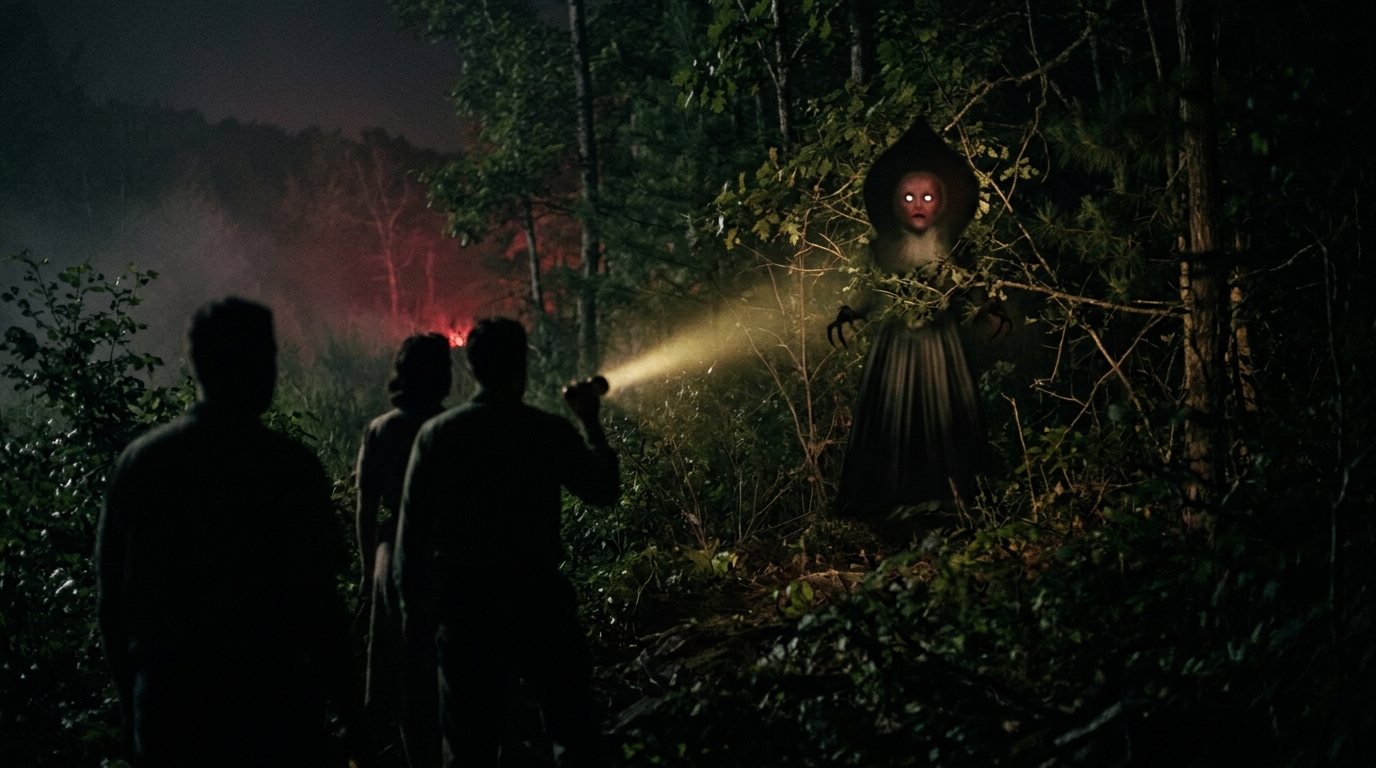
Jane Alsop Meets Jack
According to Jane's account, the stranger was wearing a large cloak.
Once she approached with the candle, he threw it aside or opened it.
What she saw beneath terrified her.
The man appeared to be wearing a tight-fitting garment.
Later descriptions compared the material to white oilskin.
His appearance was hideous.
His eyes resembled fiery red balls.
Then flame emerged from his mouth.
Blue and white flame.
Jane tried to escape.
The stranger grabbed her.
The Claws
Jane reported that the attacker tore at her clothing.
His hands seemed to possess claws.
Not fingernails.
Something harder.
She believed they were made from a metallic substance.
The attacker scratched or tore at her neck and arms.
Jane screamed.
She struggled toward the house.
Her sisters heard her.
One came to help.
The attacker released Jane and fled.
Spring-Heeled Jack had just moved from rumor to a named victim reporting a violent assault.
And the newspapers noticed.
What Jane Actually Described
The details matter because later artwork transformed Jack into a fully supernatural demon.
Jane's account can also be read another way.
A man.
A cloak.
A tight costume.
A helmet or unusual head covering.
Artificial claws.
A device capable of producing flame.
Nothing in that list necessarily requires the supernatural.
Extremely strange?
Yes.
Dangerous?
Absolutely.
Impossible?
Not necessarily.
The jumping is not even the most important part of Jane Alsop's encounter.
The famous attack is fundamentally the story of a disguised man using theatrical effects.
If Jane saw what she believed she saw, someone may have constructed a costume specifically to terrify people.
Fire-Breathing
The blue flame sounds impossible until we remember that Victorian entertainers already understood ways to produce dramatic fire effects.
Fire-eating was known.
Chemical compounds could produce colored flames.
Alcohol could burn blue.
Stage performers created effects that seemed supernatural to audiences.
A wealthy prankster or theatrical-minded criminal could conceivably produce a short burst of flame without possessing demonic respiratory anatomy.
That does not prove this happened.
But it removes one of Jack's supposed supernatural abilities from the category of absolute impossibility.
He may not have breathed fire.
He may have performed it.
Nine Days Later
On February 28, 1838, another young woman encountered a strange man in east London.
Her name was Lucy Scales.
She was eighteen.
Lucy and her sister had been visiting their brother, a butcher in Limehouse.
That evening, they left his home and walked through Green Dragon Alley.
A man stood ahead of them.
He wore a cloak.
Lucy approached.
Then he turned toward her.
Lucy Scales
According to the account later reported in the press, the man released a quantity of blue flame toward Lucy's face.
She was temporarily unable to see.
She collapsed.
Violent fits followed.
Her sister screamed.
Their brother heard the commotion and ran toward them.
He found Lucy on the ground.
The attacker had already walked away.
This time, unlike Jane Alsop's encounter, the stranger apparently did not physically grab the victim.
The flame itself was enough.
The Description
Lucy's sister described the man as:
Tall.
Thin.
Gentlemanly in appearance.
Covered by a large cloak.
He carried a small lamp resembling the sort used by police.
That description is interesting.
No enormous monster.
No giant bat wings.
No hooves.
No supernatural body.
A tall, thin man in a cloak.
The bizarre feature was the flame.
This again suggests that whatever stood behind at least some early Spring-Heeled Jack reports may have been human.
A deeply unpleasant human.
But human.
Two Women, Similar Details
Jane Alsop and Lucy Scales did not describe identical encounters.
But the overlap is significant.
Young women.
East London.
Night.
Tall or unusual man.
Large cloak.
Blue flame.
The incidents occurred only nine days apart.
This is much stronger than connecting unrelated sightings separated by decades.
Either:
The same person attacked both women.
One incident influenced the reporting or interpretation of the other.
A copycat was involved.
Or coincidence produced an extremely strange overlap.
The first possibility is difficult to ignore.
The Police Search
Police attempted to identify the attacker.
People were questioned.
Suspects were considered.
No one was conclusively proven to be Spring-Heeled Jack.
One man reportedly accused in connection with the Alsop assault was released because aspects of his appearance did not fit the description.
The problem was obvious.
If Jack was wearing a disguise, eyewitness identification became difficult.
Remove the cloak.
Remove the claws.
Remove whatever produced the flame.
Now he was simply another Victorian man.
London had quite a few.
Was Spring-Heeled Jack One Person?
This is the question underneath the entire legend.
The simplest popular version assumes:
One mysterious attacker.
Active for decades.
Possessing the same strange abilities.
But the historical record does not require that.
"Spring-Heeled Jack" could have been a label applied to multiple things.
An original prankster.
Copycats.
Ordinary criminals.
Misidentified people.
Folkloric rumors.
Later hoaxes.
Fictional embellishments.
Once the name existed, any strange nocturnal figure capable of jumping could become Jack.
The monster did not need one body.
It had a brand.
The Aristocratic Wager
The anonymous letter to the Lord Mayor suggested that wealthy young men were responsible.
This theory made sense to many Victorians.
An elaborate costume required money.
Special equipment required money.
Leisure time helped.
So did the confidence to attack strangers while assuming one might avoid serious consequences.
Then suspicion settled on one aristocrat in particular.
And he was almost suspiciously well qualified.
Henry de La Poer Beresford
Henry de La Poer Beresford, the 3rd Marquess of Waterford, was born in 1811.
He was wealthy.
Young.
Privileged.
And notorious.
He acquired the nickname:
The Mad Marquess.
Waterford became famous for drunken behavior, vandalism, fights and elaborate practical jokes.
He was exactly the sort of person people could imagine dressing like a demon and jumping out at women.
This is not evidence.
But as suspect profiles go, it is unusually convenient.
The Mad Marquess
Waterford's behavior was not merely eccentric.
He repeatedly got into serious trouble.
He participated in drunken rampages.
Fought.
Damaged property.
Played cruel jokes.
His reputation became notorious enough that contemporary newspapers regularly reported his behavior.
One famous incident occurred in Melton Mowbray in 1837.
Waterford and companions went on a destructive nighttime spree.
Property was damaged.
People were harassed.
Red paint became involved.
A lot of red paint.
Painting the Town Red
Waterford is often credited with inspiring the expression "paint the town red."
The story says that during the Melton Mowbray rampage, Waterford and his friends literally painted doors, signs and other property red.
The incident itself is historical.
The claim that it directly created the modern phrase is much shakier; the expression appears to have become associated with the episode retrospectively.
This is a useful warning.
Even stories about the man suspected of becoming folklore can themselves become folklore.
Spring-Heeled Jack has layers.
Was Waterford Jack?
The theory is tempting.
Waterford enjoyed frightening people.
He had money.
He had a history of reckless pranks.
He was young and athletic.
He possessed the social privilege necessary to behave outrageously and survive the consequences.
He was associated with London during the general period when the panic developed.
Later writers explicitly identified him as Spring-Heeled Jack.
But there is no confession.
No recovered Jack costume.
No claws.
No spring boots.
No diary entry saying:
Frightened three women tonight. Excellent evening.
The case is circumstantial.
The Waterford Problem
There is another problem.
Spring-Heeled Jack continued appearing after Waterford stopped behaving like the Mad Marquess.
Waterford married in 1842.
His reputation improved substantially.
He died in 1859 after a horse-riding accident.
Jack did not receive the memo.
Reports associated with Spring-Heeled Jack continued after Waterford's death.
Sometimes decades after.
If every report describes the same literal being, Waterford cannot explain them.
But if Spring-Heeled Jack became an identity used by copycats and folklore?
Then Waterford could theoretically explain early incidents without explaining later ones.
That possibility cannot be ruled out.
It also cannot be proven.
An Extremely Imitable Monster
Once newspapers told people how Spring-Heeled Jack behaved, imitation became easy.
You needed:
A cloak.
A frightening mask.
Perhaps artificial claws.
Maybe some theatrical fire effect.
And confidence in your ability to run.
You did not even need springs.
Jump over a wall and let the witness improve the height afterward.
Now London contained instructions for creating its own monster.
This is one reason the later sightings are so difficult to evaluate.
Jack could reproduce without biology.
Did He Really Have Springs in His Boots?
Probably not.
At least there is no physical evidence of elaborate spring-loaded footwear.
Later artwork often depicts Jack with mechanisms attached to his boots.
The technology sounds wonderfully steampunk.
Victorian rocket boots before rocket boots.
But mechanically, the idea is problematic.
Springs strong enough to launch a person several meters into the air would also need to be controlled.
Landing would be worse.
A device capable of producing the legendary jumps might launch its wearer spectacularly.
Once.
The next event would be orthopedic.
Extraordinary Jumping Without Machinery
A physically capable person can clear obstacles that look impressive to frightened witnesses.
Walls may be lower than remembered.
Distances may grow in retelling.
Darkness makes trajectories difficult to judge.
If Jack disappeared behind a wall, a witness might assume he jumped cleanly over it even if he climbed.
A running leap by an athletic person could become an impossible bound by the time the story reached a newspaper.
Folklore adds excellent suspension.
No springs required.
Or He Never Jumped That High
This possibility deserves more attention.
Spring-Heeled Jack's defining characteristic may be partly retrospective.
The early rumors certainly emphasized unusual leaping.
But the truly impossible jumps became more spectacular as the legend developed.
Later Jack could leap over buildings.
Across streets.
Onto rooftops.
The name itself encouraged exaggeration.
Once everyone knows you as Spring-Heeled Jack, disappointing jumps are bad for the brand.
A Monster Built by Newspapers
The Victorian press loved sensational crime.
Spring-Heeled Jack offered something better than ordinary crime.
Mystery.
Violence.
Supernatural possibility.
A recurring villain.
Each new report could reference previous incidents.
Readers already knew the character.
This structure looks remarkably modern.
Spring-Heeled Jack was essentially a nineteenth-century recurring media franchise.
Except nobody owned the rights.
Yet.
Then Fiction Took Him
It did not take long.
Spring-Heeled Jack began appearing in theatrical productions and cheap popular literature.
By the 1840s, fictional versions were already developing.
Later came increasingly elaborate penny dreadfuls.
These serialized stories transformed Jack.
The frightening attacker became a character.
Sometimes a villain.
Sometimes an antihero.
Sometimes almost a Victorian superhero.
Historical Spring-Heeled Jack and fictional Spring-Heeled Jack began merging.
This permanently contaminated the evidence.
Penny Dreadfuls
Penny dreadfuls were inexpensive serialized stories aimed largely at working-class readers.
Crime.
Adventure.
Horror.
Sensationalism.
Exactly the environment Spring-Heeled Jack needed.
Writers gave him motivations.
Secret identities.
Technology.
Costumes.
Adventures.
The mysterious attacker became narrative property.
Once millions of readers had encountered fictional Jack, future witnesses already knew what they were supposed to see.
Folklore had acquired illustrations.
Jack Becomes a Hero
One of the strangest transformations was Jack's movement from monster toward antihero.
Some fictional versions portrayed him as a wronged aristocrat using his extraordinary abilities against villains.
Instead of attacking women in lanes, Jack fought injustice.
This was quite a career rehabilitation.
The historical figure had allegedly assaulted teenagers.
The fictional figure became heroic.
Victorian popular culture had discovered the reboot.
Fiction Creates Memory
This creates a serious historical problem.
Suppose someone in 1880 remembered hearing about Spring-Heeled Jack when they were young.
What exactly were they remembering?
Newspaper reports?
Family stories?
A stage play?
A penny dreadful illustration?
Something that actually happened nearby?
After several decades, those sources could merge.
The Spring-Heeled Jack people remembered was not necessarily the Spring-Heeled Jack of 1838.
He had been rewritten too many times.
The Devil Appearance
Later descriptions increasingly gave Jack explicitly supernatural features.
Horns.
Pointed ears.
Cloven feet.
Bat-like characteristics.
Glowing eyes.
A demonic face.
These details fit Victorian supernatural imagery perfectly.
They also fit theatrical costumes perfectly.
The two explanations are not mutually exclusive.
A prankster trying to look demonic would use the same cultural imagery later witnesses used to describe a demon.
Jack may have looked like the Devil because someone wanted him to.
The Eyes
Glowing red eyes became one of his signature features.
This is another detail that sounds supernatural but does not necessarily require it.
Reflective lenses.
Colored glass.
Lantern effects.
Firelight.
Memory.
Exaggeration.
Or simply an expression describing terrifying eyes rather than literal illumination.
Later illustrations made the glow physical.
Once again:
Language became anatomy.
The Claws
Jane Alsop's description is especially interesting because she believed the claws were metallic.
That sounds manufactured.
Not biological.
If accurate, this strongly supports disguise or equipment.
A supernatural monster could theoretically possess metal claws.
But at that point the explanation is doing unnecessary work.
A man can buy or make metal.
Demons have more complicated procurement procedures.
The Tight Clothing
The strange tight-fitting clothing beneath Jack's cloak also sounds theatrical.
It may have been oilskin.
A costume.
Protective clothing associated with whatever fire effect he used.
Later illustrations turned it into a sleek supernatural suit.
Modern readers sometimes see something almost science-fictional in the description.
Alien.
Time traveler.
Advanced technology.
But nothing about tight nineteenth-century clothing requires visitors from the future.
Victorians had tailoring.
Was Spring-Heeled Jack a Serial Sexual Predator?
Strip away the supernatural imagery and the early incidents become darker.
Young women walking alone.
A male attacker.
Grabbing.
Kissing.
Tearing clothing.
Scratching bodies.
Targeting isolated locations.
Using disguise.
This looks less like paranormal activity and more like predatory assault.
The monstrous costume may have been part of the method.
Fear immobilizes victims.
Disguise prevents identification.
Sensational rumors provide camouflage.
The "monster" narrative may have hidden a very human crime.
Why Attack Women?
This is one of the strongest arguments against treating Jack primarily as a supernatural creature.
The victim pattern in the best-known early incidents is not random.
Young women feature prominently.
Jane Alsop was physically assaulted.
Earlier stories involved women being grabbed or frightened.
If Jack were merely an inexplicable entity wandering London, his interests were remarkably specific.
If he were a man enjoying terrorizing women, the pattern requires no mystery at all.
Only motive.
The Wager Theory Again
That brings us back to the anonymous letter.
A group of wealthy young men.
A wager.
Disguises.
Women deliberately frightened.
The letter could have been speculation.
But it describes a plausible social mechanism.
Aristocratic young men engaging in cruel entertainment was not unimaginable.
Waterford's documented behavior proves at least that the stereotype had real examples.
Perhaps the letter writer knew something.
Perhaps they merely guessed well.
We cannot tell.
Why Was Nobody Caught?
If Jack was human, this seems frustrating.
But consider the circumstances.
The attacks were brief.
Usually at night.
The perpetrator was disguised.
Descriptions varied.
London was enormous.
Police communication was primitive by modern standards.
No photographs of suspects circulated instantly.
No DNA.
No surveillance cameras.
No electronic records.
A wealthy suspect might also possess social advantages unavailable to ordinary criminals.
It is entirely plausible that a human attacker could remain unidentified.
Victorian London later failed to conclusively identify Jack the Ripper.
Spring-Heeled Jack had a forty-nine-year head start.
The Legend Leaves London
After the intense London panic faded, Spring-Heeled Jack did not disappear.
Reports migrated.
Different towns claimed sightings.
The Midlands.
Northern England.
Military installations.
Eventually Jack became a traveling figure of British folklore.
This is where the evidence becomes increasingly difficult to connect to the original attacks.
The name now existed independently.
A strange figure could become Spring-Heeled Jack simply because people knew Spring-Heeled Jack.
Aldershot
One of the most famous later clusters occurred around Aldershot, a major military town.
During the 1870s, stories circulated of soldiers encountering a strange figure.
The apparition supposedly approached sentries.
Leapt over obstacles.
Slapped or struck men.
Escaped with extraordinary jumps.
Some versions describe glowing features.
Others gunfire.
The military setting gave the stories additional credibility.
Soldiers were supposed to be disciplined observers.
But by then Spring-Heeled Jack had existed in popular culture for nearly forty years.
Any prankster knew the script.
A Soldier Shoots at Jack
Later retellings describe a sentry confronting the figure and firing.
Jack supposedly remained unharmed.
Sometimes the explanation is that the soldier's rifle contained blanks.
Sometimes the creature simply could not be injured.
Then Jack escaped with another impossible leap.
It is a wonderful story.
The documentation is far weaker than the 1838 London assaults.
That distinction matters.
Not every famous Spring-Heeled Jack incident deserves equal historical weight.
The Problem With Later Sightings
Once a legend becomes nationally known, later reports become almost impossible to evaluate independently.
A person sees something unusual.
They already know Jack.
A prankster wants attention.
They imitate Jack.
A newspaper needs a colorful headline.
It invokes Jack.
Children spread a rumor.
Jack appears.
The legend becomes a template.
The same process happens with modern cryptids.
Once Bigfoot has a recognizable shape, every large dark figure in a forest potentially becomes Bigfoot.
Jack achieved this in Victorian Britain.
Liverpool, 1904
One of the latest famous episodes occurred in Liverpool in 1904.
Reports described a strange figure making extraordinary leaps, including stories involving rooftops or streets.
Crowds reportedly gathered.
The press revived the old name.
Spring-Heeled Jack had supposedly returned.
By this point, however, the original 1838 attacker—if he had been a young adult—would have been extremely old or dead.
The Marquess of Waterford had been dead for forty-five years.
If the Liverpool reports were genuine, they almost certainly involved something else.
Copycat.
Acrobat.
Misidentification.
Rumor.
Or, if you prefer the supernatural explanation, an entity with excellent longevity.
Jack Does Not Age
This became part of his uncanniness.
1850s.
1870s.
1880s.
The dates stretch across generations.
A human cannot remain an athletic young attacker indefinitely.
So later folklore solved the problem.
Jack was not human.
Or perhaps there were multiple Jacks.
The second explanation requires fewer changes to biology.
Copycats
Copycats are probably essential to understanding the legend.
Even if one person initiated the scare, others could reproduce it.
Victorian Britain had pranksters.
Theatrical performers.
Acrobats.
Criminals.
Young men looking for excitement.
People already dressed as Jack for entertainment.
Once costumes entered popular culture, impersonation became easier still.
There may never have been one Spring-Heeled Jack.
There may have been a sequence of people performing Spring-Heeled Jack.
Mass Hysteria?
The phrase mass hysteria is often thrown at historical panics too casually.
London did not collectively hallucinate the same monster.
Real assaults were reported.
Real people were frightened.
The Lord Mayor really responded to public concern.
Something produced the panic.
But social amplification almost certainly occurred.
Rumor expands threat.
Newspaper coverage increases vigilance.
Ambiguous encounters become meaningful.
More reports appear.
The media reports those.
Fear increases.
This feedback loop can transform a small number of incidents into a citywide monster.
No mass hallucination required.
The Feedback Loop
It might have worked like this:
Someone attacks or frightens several women.
Stories spread.
A newspaper reports a mysterious attacker.
People become alert.
Someone sees a strange man jump a fence.
Spring-Heeled Jack.
Another person plays a prank.
Spring-Heeled Jack.
A child hears noises.
Spring-Heeled Jack.
A newspaper reports the new sightings.
More people become alert.
Spring-Heeled Jack grows.
Eventually the legend can generate sightings without the original perpetrator doing anything.
The monster becomes self-sustaining.
The First Viral Monster
Spring-Heeled Jack existed before radio.
Before television.
Before the internet.
Yet his story spread remarkably like a modern viral phenomenon.
A frightening claim.
Media amplification.
Copycats.
Memes—in the original sense of ideas reproducing culturally.
Fan fiction.
Merchandising.
Visual branding.
Recurring sightings.
Arguments about authenticity.
Spring-Heeled Jack would have understood social media immediately.
He already had engagement.
Was He Supernatural?
There is no physical evidence requiring a supernatural explanation.
No preserved biological material.
No verified impossible footprint.
No demonstrated superhuman jumping device.
No body.
No costume.
No photograph.
No physical evidence of a nonhuman entity.
The strongest early reports can be explained by a disguised human attacker.
The later supernatural powers grow alongside the legend.
That pattern strongly favors folklore over demonology.
But it does not identify the original attacker.
Could He Have Used Technology?
Some writers have proposed devices involving springs, compressed mechanisms or special boots.
The problem is evidence.
None survive.
No witness produced one.
No captured suspect wore one.
And practical spring footwear capable of Jack's legendary jumps would create severe problems with stability and landing.
A less dramatic explanation is better.
He was athletic.
Witnesses exaggerated.
Walls became taller with retelling.
Fiction did the rest.
Victorian engineering can keep its dignity.
Could He Have Been an Acrobat?
Possibly.
A trained acrobat could perform leaps that ordinary observers found astonishing.
Circus performers and stage entertainers possessed unusual physical skills.
Combine that with a costume and nighttime conditions and the effect could be impressive.
But again, there is no identified acrobat tied convincingly to the original assaults.
This explains capability.
Not identity.
Could He Have Been the Marquess of Waterford?
Possibly involved in some early incidents.
Not proven.
Waterford's personality makes him attractive as a suspect almost to the point of unfairness.
He was exactly the kind of person who might do it.
But history requires more than personality.
No surviving evidence conclusively places him behind Jane Alsop's attack.
No confession links him.
And Spring-Heeled Jack became much larger than anything Waterford alone could explain.
The strongest cautious conclusion is:
Waterford represents a plausible example of the type of privileged prankster who could have contributed to the original panic.
Whether he actually did remains unresolved.
Could There Have Been No Original Jack?
This is another possibility.
Perhaps there was never one central attacker.
Early incidents by unrelated men became connected by newspapers and rumor.
A sexual assault here.
A prank there.
A strange encounter somewhere else.
The public gave them one identity.
Then later imitators adopted it.
Spring-Heeled Jack would therefore be fictional from the beginning—not because nothing happened, but because unrelated events were incorrectly unified.
This happens in folklore and crime reporting surprisingly often.
A name creates a pattern.
Then the pattern creates the monster.
Jane Alsop Remains the Problem
For any theory that dismisses the entire affair as imagination, Jane Alsop remains inconvenient.
She reported a direct physical assault.
Her clothing was torn.
She described unusual equipment.
Her family intervened.
The case was investigated.
Something happened.
The historical mystery is not whether Victorian London invented every component from nothing.
The question is what happened to Jane and who did it.
The supernatural legend can be stripped away entirely and that mystery remains.
Lucy Scales Remains Too
Lucy Scales provides another serious early report.
A man in a cloak.
Blue flame.
Collapse.
Witnessed circumstances involving her sister and brother.
Again, this does not prove a supernatural entity.
It suggests a human offender using a frightening method may actually have operated during the panic.
The similarity with Jane's account makes coincidence uncomfortable.
Someone may have been performing Spring-Heeled Jack.
The police simply never established who.
What Was the Blue Flame?
If the early accounts are accurate, this may be the most interesting practical question.
Possibilities include:
A fire-eating technique.
Alcohol or another flammable substance.
A concealed chemical device.
A theatrical apparatus.
A lantern effect misunderstood under stress.
Or exaggeration introduced through reporting.
Victorian chemistry was perfectly capable of producing colored flames.
The difficult part would be producing them safely near the face.
But "dangerously reckless" is not exactly inconsistent with the personality of the suspected prankster class.
Why the Cloak?
The cloak was useful.
It concealed the costume.
It concealed equipment.
It changed the wearer's silhouette.
It created dramatic reveal.
Jane Alsop's attacker reportedly appeared relatively ordinary until the cloak opened.
Then:
Monster.
This sounds theatrical because it is theatrical.
If the goal was fear, the reveal mattered.
Spring-Heeled Jack did not merely attack people.
He staged himself.
Why the Helmet?
Jane's description included something resembling a helmet.
Again:
Protective equipment.
Costume.
Disguise.
Perhaps part of a flame-producing act.
Or simply something she interpreted as a helmet in poor light.
Later artists made it increasingly elaborate.
The historical Jack may have looked much less supernatural than the illustrated one.
A bizarrely dressed Victorian man is still bizarre.
It just requires fewer dimensions.
Why the Name Survived
Spring-Heeled Jack is an exceptionally good monster name.
It tells you what he does.
It has rhythm.
It sounds playful and threatening simultaneously.
And unlike a geographically limited name, it travels easily.
"The Old Ford Cloaked Assault Suspect" would probably have disappeared from folklore.
Spring-Heeled Jack became immortal before anyone knew whether he existed.
Sometimes branding really is everything.
From Criminal to Bogeyman
Eventually adults used Spring-Heeled Jack as a threat.
Behave.
Come home before dark.
Do not wander alone.
Or Jack might get you.
This transformation is ancient.
Real danger becomes named monster.
The monster becomes a warning.
The warning becomes children's folklore.
Whatever historical individual may have stood behind the first attacks became irrelevant.
Jack now belonged to everyone.
An Urban Legend Before the Term Existed
Spring-Heeled Jack has many characteristics of what would later be called an urban legend.
Contemporary setting.
Friend-of-a-friend reports.
Repeated narrative patterns.
Warnings.
Uncertain sourcing.
Local adaptation.
Media reinforcement.
A mixture of documented incidents and impossible embellishment.
The legend changed as it traveled.
Each generation inherited a slightly different Jack.
That is exactly how living folklore behaves.
Why Jack Matters
Spring-Heeled Jack sits at an unusual point in cultural history.
He is older than most modern cryptids.
Older than Jack the Ripper.
Older than the modern UFO phenomenon.
But he feels strangely contemporary.
A masked figure.
Urban attacks.
Superhuman movement.
Technology that looks supernatural.
A secret identity.
Media obsession.
Copycats.
He almost resembles a comic-book villain decades before modern comics.
That is not accidental.
Later fictional versions helped establish precisely that archetype.
Jack Before Batman
A mysterious figure wearing a frightening costume.
Moving across rooftops.
Using unusual equipment.
Possessing an alternate identity.
Appearing at night.
Terrifying criminals or civilians depending on the version.
Spring-Heeled Jack fiction eventually became surprisingly superhero-like.
He belongs to the prehistory of the masked vigilante.
The original alleged attacker would probably be surprised by this development.
Assuming he had literary ambitions.
The Historical Core
Strip away everything that came later.
No penny dreadfuls.
No giant rooftop leaps.
No Aldershot apparition.
No Liverpool return.
No demon immortality.
What remains?
In late 1837 and early 1838, London experienced a genuine scare involving reports of a mysterious attacker.
Authorities publicly acknowledged the alarm.
In February 1838, Jane Alsop reported being attacked at her home by a strangely dressed man who used flame and metallic claws.
Days later, Lucy Scales reported a tall cloaked man projecting blue flame toward her.
The perpetrator was never conclusively identified.
That alone is a legitimate historical mystery.
Everything else grew around it.
What We Know
Spring-Heeled Jack was not invented by twentieth-century paranormal writers.
The name and panic existed in Victorian Britain.
Contemporary newspapers reported the incidents.
Jane Alsop and Lucy Scales were real witnesses associated with early 1838 reports.
Authorities investigated.
The legend rapidly entered popular culture.
Later fiction greatly expanded Jack's powers and personality.
Reports under his name continued long after the original London scare.
Those points are reasonably secure.
What We Don't Know
We do not know who attacked Jane Alsop.
We do not know whether the same person encountered Lucy Scales.
We do not know whether the anonymous aristocratic-wager letter contained genuine information.
We do not know whether the Marquess of Waterford participated in any Spring-Heeled Jack incidents.
We do not know exactly how the flame effect worked.
We do not know how many early reports were genuine.
We do not know whether later sightings involved copycats, misidentification or pure folklore.
And we certainly do not know that one supernatural entity spent nearly seventy years jumping around Britain.
That last option requires considerably more evidence.
The Most Likely Explanation
The evidence fits a layered explanation better than a single one.
At least one real person probably contributed to the original panic.
Possibly more than one.
Some early attacks may have involved a deliberately disguised prankster or predator using theatrical effects.
Sensational press coverage magnified those incidents.
Rumors added impossible abilities.
Copycats followed.
Popular fiction transformed the attacker into a supernatural character.
Later witnesses interpreted ambiguous encounters through the existing legend.
By the end of the century, Spring-Heeled Jack no longer needed an original Spring-Heeled Jack.
The story could produce him whenever required.
The Monster Who May Have Been a Man
That possibility makes the story darker rather than less interesting.
Imagine removing the demon.
No supernatural eyes.
No magical springs.
No immortal monster.
There is simply a young woman answering her door in February 1838.
A stranger claims to be a police officer.
He asks her to bring a candle.
She trusts him.
Then he opens his cloak.
Underneath is a carefully constructed costume.
Something produces blue flame.
Metal claws tear at her clothing and skin.
She screams.
Her family rushes toward her.
The man runs.
He is never identified.
That is not less frightening because he may have been human.
It is more so.
The Monster Who Outlived His Creator
Whoever—or whatever—started Spring-Heeled Jack eventually disappeared.
The legend did not.
A human attacker ages.
A prankster gets bored.
A marquess marries.
A criminal dies.
Folklore has none of these limitations.
Once Jack entered newspapers and popular fiction, he no longer depended on one person.
He could appear anywhere.
London.
Sheffield.
Aldershot.
Liverpool.
Any strange figure on any dark road could wear the name.
That is why attempts to find one man responsible for seventy years of sightings are probably doomed.
There may never have been one.
A Victorian Night
Return to east London.
February 1838.
No penny dreadful has yet turned Jack into a hero.
No later illustrator has given him giant bat wings.
No historian has accused the Marquess of Waterford.
No paranormal investigator has tried to explain his boots.
Jane Alsop hears someone at the door.
A man says he is a police officer.
Spring-Heeled Jack has been caught nearby.
Bring a light.
Jane takes a candle outside.
The stranger opens his cloak.
Something shines beneath it.
His eyes appear red.
Blue-white flame flashes near his face.
Then he grabs her.
For a few moments, Spring-Heeled Jack is not folklore.
He is simply the terrifying thing directly in front of her.
Jane escapes.
The stranger disappears into the night.
London tries to identify him.
It fails.
Then the stories begin doing what stories do.
The jump gets higher.
The eyes get brighter.
The claws get longer.
The attacker becomes a demon.
The demon becomes a character.
The character becomes a legend.
And nearly two centuries later, we still know his name.
We just do not know who was wearing the cloak.
Sources and Further Reading
- Cambridge University Press — Karl Bell, The Legend of Spring-Heeled Jack: Victorian Urban Folklore and Popular Cultures
- JSTOR — Karl Bell, The Legend of Spring-Heeled Jack
- Mike Dash — Spring-heeled Jack, historical research and primary-source study
- Mike Dash — Spring-Heeled Jack and the Terrified Child
- Project Gutenberg Australia — Spring-Heeled Jack: The Terror of London
- The Times, March 2, 1838 — contemporary reporting on the Jane Alsop assault
- The Morning Post, March 7, 1838 — contemporary reporting associated with the Lucy Scales incident
- The Annual Register — contemporary nineteenth-century accounts of the Spring-Heeled Jack panic
- Karl Bell, The Legend of Spring-Heeled Jack: Victorian Urban Folklore and Popular Cultures, Boydell Press, 2012
- Mike Dash, "Spring-Heeled Jack," Fortean Studies, Vol. 3