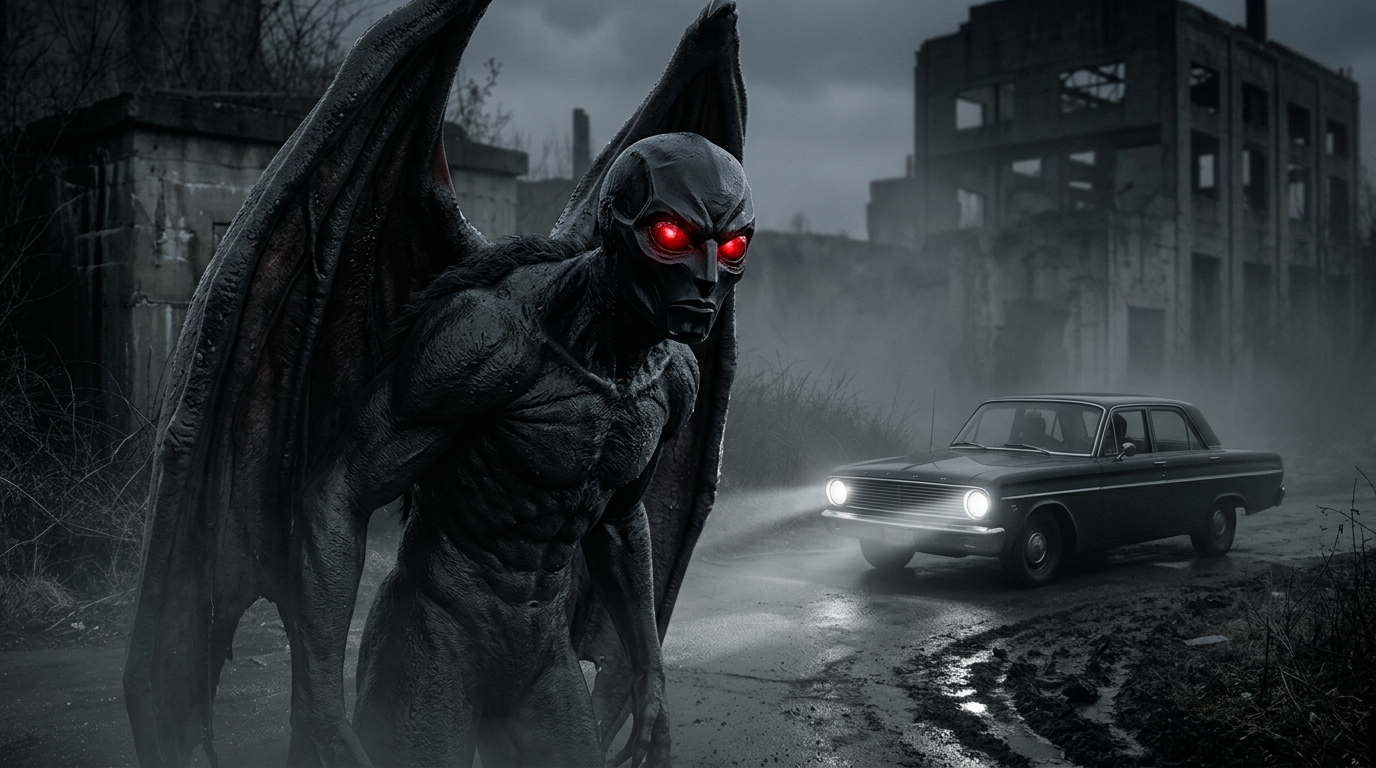
Mothman: The Winged Creature That Haunted Point Pleasant
Late on the night of November 15, 1966, two young couples were driving through an abandoned industrial area several miles north of Point Pleasant, West Virginia.
Roger and Linda Scarberry were in the car.
So were Steve and Mary Mallette.
The place they were driving through was locally known as the TNT area.
During World War II, it had been part of the massive West Virginia Ordnance Works, where explosives were manufactured and stored.
By 1966, much of the facility was abandoned.
Concrete bunkers sat among the trees.
Old industrial buildings deteriorated behind fences.
Ponds and wetlands had reclaimed sections of the property.
At night, the place already looked like somewhere a monster should live.
The four young people were near an old power plant when they noticed something beside the building.
At first, they saw the eyes.
Two enormous red lights.
Then the shape around them became visible.
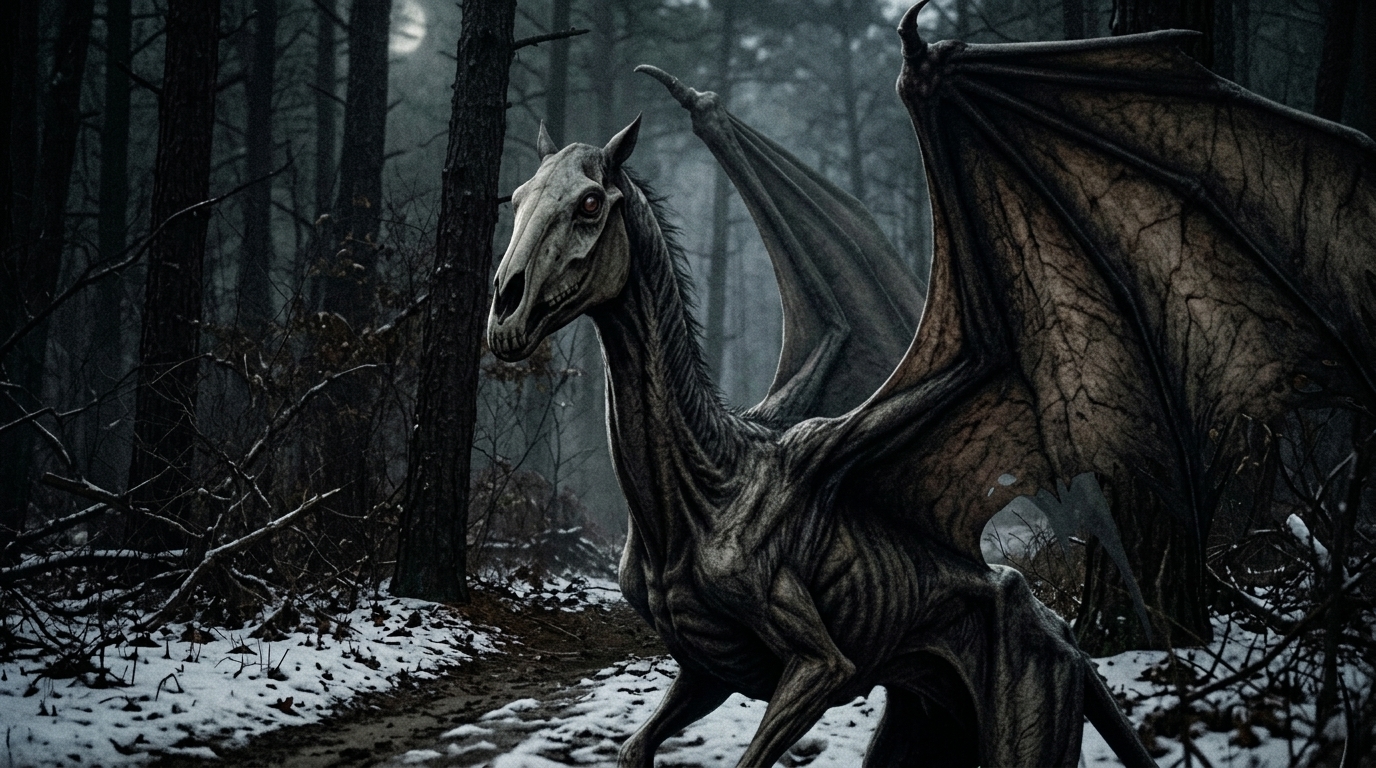
The witnesses later described a creature standing roughly six or seven feet tall.
It appeared humanoid.
Dark.
Broad.
And attached to it were enormous wings.
The creature did not behave like a person wearing a costume.
It did not simply stand there.
According to the witnesses, it moved.
Then it flew.
Terrified, Roger Scarberry accelerated away from the abandoned plant.
The thing followed them.
The witnesses claimed it flew after their car as they raced toward Point Pleasant.
Its wings reportedly remained extended.
It kept pace.
The car was traveling fast.
Very fast.
And the creature stayed with them.
When the four finally reached town, they went to the police.
They told officers they had encountered something impossible.
The following day, the story appeared in the local newspaper.
The headline read:
"Couples See Man-Sized Bird ... Creature ... Something."
It was an appropriately uncertain beginning.
The witnesses did not call the creature Mothman.
That name came later.
They did not claim they had seen a demon.
Or an alien.
Or a supernatural messenger.
They had seen something large.
Something winged.
Something with red eyes.
Something they could not identify.
Over the following days, other people began reporting strange sightings around Point Pleasant.
Then the story expanded.
There were UFO reports.
Unusual lights.
Strange telephone calls.
Television interference.
People claiming to be followed.
Stories of mysterious men asking questions.
Premonitions.
Prophecies.
And a New York writer named John Keel, who arrived in Point Pleasant and eventually became convinced that all of these events were connected.
For thirteen months, the legend grew.
Then, on December 15, 1967, the Silver Bridge connecting Point Pleasant with Ohio collapsed during rush-hour traffic.
Cars plunged into the freezing Ohio River.
Forty-six people died.
Afterward, Mothman became something more than a strange creature seen near an abandoned factory.
It became a warning.
A harbinger.
A thing that appeared before catastrophe.
And one of the most enduring figures in American folklore.
Point Pleasant Before Mothman
Point Pleasant sits where the Kanawha River meets the Ohio River in western West Virginia.
The town's location gives it a long history.
Indigenous peoples lived and traveled throughout the region for centuries.
European settlement brought warfare, trade, expansion, and conflict.
The Battle of Point Pleasant took place nearby in 1774.
By the twentieth century, Point Pleasant had become a small river town connected to neighboring Ohio by the Silver Bridge.
Nothing about the town suggested it was about to become internationally famous for a winged monster.
That changed in 1966.
But the creature did not first appear downtown.
It appeared several miles away.
In one of the strangest landscapes in the region.
The TNT Area
During World War II, the federal government constructed the West Virginia Ordnance Works north of Point Pleasant.
The installation covered thousands of acres.
Explosives and munitions components were produced there for the war effort.
Storage bunkers were built from concrete and covered with earth.
Industrial buildings stood throughout the property.
Rail lines crossed the site.
After the war, much of the installation was abandoned or repurposed.
Eventually, large portions became part of what is now the McClintic Wildlife Management Area.
Nature reclaimed the landscape.
Wetlands formed.
Trees grew around abandoned structures.
Wildlife moved into the area.
And dozens of concrete storage bunkers remained.
Locals called them igloos.
At night, the abandoned industrial landscape became particularly eerie.
Old roads led through woods and wetlands.
Concrete structures emerged unexpectedly between trees.
Ruined buildings stood behind fences.
There were few lights.
The area was isolated enough for teenagers and young couples to drive around after dark.
That is exactly what Roger and Linda Scarberry and Steve and Mary Mallette were doing on November 15, 1966.
November 15, 1966
The two couples were riding in Roger Scarberry's car when they approached an old generator or power plant in the TNT area.
The building was abandoned.
Near it, they saw two red lights.
Then they realized the lights appeared to be eyes.
The eyes belonged to a large figure.
Descriptions vary somewhat across later retellings, but the essential details remained remarkably consistent.
The creature was tall.
Approximately six to seven feet.
Its body seemed humanlike.
Its coloring appeared dark or gray.
The eyes were bright red.
And the wings were enormous.
Linda Scarberry later described the figure as muscular and man-shaped.
Others emphasized that the wings appeared folded behind it when it stood.
The witnesses were frightened almost immediately.
They began driving away.
The creature reportedly moved toward them.
Then it took flight.
The Chase
The chase became one of the defining elements of the Mothman legend.
According to the witnesses, the creature followed the vehicle as they fled the TNT area.
They estimated the car reached speeds approaching 100 miles per hour.
The creature supposedly remained above or behind them.
No visible flapping was necessary for it to maintain speed.
The wings were extended.
The witnesses described it as gliding.
At one point, they reportedly heard a squeaking or screeching sound.
The thing followed the car toward the outskirts of Point Pleasant.
Eventually it disappeared.
The couples did not go home.
They went to the police.
The Police Report
The four witnesses arrived visibly frightened.
They told Mason County authorities what had happened.
Deputy Millard Halstead was among the officers who heard the story.
The witnesses were known locally.
They did not have reputations as habitual pranksters.
Their fear appeared genuine.
That does not establish that a supernatural creature chased them.
People can sincerely misidentify ordinary things.
But the witnesses themselves apparently believed they had encountered something extraordinary.
Police returned to the TNT area with them.
The creature was not found.
Reports sometimes describe radio interference occurring during the search.
Other details were added through later interviews and retellings.
Whatever happened that night, the four witnesses had created the central Mothman story before the creature even had a name.
The next morning, Point Pleasant learned about it.
"Couples See Man-Sized Bird ... Creature ... Something"
The Point Pleasant Register published the story on November 16.
The headline captured the uncertainty perfectly.
"Couples See Man-Sized Bird ... Creature ... Something."
Local reporter Mary Hyre also covered the developing story for the Athens Messenger.
Her reporting became enormously important to everything that followed.
The first accounts did not describe an elaborate supernatural mythology.
They described frightened witnesses reporting a large winged creature.
That distinction matters.
Mothman began as a sighting.
The prophecy came later.
The Men in Black came later.
The Silver Bridge connection came later.
Even the name came later.
Where Did the Name "Mothman" Come From?
The creature was initially described using phrases such as:
bird
man-sized bird
winged man
creature
something
The name Mothman appears to have been inspired by the popularity of Batman.
The Batman television series starring Adam West had premiered earlier in 1966 and became a cultural phenomenon.
One of Batman's recurring enemies was Killer Moth.
Whether a particular newspaper employee first coined the word or the label developed through local conversation is less important than what happened next.
The name stuck.
And it was remarkably effective.
"Large unidentified flying humanoid" is accurate but cumbersome.
"Mothman" fits on a newspaper headline.
More Sightings
After the first story appeared, additional witnesses came forward.
This is where the case becomes difficult.
Whenever a strange report receives publicity, later reports become contaminated by awareness.
People now know what others supposedly saw.
Ambiguous experiences can be reinterpreted.
Ordinary animals suddenly look suspicious.
People seeking attention may invent stories.
But genuine witnesses who previously remained silent may also feel safer coming forward.
All of those processes can happen at the same time.
Point Pleasant soon experienced a wave of reports.
Some witnesses described large birds.
Some described humanoid figures.
Some saw red eyes.
Some reported enormous wings.
Some saw strange lights.
Not every sighting was identical.
But they became grouped beneath one name.
Mothman.
Newell Partridge
One of the more famous stories reportedly occurred before the Scarberry-Mallette encounter.
A contractor named Newell Partridge later said he experienced something strange on the evening of November 15.
His television began behaving unusually.
The screen reportedly filled with interference.
A strange sound came from outside.
His dog, Bandit, reacted.
Partridge took a flashlight and went outside.
In a nearby field, he saw two red circles reflecting the light.
They resembled enormous eyes.
Bandit ran toward whatever was there.
The dog never returned.
The following day, after hearing about the TNT-area encounter, Partridge connected his experience with the reported creature.
This story became one of the most memorable details in Mothman lore.
The monster had not merely appeared.
It may have taken the dog.
There is no physical evidence establishing what happened to Bandit.
But in a legend already involving glowing eyes and a flying humanoid, the disappearance of a dog fit very well.
The Red Eyes
The eyes became Mothman's signature feature.
Not the wings.
Not the humanoid body.
The eyes.
Witnesses repeatedly described them as red.
Bright.
Reflective.
Sometimes hypnotic.
Later artwork exaggerated them into glowing supernatural orbs.
But there is an important natural explanation for red or orange eyes at night.
Eyeshine.
Many animals possess a reflective layer behind the retina called the tapetum lucidum.
It improves night vision by reflecting light through the retina.
When illuminated by headlights or flashlights, animal eyes can appear to glow.
Different species produce different colors.
Owls.
Deer.
Cats.
Dogs.
Raccoons.
And birds can all produce striking eyeshine.
That does not explain the entire Mothman story.
But glowing eyes are much less supernatural than they appear.
The Bird Theory
Almost immediately, people proposed that witnesses had seen a large bird.
Several candidates have been suggested.
A large owl.
A heron.
A crane.
Most famously:
the sandhill crane.
Sandhill cranes can stand around four feet tall.
Their wingspan can reach six or seven feet.
They possess long legs.
They can appear surprisingly humanlike when seen upright from a distance.
Adults also have red coloring on their heads.
Under poor lighting, the combination of height, large wings, red coloration, and surprise could potentially produce a startling misidentification.
A crane seen at night beside an abandoned munitions plant is still a crane.
But under the right circumstances, it may not look like one.
The Sandhill Crane Problem
The sandhill-crane explanation is attractive.
It is also imperfect.
The original witnesses insisted they had seen something much larger.
They described a humanoid body.
They claimed it followed their speeding vehicle.
A normal crane cannot cruise behind a car traveling nearly 100 miles per hour.
If those details are accurate, the bird explanation struggles.
The problem is the phrase:
if those details are accurate.
Eyewitnesses are notoriously poor at estimating speed, distance, height, and size during frightening encounters.
At night, those estimates become even less reliable.
A flying animal seen intermittently from a moving car could appear to be pursuing the vehicle even if its actual path was different.
A frightening encounter can also expand in memory.
That does not mean the witnesses lied.
Memory is reconstructive.
Sincere testimony can still be wrong.
Could It Have Been an Owl?
Owls offer another possibility.
Large owls have broad wings.
They fly silently.
Their eyes can reflect intense colors in artificial light.
They can appear surprisingly large at close range.
Their faces can also look eerily human.
The barred owl and great horned owl are both found in the region.
An owl perched at an unusual height could create an extraordinary first impression.
But again, the reported size remains a problem.
A seven-foot humanoid is not an owl.
Unless the witnesses significantly overestimated what they saw.
That question sits at the center of almost every cryptid case.
Are the extraordinary details accurate?
If they are, ordinary explanations fail.
If they are not, the mystery becomes much smaller.
Was There One Creature?
Even assuming every witness sincerely reported something unusual, there is no reason to assume everyone saw the same thing.
This is one of the most important weaknesses in mass-sighting cases.
Once a name exists, unrelated experiences can become connected.
Someone sees a crane.
Mothman.
Someone sees an owl.
Mothman.
Someone notices red lights.
Mothman.
Someone sees an unidentified aircraft.
Mothman.
Someone hears a strange scream.
Mothman.
Eventually the legend becomes a container.
Anything strange in Point Pleasant can be placed inside it.
The TNT Area Was Full of Birds
The creature's preferred habitat created another problem for paranormal interpretations.
The former ordnance property was also a wildlife area.
Wetlands surrounded the abandoned structures.
Birds lived there.
Large birds lived there.
Migratory birds passed through the region.
A place filled with unusual avian wildlife is exactly where one might expect people to occasionally encounter birds they do not recognize.
It is also exactly where a giant winged monster would apparently choose to live.
This is inconvenient.
The habitat supports both narratives.
The Creature Becomes Humanoid
As reports accumulated, Mothman became increasingly standardized.
Tall.
Broad shoulders.
No obvious neck.
Large wings.
Red eyes.
Dark coloration.
Sometimes no visible head.
Some witnesses described the eyes as positioned where a human chest might be.
Others described the creature more conventionally.
This inconsistency is often overlooked in modern artwork.
Today's Mothman is usually depicted as a black humanoid with a clear head, enormous red eyes, and wings attached to its back.
The original reports were less anatomically cooperative.
Folklore eventually solved the problem.
Artists simply chose the coolest version.
The UFO Wave
Then things became stranger.
The Point Pleasant region began producing UFO reports.
People described lights in the sky.
Unidentified aerial objects.
Strange activity.
These reports were not unique to West Virginia.
The 1960s were one of the great eras of UFO culture in the United States.
Reports of flying saucers had been increasing since the late 1940s.
The Cold War filled the sky with military aircraft, experimental technology, satellites, missiles, and anxiety.
By 1966, UFOs were a major cultural phenomenon.
Point Pleasant had now acquired both a winged humanoid and unidentified lights.
Someone would eventually connect them.
Enter John Keel
The person most responsible for transforming Mothman from a local monster into an elaborate paranormal mystery was John A. Keel.
Keel was a writer and investigator fascinated by UFOs and unexplained phenomena.
Unlike researchers who assumed UFOs were mechanical spacecraft carrying extraterrestrials, Keel became increasingly skeptical of the simple alien-visitation model.
He suspected something stranger.
Something that might manipulate perception.
Something connected with folklore.
Ghosts.
Demons.
Monsters.
Psychic experiences.
And UFOs.
When reports from Point Pleasant attracted his attention, Keel traveled to West Virginia.
He began interviewing witnesses.
He met reporter Mary Hyre.
And the Mothman story expanded enormously.
Mary Hyre
Mary Hyre was one of the most important people in the entire case.
She worked as a correspondent for the Athens Messenger and knew the Point Pleasant community intimately.
People trusted her.
When residents experienced something strange, many contacted Hyre.
She collected reports.
She spoke with witnesses.
She communicated regularly with Keel.
Without her reporting and correspondence, much of the Mothman case might have disappeared into a handful of yellowing newspaper articles.
Instead, Point Pleasant became a laboratory for the strange.
Hyre reported more than Mothman sightings.
There were unusual telephone calls.
UFOs.
Strangers.
Electrical disturbances.
And increasingly bizarre incidents.
Strange Telephone Calls
Keel claimed that he and people around the case received unusual telephone calls.
Sometimes callers spoke strangely.
Sometimes there were clicks or electronic sounds.
Sometimes apparent voices delivered mysterious messages.
Keel believed his telephone might be monitored.
He also described bizarre conversations with entities or individuals who appeared to know things they should not know.
These stories became central to The Mothman Prophecies.
They are also among the most difficult parts of the case to independently verify.
Telephone records do not preserve supernatural tone.
Memories do.
A strange call can be real without its explanation being paranormal.
Pranksters existed in 1967.
So did technical problems.
So did people who enjoyed frightening reporters investigating flying monsters.
Still, to Keel, the calls were part of a pattern.
Men in Black
Point Pleasant also became associated with Men in Black.
Long before the comedy films, Men in Black were figures in UFO folklore.
Witnesses claimed that strange men sometimes appeared after UFO sightings.
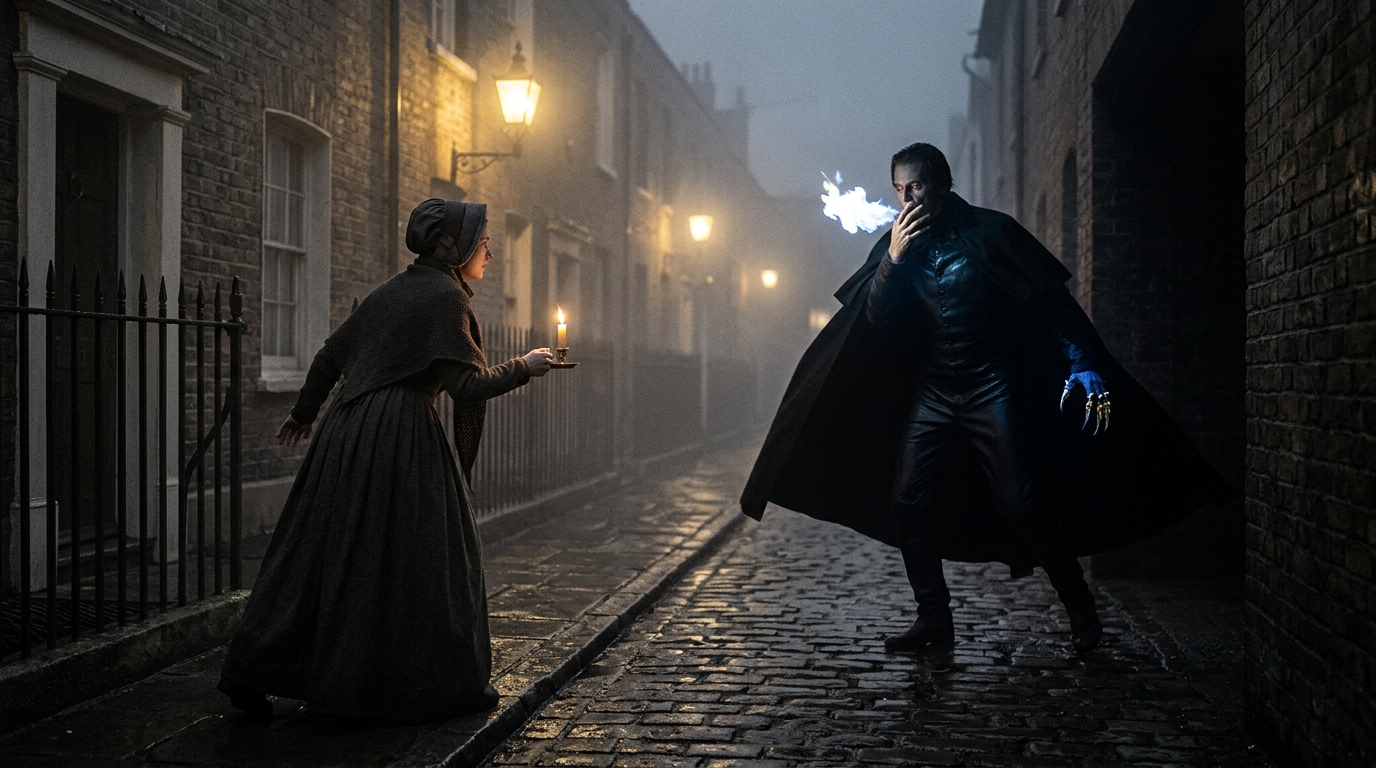
They wore dark suits.
Asked unusual questions.
Warned witnesses not to speak.
Sometimes they behaved almost normally.
Sometimes they behaved as though they were imitating human beings without fully understanding how.
Their skin might look unusual.
Their speech might seem mechanical.
They might drive immaculate old cars.
They might display knowledge they should not possess.
Keel had already been interested in such stories.
Point Pleasant gave him more.
Who Was Indrid Cold?
No figure demonstrates the expansion of the Mothman story better than Indrid Cold.
Cold was not originally Mothman.
He came from an entirely separate encounter.
On November 2, 1966—less than two weeks before the famous TNT-area sighting—a sewing-machine salesman named Woodrow Derenberger claimed he was driving near Parkersburg, West Virginia, when a strange vehicle intercepted him.
A man emerged.
The stranger supposedly communicated telepathically.
He identified himself as Cold.
Later accounts gave the fuller name Indrid Cold.
The figure smiled continuously.
Derenberger believed the stranger was not from Earth.
The story received publicity.
Keel investigated it.
And over time, Indrid Cold became woven into the broader Point Pleasant mystery.
UFOs.
Mothman.
Men in Black.
Prophecies.
One strange event absorbed another.
Was Indrid Cold Connected to Mothman?
There is no direct evidence that the winged creature seen near the TNT plant had anything to do with Derenberger's alleged visitor.
They were different reported beings.
Different sightings.
Different locations.
Different circumstances.
But John Keel increasingly believed strange phenomena should not be separated so neatly.
To him, they might be manifestations of the same underlying force.
That interpretation transformed the case.
Mothman was no longer a question of zoology.
It became a question of reality itself.
The Ultraterrestrial Idea
Keel eventually used terms such as ultraterrestrials to discuss entities he believed might exist alongside humanity in ways not captured by ordinary extraterrestrial theories.
Instead of aliens traveling millions of miles in metal spacecraft, perhaps the phenomena represented something that had always been here.
Something capable of presenting itself differently depending upon culture and expectation.
Fairies in one era.
Demons in another.
UFO occupants in the twentieth century.
Monsters in the woods.
To Keel, folklore and UFO reports resembled one another too closely to dismiss the similarities.
Mothman fit perfectly.
A winged humanoid could be treated as an animal.
An alien.
A demon.
An omen.
Or something capable of appearing as any of those things.
The Problem With Keel
John Keel is indispensable to the Mothman story.
He is also one of its greatest complications.
Keel interviewed witnesses.
Preserved stories.
Collected local reports.
And produced one of the most influential books in paranormal literature.
But Keel was not writing a police report.
The Mothman Prophecies is intensely personal.
Events are arranged through his interpretation.
Connections are emphasized.
Coincidences become meaningful.
Experiences occurring across different places and times are woven together.
The result is compelling.
It is also difficult to separate independent evidence from Keel's theory.
Once Keel entered Point Pleasant, the legend gained an author.
Predictions of Disaster
Keel claimed that strange communications began containing predictions.
Some involved disasters.
Some involved political events.
Some were vague.
Some failed.
Others seemed meaningful after events occurred.
This is an important problem in prophecy cases.
A prediction becomes impressive when it matches an event.
Failed predictions are forgotten.
Vague statements can be interpreted afterward.
A warning that "many will die" can eventually match something.
The world unfortunately produces disasters with regularity.
Keel knew this problem existed.
Yet he became increasingly convinced that Point Pleasant was moving toward something terrible.
December 15, 1967
Exactly thirteen months after the famous Scarberry-Mallette encounter, Point Pleasant experienced a real catastrophe.
It was Friday.
December 15, 1967.
Christmas was ten days away.
Rush-hour traffic filled the Silver Bridge.
The bridge crossed the Ohio River between Point Pleasant, West Virginia, and Kanauga, Ohio.
At approximately 5 p.m., something failed.
The bridge began to collapse.
Within about one minute, its center span, side spans, and towers fell.
Vehicles dropped into the river.
Others crashed onto the Ohio shore.
The water was freezing.
Rescue efforts began immediately.
Forty-six people died.
Nine were injured.
Two of the victims were never recovered.
Unlike Mothman, the Silver Bridge disaster is not mysterious.
Investigators eventually determined exactly why the bridge failed.
Why the Silver Bridge Collapsed
The official investigation identified the initiating failure in a component known as eyebar 330.
The Silver Bridge used eyebars—large steel bars with circular ends—as critical parts of its suspension system.
Over decades, a tiny flaw developed.
Stress corrosion and corrosion fatigue gradually worsened it.
The flaw reached a critical size.
The eyebar fractured.
The design lacked sufficient redundancy to prevent that single failure from propagating through the structure.
Once the suspension chain separated, the bridge collapsed.
The National Transportation Safety Board concluded that the failure originated in a cleavage fracture in the eyebar.
The flaw was extremely difficult to detect using inspection methods available at the time.
No supernatural creature was required.
No unexplained force acted on the bridge.
The cause was engineering.
A tiny defect in a critical structural component brought down an entire bridge.
Sometimes reality creates symbolism more powerful than fiction.
Forty-Six Dead
The death toll is occasionally listed as 46 or 47 depending on older accounts, but official modern sources identify 46 fatalities.
Thirty-one of the 37 vehicles on the bridge fell with it.
Twenty-four entered the Ohio River.
The collapse became one of the most important bridge disasters in American history.
It contributed directly to changes in national bridge-inspection standards.
The catastrophe transformed infrastructure policy.
It also transformed Mothman.
Because the sightings had occurred before the bridge fell.
Did Mothman Predict the Silver Bridge Collapse?
This is the central question of the legend.
Was Mothman warning Point Pleasant?
The popular story often implies that witnesses repeatedly saw the creature around the Silver Bridge immediately before it collapsed.
That version is stronger than the historical evidence.
Most famous sightings occurred around the TNT area and elsewhere in the region.
The connection between Mothman and the bridge became especially powerful after the disaster and through later retellings.
John Keel's book cemented the association.
There is no documented message from Mothman saying:
The Silver Bridge will collapse on December 15.
There is no known witness who decoded the creature's appearances beforehand and warned authorities to close the bridge.
The prophetic interpretation emerged largely in retrospect.
That does not make the coincidence emotionally meaningless.
But it does make it weaker as evidence.
The Problem With Omens
Suppose an unexplained creature appears repeatedly near a town.
Thirteen months later, a major disaster occurs there.
Was the creature an omen?
Perhaps.
But now change the order of events.
If the bridge had not collapsed, would anyone today interpret the sightings as warnings?
Probably not.
The disaster gave the sightings a new meaning.
This is one of the ways folklore forms.
An unexplained event occurs.
Later, a catastrophe occurs.
Human beings connect them.
The connection becomes part of the story.
Eventually the two events seem inseparable.
Did the Sightings Stop After the Collapse?
Popular retellings often claim that Mothman disappeared immediately after the Silver Bridge disaster.
There is some truth behind this.
The intense Point Pleasant sighting wave was largely associated with the period from late 1966 through 1967.
After the bridge collapse, reports diminished.
But the neatness of the timeline should not be exaggerated.
Folklore prefers clean endings.
Monster appears.
Monster warns town.
Bridge collapses.
Monster leaves.
Real reports are messier.
Still, the coincidence remains striking.
The most famous period of Mothman activity ended at roughly the same time Point Pleasant experienced its greatest modern tragedy.
That was enough.
Mothman became a harbinger.
Was Mothman Evil?
Interestingly, the omen interpretation changed Mothman's moral character.
At first, the creature was frightening.
It chased cars.
It may have taken a dog.
It appeared unexpectedly.
People feared it.
After the bridge disaster, another possibility emerged.
What if Mothman had not caused the tragedy?
What if it had been trying to warn people?
That interpretation turned the monster into something stranger.
A messenger.
Perhaps even a protector.
Today Mothman is often portrayed less as a predator and more as an entity that appears before disaster.
This idea has spread far beyond Point Pleasant.
Mothman Sightings Before Other Disasters
Over the years, stories have claimed that Mothman-like beings appeared before other catastrophes.
The Chernobyl disaster.
The September 11 attacks.
Bridge collapses.
Industrial accidents.
Earthquakes.
These claims often circulate online without strong contemporary documentation.
The pattern usually works backward.
A disaster occurs.
Someone later reports that a winged creature had been seen.
Because Mothman is now culturally associated with disaster, the sighting acquires significance.
That does not mean every account is fabricated.
It means prophecy claims require particularly strong documentation.
A warning recorded before the event is evidence.
A warning remembered after the event is much weaker.
The Cornstalk Curse
Mothman eventually absorbed an older Point Pleasant legend.
In 1777, Shawnee leader Cornstalk was killed at Fort Randolph in Point Pleasant.
Later folklore claimed that before dying, Cornstalk placed a curse on the area.
The curse has been connected retrospectively with disasters including floods, fires, the Silver Bridge collapse, and Mothman.
There is little reliable evidence establishing that Cornstalk actually pronounced the dramatic curse attributed to him.
The curse appears to be another later legendary layer.
But once again, Point Pleasant offered fertile ground.
A murdered Indigenous leader.
A cursed town.
A winged monster.
A collapsing bridge.
Folklore rarely leaves ingredients like those separate.
Was Mothman an Alien?
The UFO activity around Point Pleasant encouraged extraterrestrial theories.
Perhaps Mothman was an alien.
Perhaps it was a biological creature transported by UFOs.
Perhaps the wings were misinterpreted technology.
Perhaps the creature was an observer.
There is no physical evidence supporting any of those ideas.
No spacecraft was recovered.
No biological sample exists.
No witness reported receiving a clear explanation from Mothman regarding its planetary citizenship.
The alien theory survives because the UFO reports and creature sightings occurred within the same broad wave.
That is correlation.
Not proof.
Was Mothman an Interdimensional Being?
The interdimensional explanation became particularly popular among readers influenced by Keel.
It solves several problems conveniently.
Why is there no body?
Because the creature leaves our reality.
How can it fly so fast?
Different physics.
Why does it appear before disasters?
It perceives time differently.
Why are UFOs connected?
Same phenomenon.
Why are Men in Black involved?
Also same phenomenon.
The theory can explain nearly anything.
That is also its weakness.
An explanation that accommodates every possible outcome becomes difficult to test.
If no observation could prove the theory wrong, the theory cannot function like an ordinary scientific hypothesis.
It becomes metaphysics.
Which may still be interesting.
It just is not evidence.
Could Mothman Have Been a Mutant?
The abandoned TNT area inspired another popular idea.
Perhaps chemical contamination created a mutant animal.
The West Virginia Ordnance Works had indeed been an industrial military site.
Pollution and explosive residues were genuine environmental concerns.
Later cleanup work documented contamination within portions of the property.
From there, folklore did the rest.
A strange military facility plus pollution plus giant creature equals mutant.
The problem is biology.
Chemical contamination can cause mutations.
It does not normally turn ordinary birds into seven-foot flying humanoids with prophetic abilities.
A mutant crane is possible in the technical sense that any animal can possess mutations.
A Mothman requires considerably more.
The Secret Experiment Theory
Abandoned military facilities attract conspiracy theories almost automatically.
Perhaps the government created Mothman.
Perhaps experiments occurred beneath the TNT area.
Perhaps biological weapons were involved.
Perhaps the creature escaped.
There is no credible evidence for such a program.
The site's real military history is enough to create suspicion without adding secret laboratories.
Thousands of acres of abandoned wartime infrastructure look mysterious.
But a creepy building is not evidence that anyone constructed a flying humanoid inside it.
If they did, the paperwork has remained impressively elusive.
Could Someone Have Worn a Costume?
Hoax theories have existed since the beginning.
Could someone have frightened motorists using a costume?
Possibly.
The practical difficulties are substantial.
A convincing seven-foot winged costume capable of apparently flying alongside a speeding car would be difficult even today.
In 1966, accomplishing that near an abandoned power plant at night would require significant preparation.
Multiple sightings would require either repeated performances or copycats.
There is also no confirmed hoaxer.
That does not eliminate hoaxing from individual reports.
It simply makes a single-costumed-prankster explanation for the entire wave unlikely.
Mass Hysteria?
The term mass hysteria is often used lazily.
A newspaper reports a monster.
People become excited.
More people report monsters.
Therefore everyone was hysterical.
That is too simple.
Social expectation can absolutely influence perception.
If a community is talking about a red-eyed flying creature, ambiguous sights are more likely to be interpreted through that framework.
But that does not mean witnesses are pretending.
It means perception is contextual.
A person seeing a strange bird before November 15 might think:
What was that?
The same person seeing it after November 15 might think:
Mothman.
That shift alone can create a sighting wave.
No collective insanity required.
The Power of Headlines
Newspapers helped create Mothman.
That is not an accusation.
It is how modern folklore works.
A bizarre report becomes a headline.
The headline reaches thousands of people.
Additional witnesses reinterpret experiences.
Reporters publish those stories.
National media notice.
More people become aware.
The creature becomes famous.
Fame produces more sightings.
By the time investigators arrive, the legend has begun feeding itself.
This does not prove the first sighting was false.
It explains how four people seeing something strange can become a national monster legend.
Why Mothman Looks Different Today
Like the Wendigo, Mothman has undergone visual standardization.
Original witnesses did not provide one perfect anatomical blueprint.
Modern Mothman usually has:
A muscular humanoid body.
Black or dark gray skin.
Huge moth-like wings.
A recognizable head.
Two enormous glowing red eyes.
Sometimes antennae.
Sometimes claws.
Occasionally actual moth features.
The name began influencing the creature.
Mothman became increasingly moth-like because he was called Mothman.
The original reports were more birdlike.
Language changed anatomy.
Mothman Wasn't Really a Moth
This deserves emphasis.
There is very little in the earliest reports requiring the creature to resemble an actual moth.
Witnesses described wings.
Large wings.
That is essentially the connection.
The name was catchy.
No witness carefully documented scales.
No giant proboscis was reported.
No one found enormous cocoons hanging from the TNT bunkers.
The monster became moth-like because popular culture has a sense of humor.
The Eyes Become Everything
The Mothman statue in Point Pleasant gives the creature enormous red eyes.
Artwork emphasizes them.
Merchandise emphasizes them.
The eyes are now inseparable from the legend.
That makes sense.
Eyeshine is one of the most disturbing experiences available in darkness.
You shine a light toward the trees.
Something reflects it.
Two lights appear.
They are too high.
Or too far apart.
You cannot see the body.
Only the eyes.
Your brain tries to construct the thing around them.
That reconstruction can become monstrous very quickly.
The Biology of a Seven-Foot Flying Humanoid
Suppose Mothman was a real animal.
Its anatomy presents serious problems.
Human beings are heavy.
Human-shaped bodies are poorly designed for powered flight.
Birds possess extensive adaptations.
Lightweight skeletons.
Specialized muscles.
Efficient respiratory systems.
Body shapes optimized for flight.
A seven-foot humanoid weighing perhaps hundreds of pounds would require enormous wings and extraordinary musculature.
The reported wingspan, though large, may still be insufficient for sustained flight if the body truly resembled a muscular human.
Gliding is somewhat easier.
But the creature would still need altitude.
The original witnesses claimed it rose from the ground.
That is biologically difficult.
Not absolutely imaginable.
Just difficult enough that finding a body would be helpful.
We have not.
No Body
For all the sightings, no physical specimen has emerged.
No feather conclusively linked to an unknown species.
No bone.
No tissue.
No nest.
No egg.
No corpse.
No verified footprint demonstrating an unidentified giant flying humanoid.
No DNA.
No road-killed Mothman.
That absence does not prove nothing unusual was seen.
It does weigh heavily against Mothman being a breeding population of large unknown animals.
A creature that large requires food.
Habitat.
Reproduction.
And occasionally the biological inconvenience of dying.
The Single-Creature Problem
Folklore usually speaks of the Mothman.
One creature.
That creates an ecological problem.
If Mothman is biological, where did it come from?
A species requires more than one individual.
If only one existed, it still had parents.
If it was the last surviving member of an unknown species, where were the others?
If it migrated, from where?
A supernatural creature avoids these questions.
So does an interdimensional one.
Ordinary biology does not.
Why Point Pleasant?
If Mothman was supernatural, why Point Pleasant?
The TNT area provides atmosphere.
But atmosphere is not a supernatural mechanism.
The Silver Bridge provides tragedy.
But the bridge had existed since 1928.
John Keel believed the region possessed unusual characteristics.
Others have suggested ancient history, geography, electromagnetic anomalies, curses, military contamination, or UFO activity.
No proposed explanation has been demonstrated.
Perhaps Point Pleasant was special.
Perhaps it simply happened to be where four frightened people saw something they could not identify on a November night.
Everything else followed.
The Silver Bridge Changes the Entire Story
Without the Silver Bridge collapse, Mothman might have remained a regional cryptid.
A strange West Virginia birdman remembered alongside dozens of other twentieth-century monster sightings.
The disaster changed that.
It introduced tragedy.
Meaning.
Prophecy.
A beginning and an ending.
November 1966:
The creature appears.
December 1967:
The bridge falls.
The creature disappears.
That narrative is almost too perfect.
Real history rarely arrives with such satisfying structure.
Folklore supplies it afterward.
The Engineering Explanation Does Not Kill the Legend
Some skeptical discussions treat the official bridge-collapse explanation as though it disproves Mothman.
It does not.
The bridge failed because of a structural defect.
That tells us why the bridge collapsed.
It does not tell us what the witnesses saw thirteen months earlier.
Likewise, proving that witnesses saw something strange would not undermine the engineering investigation.
Both statements can be true:
People reported an unidentified winged creature.
The Silver Bridge collapsed because of a failed eyebar.
The supernatural connection is the unsupported step between them.
That distinction is important.
Could Mothman Have Warned People Anyway?
In theory, yes.
The fact that engineers can explain the collapse does not logically prevent a supernatural entity from predicting it.
But evidence matters.
To establish that Mothman knew the bridge would fail, we would need something more specific than:
A strange creature was seen in the region before a later disaster.
The warning would need to be recognizable before the event.
Otherwise every earlier anomaly can become an omen after something bad happens.
A raven flies over town.
Three weeks later, a fire occurs.
Was the raven warning everyone?
Perhaps.
But nothing distinguishes that interpretation from coincidence.
Precognition and Retrospective Meaning
Human beings are exceptionally good at finding patterns.
That ability is useful.
It can also mislead us.
After a tragedy, people revisit earlier experiences.
Dreams.
Bad feelings.
Unusual behavior.
Coincidences.
Unexplained sightings.
Everything feels different afterward.
Someone remembers saying:
I had a bad feeling about that bridge.
Someone remembers a strange dream.
Someone remembers a winged figure.
The event reorganizes memory.
This does not require dishonesty.
Trauma changes meaning.
Mothman became part of the Silver Bridge tragedy because the people of Point Pleasant had already been living with the legend.
The Mothman Prophecies
John Keel published The Mothman Prophecies in 1975.
The book is the single most influential telling of the case.
It is not simply a book about a winged creature.
Mothman occupies surprisingly little of the story compared with the wider paranormal environment.
Keel writes about:
UFOs.
Strange phone calls.
Premonitions.
Men in Black.
Indrid Cold.
Synchronicities.
Unusual visitors.
Psychic phenomena.
And the Silver Bridge.
The title transformed Mothman permanently.
The creature became prophetic.
The 2002 Film
In 2002, The Mothman Prophecies became a major Hollywood film starring Richard Gere, Laura Linney, Will Patton, and Debra Messing.
The movie took substantial liberties.
It shifted events.
Combined characters.
Invented scenes.
Turned Indrid Cold into a more overtly supernatural presence.
And transformed Keel's sprawling paranormal investigation into a psychological supernatural thriller.
For millions of viewers, the film became the Mothman story.
That created another layer.
Historical sightings.
Keel's interpretation.
The movie's interpretation of Keel.
Then internet retellings based partly on the movie.
Folklore built upon folklore.
"Chapstick"
One of the film's most memorable scenes involves a mysterious voice demonstrating impossible knowledge during a telephone call.
The word:
Chapstick.
The scene is terrifying.
It is also useful as a reminder.
Dramatic scenes from the film should not automatically be treated as historical evidence.
The cinematic Mothman story is not the same thing as the 1966–1967 record.
Popular culture tends to erase that boundary.
A good scene survives longer than a footnote.
Point Pleasant Embraces the Monster
Many towns would prefer not to be internationally associated with a glowing-eyed winged creature.
Point Pleasant made a different decision.
It adopted him.
Downtown now features a large stainless-steel Mothman statue created by artist Bob Roach.
The statue is muscular.
Winged.
Red-eyed.
And anatomically memorable.
It has become one of the most photographed landmarks in West Virginia.
Nearby is the Mothman Museum.
Businesses sell Mothman merchandise.
Murals depict the creature.
Visitors come from around the world.
The monster that once terrified motorists now supports tourism.
This is one of folklore's more charming career transitions.
The Mothman Festival
Point Pleasant hosts an annual Mothman Festival.
Thousands of visitors arrive.
There are speakers.
Vendors.
Costumes.
Tours.
Paranormal investigators.
Cryptid enthusiasts.
And enormous amounts of Mothman merchandise.
What began as four frightened witnesses in a car has become a civic identity.
That transformation does not trivialize the original reports.
It shows what communities can do with folklore.
Point Pleasant did not erase the tragedy of the Silver Bridge.
It also did not allow the Mothman legend to remain only frightening.
The monster became fun.
Mothman Becomes Cute
This may be the strangest stage in the creature's development.
Modern Mothman is often adorable.
Plush toys.
Cartoons.
Stickers.
Coffee mugs.
Pins.
Valentine cards.
"Mothman ate my homework."
"Mothman is my boyfriend."
A creature once accused of stalking motorists and foreshadowing forty-six deaths has become a cuddly cryptid mascot.
Folklore does not simply become scarier over time.
Sometimes it becomes marketable.
Mothman has achieved both.
Chicago Mothman
Beginning decades after the Point Pleasant sightings, reports of large winged humanoids emerged around Chicago.
Witnesses described dark figures with wings.
Glowing or red eyes.
Humanoid shapes.
The reports were quickly compared with Mothman.
Some paranormal researchers compiled dozens of alleged sightings.
Skeptics questioned whether the reports represented a genuine cluster, misidentified birds, hoaxes, or the contagious power of expectation.
Whatever the explanation, the Chicago reports demonstrate how portable the legend has become.
Mothman no longer needs Point Pleasant.
The name can travel.
Every Winged Humanoid Becomes Mothman
This is now a major classification problem.
A witness sees a winged humanoid anywhere in the world.
The report is labeled Mothman.
But historically, Mothman referred to the Point Pleasant phenomenon.
Other cultures possess different winged beings.
Other cryptid legends exist.
Large birds are seen everywhere.
The Mothman label can therefore flatten unrelated reports into one global creature.
It is the same process that turns every pale crawler into a Skinwalker and every antlered monster into a Wendigo.
The internet dislikes unidentified things.
It prefers searchable categories.
Is Mothman a Cryptid?
Mothman is usually classified as one.
But the term becomes complicated.
If Mothman was an unidentified bird, cryptozoology makes sense.
If Mothman was a unique supernatural messenger, it does not.
If it was an interdimensional manifestation, it definitely does not.
The original sightings could theoretically involve zoology.
The later legend overwhelmingly involves the paranormal.
Mothman therefore sits in a strange category.
Part cryptid.
Part ghost story.
Part UFO lore.
Part disaster omen.
Part local folklore.
That flexibility is probably one reason the legend survives.
The Most Plausible Ordinary Explanation
If the original Scarberry-Mallette encounter had an ordinary explanation, a large bird remains among the strongest candidates.
The environment supports it.
The darkness supports misidentification.
Red eyes can be explained by reflected light or coloration.
Large wings are expected.
Unexpected birds can appear enormous when viewed at close range.
Panic can distort estimates.
A bird flying parallel to a vehicle could seem to pursue it.
None of that proves a crane or owl was responsible.
It simply requires fewer extraordinary assumptions than an unknown supernatural humanoid.
The Hardest Part to Explain
The strongest element of the case is not the red eyes.
Those are easy.
It is not the wings.
Large birds have them.
The difficult part is the witnesses' insistence that the creature was human-shaped and enormous.
If four people had a clear view of a seven-foot humanoid with wings, ordinary bird explanations become weak.
The question therefore becomes one of perception.
How clear was the view?
How long did it last?
How frightened were the witnesses?
How accurately were later descriptions preserved?
Those are impossible questions to reconstruct perfectly sixty years later.
Four Witnesses Are Better Than One
One argument in favor of the encounter is that there were four witnesses.
Multiple witnesses reduce certain explanations.
A hallucination experienced by one person becomes less likely.
A dream disappears as an explanation.
But multiple witnesses do not guarantee accurate identification.
Groups influence one another.
Someone says:
Look at that man!
Others begin interpreting the shape as human.
Someone says:
It has red eyes!
Everyone focuses on the eyes.
Shared misidentifications occur constantly.
Four sincere witnesses can still be wrong.
They are simply more interesting than one.
Why Didn't They Photograph It?
In 1966, people did not carry high-resolution cameras in their pockets.
This seems obvious.
It still matters.
Modern cryptid discussions frequently ask why witnesses did not take photographs.
The Scarberry-Mallette encounter happened decades before smartphones.
A camera would have been a separate object.
Film would need to be loaded.
Low-light photography was difficult.
The witnesses were also fleeing.
Taking a carefully exposed photograph was not an especially realistic response.
The lack of imagery is therefore unsurprising.
Unfortunately, it also means the strongest evidence remains testimony.
Could Modern Technology Solve the Case?
Probably not retroactively.
The original creature is gone.
The landscape has changed.
Witness memories have aged.
Some witnesses have died.
But modern surveillance would make a similar event much harder to preserve only as folklore.
Dashcams.
Phones.
Security cameras.
Traffic cameras.
Wildlife cameras.
Drones.
Satellite imagery.
A seven-foot winged humanoid repeatedly appearing near a populated town today would face an unprecedented photography problem.
So far, Mothman has avoided it.
The Absence of Evidence
Skeptics sometimes say:
No body, therefore no Mothman.
Believers respond:
Absence of evidence is not evidence of absence.
Both statements oversimplify the issue.
Absence of evidence can become meaningful when evidence should reasonably exist.
If someone claims one supernatural being appeared a handful of times, lack of a body is unsurprising.
If someone claims a breeding species of giant humanoid flyers inhabits North America, lack of biological evidence becomes a serious problem.
The explanation determines what evidence we should expect.
Mothman survives partly because nobody agrees what Mothman is supposed to be.
The Monster That Escapes Every Category
If birds explain the reports:
Mothman was misidentification.
If a hoax explains them:
Mothman was social contagion.
If an unknown animal explains them:
Mothman was a cryptid.
If UFOs explain them:
Mothman was extraterrestrial.
If Keel was right:
Mothman was ultraterrestrial.
If the bridge connection matters:
Mothman was prophetic.
If Point Pleasant's tourism industry gets a vote:
Mothman is also excellent branding.
A creature that can occupy this many categories is difficult to kill.
Every failed explanation simply sends it somewhere else.
Mothman and the Harbinger Archetype
Mothman belongs to a much older family of legends.
Creatures that appear before death or disaster exist throughout folklore.
The banshee cries before a death.
Black dogs appear as omens.
Birds have long carried prophetic symbolism.
Owls can signify death in some traditions.
Ravens and crows gather around battlefields and corpses.
Comets were interpreted as warnings.
Strange births were once treated as signs of political disaster.
Mothman fits comfortably into this ancient human tendency.
We see something strange.
Then something terrible happens.
We decide the first event meant the second.
The costume changes.
The structure remains.
Why Wings Make Good Omens
Winged beings occupy a peculiar place in human imagination.
Angels have wings.
Demons often have wings.
Dragons have wings.
Gargoyles have wings.
Birds move between earth and sky.
That makes winged creatures natural messengers.
They arrive from above.
They disappear quickly.
They can observe without being reached.
Mothman's wings may therefore contribute to its transformation from animal to omen.
A giant ground-dwelling rodent with red eyes would have struggled to achieve the same prophetic dignity.
The Silver Bridge as Folklore Engine
Disasters create stories.
People need explanations.
Official engineering conclusions answer one kind of question.
Why did the bridge physically fail?
Because a critical eyebar fractured after decades of corrosion fatigue and stress corrosion.
But that does not answer emotional questions.
Why this bridge?
Why that day?
Why those people?
Why did no one know?
Could it have been prevented?
Was there a warning?
Mothman enters the space engineering cannot fill.
Not because engineering is inadequate.
Because engineering explains mechanisms.
Folklore explains meaning.
Two Point Pleasants
There are therefore two Point Pleasants in the Mothman story.
The historical town:
A real community.
A former munitions facility.
A wildlife area.
A bridge with a structural defect.
Forty-six deaths.
Newspaper reports.
Witnesses.
Police officers.
And there is the legendary Point Pleasant:
UFOs overhead.
Red eyes in the darkness.
Mysterious telephone calls.
Men in Black.
Prophecies.
Indrid Cold.
A curse.
A monster waiting near the TNT bunkers.
Both exist.
One geographically.
The other culturally.
What Did John Keel Actually Prove?
Keel proved that Point Pleasant produced an extraordinary collection of reports.
He documented witnesses.
He preserved stories.
He showed how UFOs, monster reports, folklore, and psychic experiences could overlap in the minds of witnesses and investigators.
He did not establish what caused them.
That distinction sometimes disappears because The Mothman Prophecies is so persuasive as narrative.
Keel gave the chaos structure.
Once the structure exists, it is difficult to see the events separately again.
That may be his greatest achievement.
And his greatest influence on the legend.
What We Can Verify
Several core facts are solid.
On November 15, 1966, Roger and Linda Scarberry and Steve and Mary Mallette reported encountering a large winged creature near the TNT area.
Local newspapers reported the story immediately.
Additional sightings followed.
The region experienced reports of UFOs and other strange phenomena.
John Keel investigated the events.
The Silver Bridge collapsed on December 15, 1967.
Forty-six people died.
The bridge failed because of a structural fracture.
Keel later connected the broader paranormal events and the disaster in The Mothman Prophecies.
Those facts are enough to explain how the legend formed.
Everything beyond them requires increasing caution.
What We Cannot Verify
We cannot verify that the creature was supernatural.
We cannot verify that it came from another planet.
We cannot verify that it came from another dimension.
We cannot verify that every later Mothman sighting involved the same phenomenon.
We cannot verify that Men in Black were nonhuman agents.
We cannot verify that Indrid Cold was anything other than the subject of an extraordinary witness account.
We cannot verify that Mothman knew the Silver Bridge would collapse.
We cannot verify that the creature caused it.
And we cannot verify that its disappearance afterward had any relationship to the tragedy.
The legend fills those gaps.
The evidence does not.
Does That Mean the Witnesses Saw Nothing?
No.
This is one of the false choices that damages discussions of unexplained cases.
Either:
A supernatural winged humanoid objectively existed exactly as described.
Or:
The witnesses fabricated everything.
There are many possibilities between those extremes.
They could have seen a large bird.
An unusual bird.
Multiple birds.
An animal under poor lighting.
A person.
Something genuinely unidentified.
Their perceptions could have combined several stimuli.
Their memories could have changed.
Some later witnesses could have been sincere.
Others could have exaggerated.
Others could have lied.
A folklore event can contain many different causes.
There does not need to be one answer.
Why Mothman Endures
Mothman has almost every ingredient a modern legend needs.
A memorable creature.
Multiple witnesses.
A creepy location.
A limited period of intense sightings.
UFOs.
Men in Black.
A famous paranormal writer.
A terrible disaster.
An unresolved central mystery.
And a fantastic name.
Then Hollywood arrived.
Then the internet arrived.
Then Point Pleasant built a statue.
At that point, extinction was no longer possible.
The Statue Changes Everything
There is something wonderful about the modern Mothman statue.
The original witnesses were terrified.
Today tourists hug the monster.
People pose beneath its wings.
Couples take photographs beside it.
Visitors rub portions of the statue for luck.
The feared unknown has become familiar.
That is one of the oldest things humans do with monsters.
We tell stories about them until they belong to us.
Eventually the thing in the dark becomes a mascot.
Mothman as American Folklore
Mothman is sometimes treated as a cryptozoological case.
That description is too narrow.
Whatever Roger Scarberry and the others actually encountered, what grew from that night is now unmistakably folklore.
The story changes with retelling.
New motifs attach themselves.
Old details disappear.
The creature gains characteristics.
Connections strengthen.
Prophecy replaces uncertainty.
A single strange encounter becomes part of a town's identity.
That is folklore happening within living memory.
The Original Story Was Smaller
Strip away everything added later.
No Men in Black.
No Indrid Cold.
No curse.
No ultraterrestrials.
No Silver Bridge prophecy.
No Hollywood movie.
No plush toys.
No festival.
No statue.
What remains?
Four young people driving through an abandoned industrial complex at night.
They saw something.
It frightened them badly enough that they went directly to the police.
They described a large winged creature with red eyes.
That is the original mystery.
And oddly enough, it may be the strongest part of the entire case.
The Creature in the Headlights
Imagine the scene without sixty years of mythology.
November.
Cold.
Dark.
An abandoned World War II plant.
Trees surrounding ruined industrial buildings.
Your headlights sweep across concrete.
Then something appears.
Two red reflections.
Too high.
Too large.
You slow down.
The shape moves.
Something unfolds behind it.
Wings.
Your brain attempts to identify what you are seeing.
Bird.
Person.
Animal.
Nothing fits quickly enough.
Then the shape rises.
You accelerate.
Whatever it is appears to follow.
At that moment, the distinction between crane and monster becomes irrelevant.
You are terrified.
That terror is real.
Everything afterward depends upon what caused it.
If It Was a Bird
Then one of America's most famous monster legends began with misidentification.
That sounds disappointing.
It should not.
A frightened group seeing an unfamiliar animal under terrible viewing conditions can create a story powerful enough to reshape an entire town's identity.
The animal disappears.
The story remains.
People add meaning.
A bridge collapses.
A writer arrives.
A book is published.
A film is made.
A statue rises.
Thousands gather every year.
That is not nothing.
That is how folklore works.
If It Was Something Else
Then the mystery becomes much larger.
Four witnesses saw an unknown creature.
Others reported similar beings.
No specimen was recovered.
The sightings diminished.
Whatever appeared around Point Pleasant either left, died, hid extraordinarily well, or was never biological in the first place.
There is no evidence capable of choosing confidently among those possibilities.
And that uncertainty is exactly why Mothman survives.
Was Mothman Real?
As a literal supernatural creature?
Unproven.
As an unidentified animal?
Possible, but unsupported by physical evidence.
As a misidentified bird?
Plausible.
As a product of hoaxing and social expectation?
Likely relevant to at least some later reports.
As a cultural phenomenon?
Absolutely real.
People saw something.
People became frightened.
Newspapers documented the reports.
The community experienced a sighting wave.
A real bridge collapsed.
Real people died.
John Keel wrote a real book connecting those events.
And a real legend grew from them.
The Most Important Distinction
Mothman did not cause the Silver Bridge collapse.
At least, there is no evidence that it did.
The bridge's failure has a documented mechanical explanation.
But the fact that the bridge collapse was not supernatural does not erase the strange reports that preceded it.
Likewise, the existence of those reports does not transform an engineering failure into a prophecy.
The two events became connected because humans connected them.
Whether something else connected them first remains the question.
The Harbinger in the Trees
Today, when people think of Mothman, they rarely picture a sandhill crane.
They picture red eyes.
Black wings.
A dark silhouette.
A creature watching from somewhere it should not be.
And behind the image is always the bridge.
Even when the bridge is not mentioned, it is there.
The tragedy gave Mothman his purpose.
Before December 15, 1967, he was a monster.
After December 15, he became a warning.
That transformation may be the most important event in the entire legend.
Not the first sighting.
Not the chase.
Not the UFO reports.
The moment people looked backward after forty-six deaths and wondered:
Was something trying to tell us?
No evidence has ever answered that question.
Which is precisely why people are still asking it.
The Last Drive Through the TNT Area
The old TNT bunkers still exist.
Trees surround them.
Water fills old ponds.
Wildlife moves through the landscape.
Visitors still go looking for Mothman.
Most find concrete.
Mud.
Birds.
Mosquitoes.
And darkness.
Perhaps that is enough.
Because the Mothman legend does not require the creature to remain there.
It only requires the possibility that once, on a cold November night in 1966, four people drove past an abandoned building and saw something they could not explain.
Something stood in the darkness.
Something opened its wings.
Something followed them toward town.
Thirteen months later, a bridge fell.
The official investigation explained why.
Folklore explained what it meant.
And somewhere between those two explanations, Mothman has been flying ever since.
Sources and Further Reading
- West Virginia Encyclopedia — Mothman
- Smithsonian Center for Folklife and Cultural Heritage — An Ode to a Hometown Creature: Mothman of Point Pleasant, West Virginia
- National Transportation Safety Board — Collapse of U.S. 35 Highway Bridge, Point Pleasant, West Virginia
- National Technical Reports Library — Collapse of U.S. 35 Highway Bridge, Point Pleasant, West Virginia, December 15, 1967
- Federal Highway Administration — Silver Bridge Collapse and National Bridge Inspection Standards
- American Society of Civil Engineers — Silver Bridge Collapse and Creation of National Bridge Inspection Standards
- NIST Digital Archives — Silver Bridge Collapse
- Fortean Archives — Mothman Datasheets, 1966–1967
- Atlas Obscura — TNT Area, Point Pleasant
- John A. Keel, The Mothman Prophecies (1975)
- Donnie Sergent Jr. and Jeff Wamsley, Mothman: The Facts Behind the Legend